Where should you go in Italy, and which sights are worth booking ahead? On a first trip, pair Rome with Florence and Venice. The Colosseum, the Vatican Museums and the Uffizi Gallery all sell timed tickets that run out, so book those three before anything else.

Rome
Must-visitUNESCOGo for the Colosseum, the Vatican Museums, the Pantheon
Top sights
- Colosseum, Roman Forum and Palatine HillUNESCO3 to 4 hours on one combined ticket
- Vatican Museums and the Sistine Chapelabout 3 hours; timed entry, book ahead
- PantheonUNESCO30 to 45 minutes; free
- Trevi FountainEUR 2 to step into the fountain basin, in force since February 2026; viewing from the piazza is free
Book ahead: Colosseum, Vatican Museums
Read the full sectionShowing Rome
Seven days covers Rome, Florence and Venice at an easy pace, or Rome paired with a few days on the Amalfi Coast. With ten days to two weeks, add Milan, Cinque Terre, Sicily or Lake Como. Each sight below carries the time it takes, whether to book, its UNESCO status and the official price where one exists.
- Book three things first: the Colosseum, the Vatican Museums and the Uffizi Gallery sell timed tickets that sell out in spring and summer.
- Book the Last Supper weeks ahead. Its 15-minute viewing slots in Milan sell out weeks in advance.
- Go by ferry and bus on the Amalfi Coast, not by rental car: the one coast road is jammed by midsummer.
Where to go in Italy
These 12 cities and regions run from the must-sees down.
Rome
Must-visit
- Colosseum, Roman Forum and Palatine Hill: 3 to 4 hours on one combined ticket; UNESCO
- Vatican Museums and the Sistine Chapel: about 3 hours; timed entry, book ahead
- Pantheon: 30 to 45 minutes; free; UNESCO
- Trevi Fountain: EUR 2 to step into the fountain basin, in force since February 2026; viewing from the piazza is free
- Plan it: 3-day Rome itinerary, Rome in May
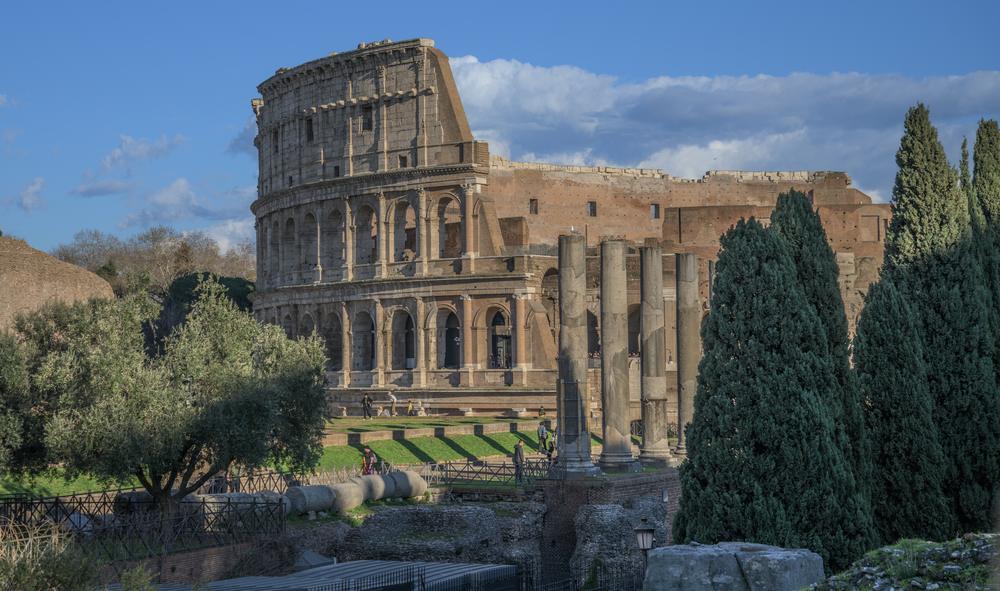
Rome's historic center holds more than 25,000 points of interest, and it "guarantees to stir emotions with every step," Italy's tourism board says. Most of them cluster around the Colosseum, the Roman Forum and the Pantheon, close enough to walk between on a single day.
Book the Vatican Museums for a separate morning; the Sistine Chapel sits at the end of a long, one-way route through them. At the Trevi Fountain, toss a coin over your shoulder for the old promise of a return to Rome. Then wander into Piazza Navona, or across the river to Trastevere for dinner.
 Wilfredor (CC0)
The Colosseum, Rome
Florence
Must-visit
- Uffizi Gallery: 2 to 3 hours; EUR 25 on the day, EUR 29 booked ahead; EUR 2 reduced; UNESCO
- Florence Cathedral (the Duomo) and Brunelleschi's Dome: 1.5 hours, more with the dome climb; UNESCO
- Galleria dell'Accademia (Michelangelo's David): 1 hour; EUR 20, EUR 2 reduced for EU citizens 18 to 25; reservations recommended; UNESCO
- Ponte Vecchio: 30 minutes; free; UNESCO
- Plan it: 7-day Italy itinerary, Florence in September
Florence's entire historic center is one UNESCO listing, so its sights sit within walking distance of each other. Michelangelo's David, at the Accademia, is the single most-booked ticket in the city; the Uffizi, a few streets over, holds Botticelli's Birth of Venus and work by da Vinci and Raphael.
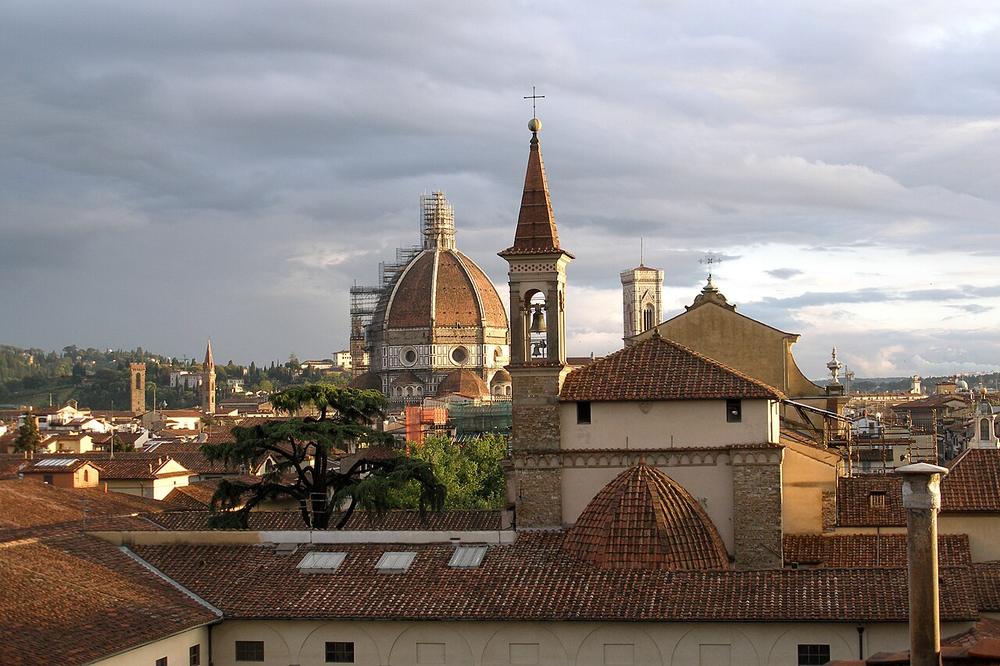
Climb Brunelleschi's Dome above the Duomo for the view over the terracotta rooftops, or save your legs for Piazzale Michelangelo at sunset instead. The Ponte Vecchio, lined with jewelers since the 16th century, is free to cross at any hour.
 Vyacheslav Argenberg (CC BY 4.0)
Florence Cathedral and Brunelleschi's Dome above the rooftops
Venice
Must-visit
- St Mark's Basilica: 30 to 45 minutes inside, longer for the line outside; UNESCO
- Doge's Palace: 1.5 to 2 hours; UNESCO
- Rialto Bridge: free to cross, busiest at midday; UNESCO
- Murano and Burano: half a day by vaporetto; UNESCO
- Plan it: 3-day Venice itinerary
Venice was founded in the 5th century on more than 100 islands in its lagoon. St Mark's Basilica still carries the gold mosaics of the maritime republic that once ruled the eastern Mediterranean. The Doge's Palace, next door, was the seat of that power; its prison connects to the palace by the Bridge of Sighs.
Cross the Rialto Bridge early, before the day-trip crowds arrive from the mainland, then take the vaporetto out to Murano for glassblowing and Burano for its bright, lopsided houses. The Peggy Guggenheim Collection, in a palazzo on the Grand Canal, is a quieter stop for modern art between the two.
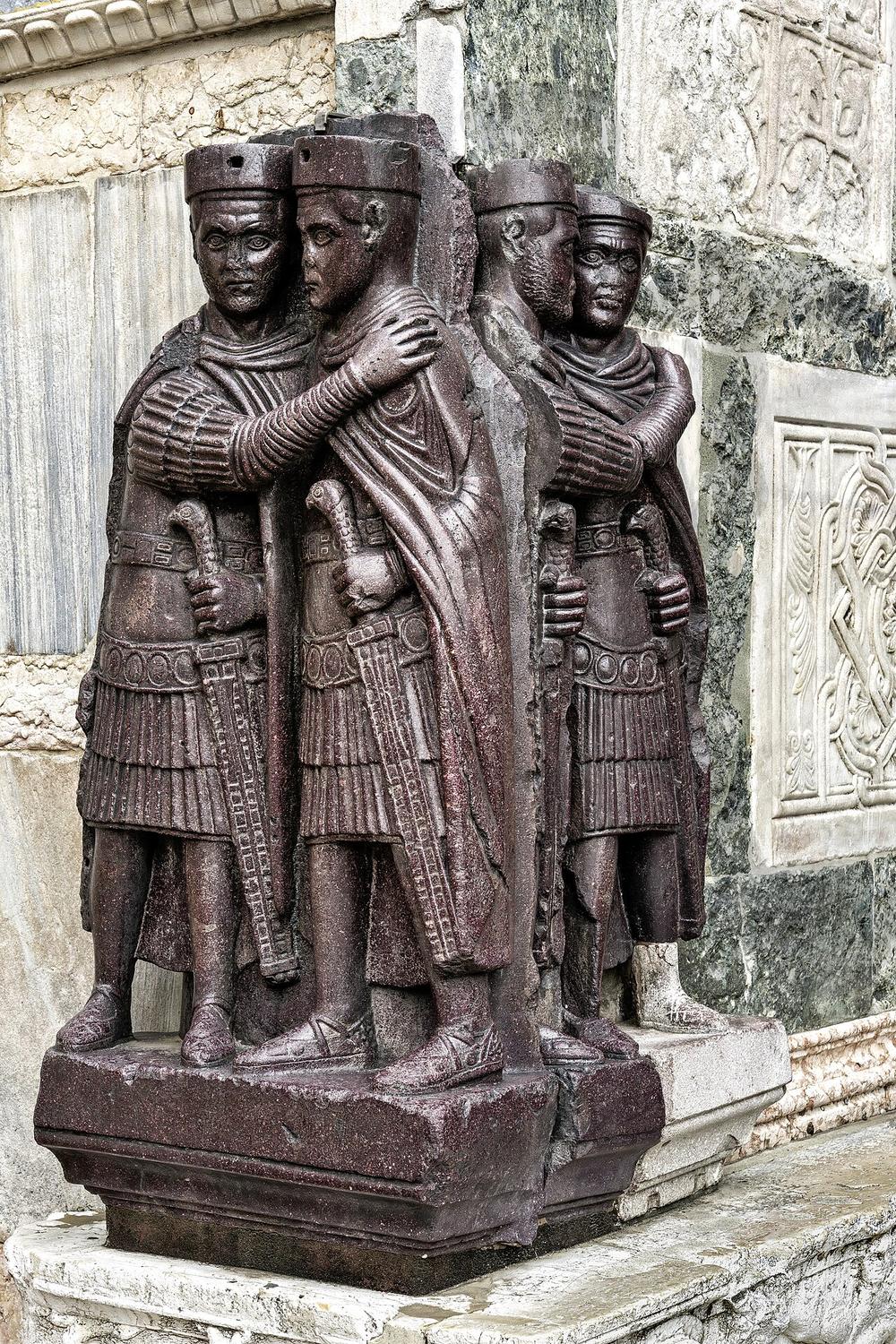 Archaeodontosaurus (CC BY-SA 4.0)
The Four Tetrarchs statue at the corner of St Mark's Basilica
Cinque Terre
Must-visit
- The five villages: Monterosso al Mare, Vernazza, Corniglia, Manarola, Riomaggiore
- Sentiero Azzurro (Blue Trail): about 7.5 miles (12 km) end to end; sections close for repairs without much notice
- Via dell'Amore: the short, paved stretch between Riomaggiore and Manarola
- UNESCO: Portovenere, Cinque Terre, and the Islands (1997)
- Plan it: 10-day Italy itinerary
Cinque Terre is a national park first and five villages second: Monterosso, Vernazza, Corniglia, Manarola and Riomaggiore, wedged into a stretch of the Ligurian coast that has only had a road since the 20th century. The Sentiero Azzurro links all five on foot, with the short paved Via dell'Amore, Lovers' Lane, as its easiest and most popular section.
A local train links all five stations and gets crowded in high season; book a boat between villages instead if you'd rather skip the squeeze. Base yourself in Vernazza or Manarola, and add Porto Venere, just south along the same stretch of coast, for an extra afternoon.
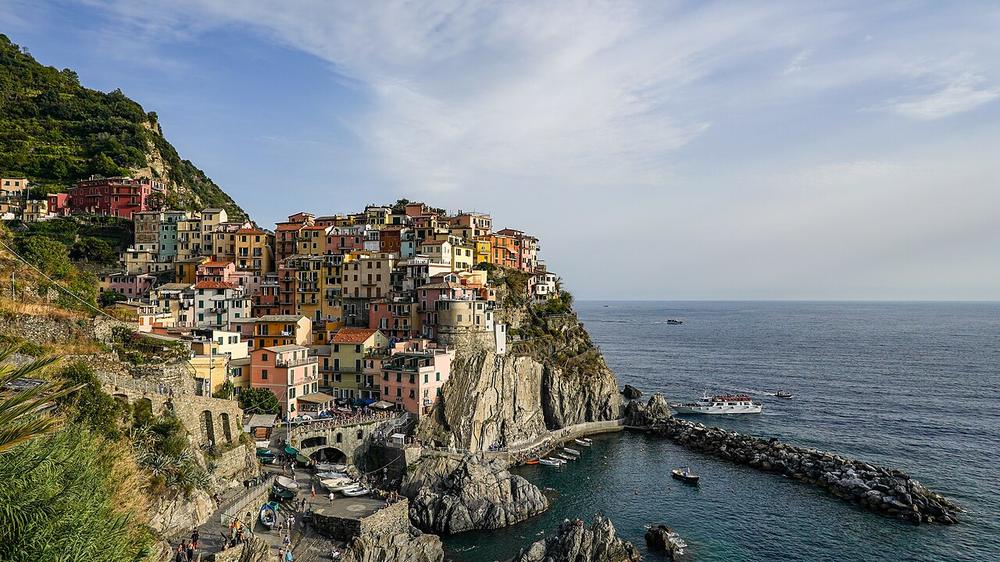 Timothy A. Gonsalves (CC BY-SA 4.0)
Manarola, one of the five villages of Cinque Terre
Milan
Must-visit
- The Last Supper (Cenacolo Vinciano): 15-minute timed slot; EUR 15 full, EUR 2 reduced (18 to 25), free under 18; booking mandatory, weeks ahead; UNESCO
- Milan Cathedral (the Duomo): 1 hour, more with the rooftop
- Galleria Vittorio Emanuele II: 20 minutes; free
- Plan it: 14-day Italy itinerary
Leonardo da Vinci's Last Supper, painted on a refectory wall for the Dominican friars of Santa Maria delle Grazie, is Milan's single hardest ticket in the country. Visits run in 15-minute slots inside a small, climate-controlled room, and they sell out weeks ahead. Book it the moment your Italy dates are fixed, before the Colosseum or the Uffizi.
Milan's Duomo, its marble spires needling the skyline, took six centuries to finish. Walk out of it straight into the Galleria Vittorio Emanuele II, a glass-roofed, 19th-century shopping arcade that connects the cathedral square to La Scala, the opera house a block away.
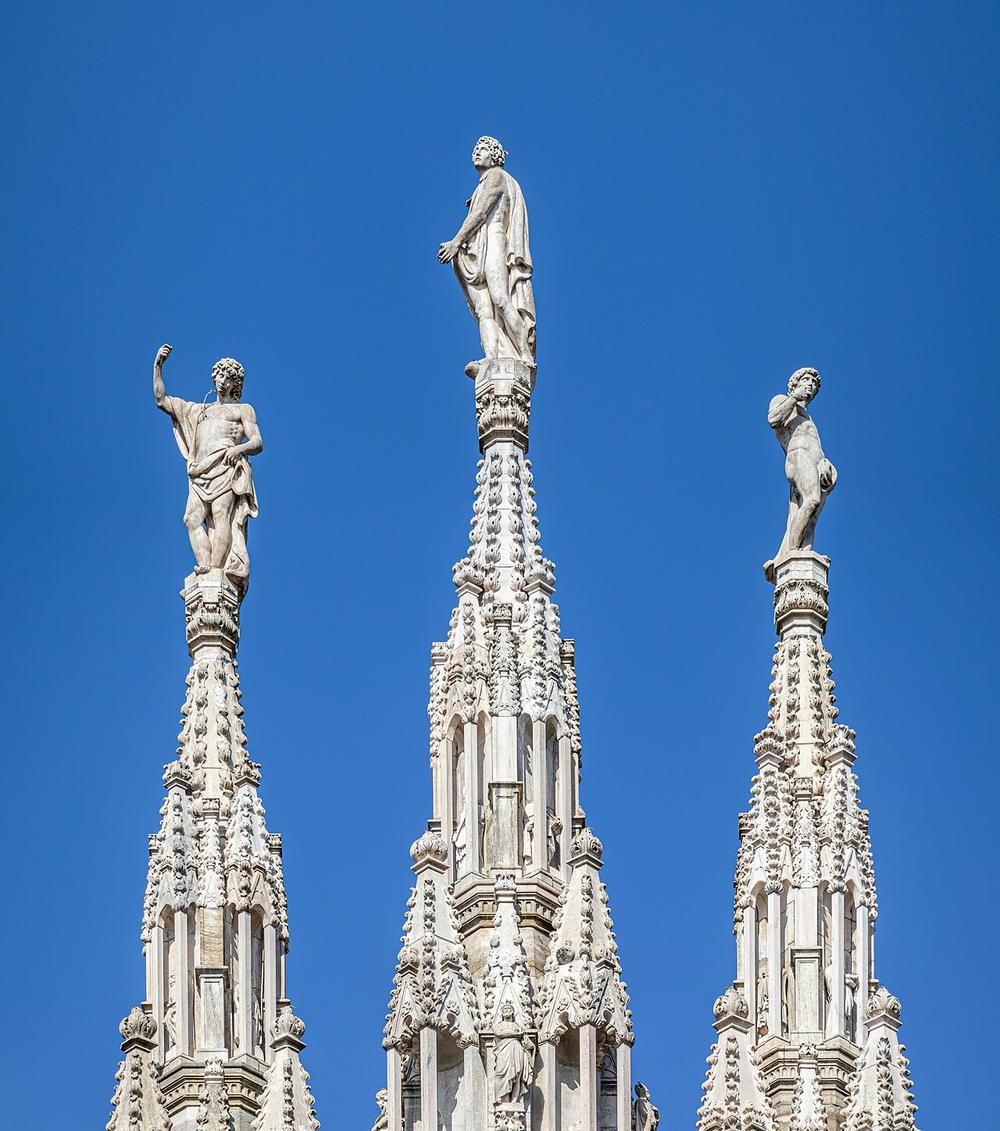 Terragio67 (CC BY-SA 4.0)
Milan Cathedral's spires against the sky
Amalfi Coast
Must-visit
- Towns: Positano, Amalfi, Ravello, with Sorrento and Capri at the coast's edges
- Capri's Blue Grotto: by boat only, closed in rough seas
- UNESCO: Amalfi Coast (Costiera Amalfitana), 1997
- Plan it: 5-day Amalfi Coast itinerary, Amalfi in June
The Amalfi Coast was shaped by the medieval Duchy of Amalfi, which left behind the vineyards, orchards and pastel-colored towns now stacked into the cliffs between the mountains and the sea. Positano is the postcard stop; Ravello, higher up and quieter, has the gardens and the view down over the coastline that Positano's own streets can't give you.
The coast road is one narrow lane each way, jammed solid by midsummer, so get around by ferry or local bus instead of a rental car. Capri, a short boat ride off the coast, adds the Blue Grotto, a sea cave that glows blue with reflected light when the tide is low enough to enter.
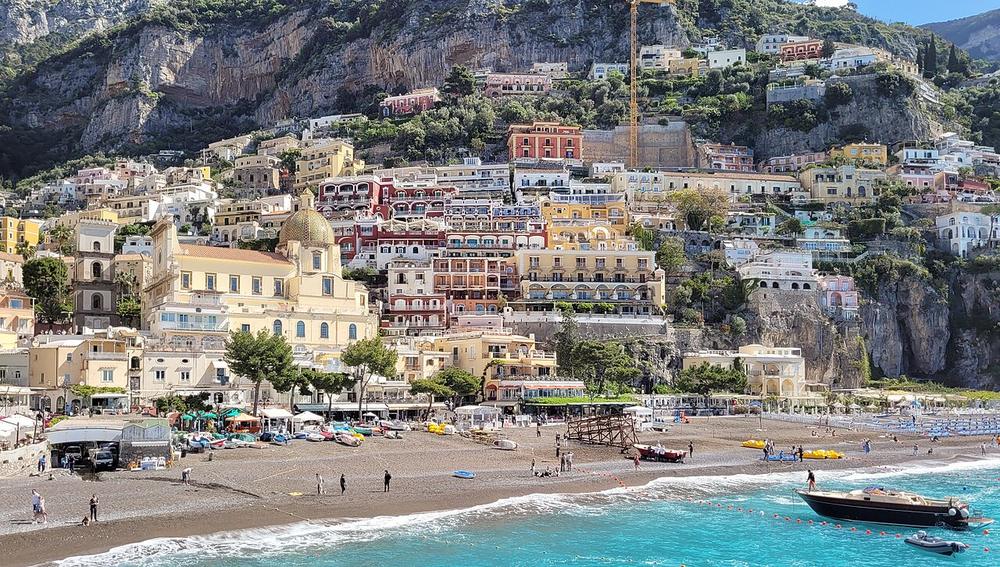 Bernard Gagnon (CC BY 4.0)
Positano stacked into the cliffside above the sea
Naples
Must-visit
- Pompeii: half a day; UNESCO (Archaeological Areas of Pompei, Herculaneum and Torre Annunziata, 1997)
- Herculaneum: 2 to 3 hours; smaller and better preserved than Pompeii; UNESCO
- Mount Vesuvius: a separate trip up from either site, weather permitting
- Plan it: 7-day Italy itinerary
Naples is the gateway to Pompeii and Herculaneum, the two Roman towns buried under volcanic ash when Mount Vesuvius erupted in 79 CE. Pompeii is the bigger ruin and the better-known name; Herculaneum, smaller and preserved by mud rather than ash, kept its wooden beams, furniture and upper floors intact in a way Pompeii didn't.
Both sites sit a short train ride from central Naples, with Vesuvius itself visible from both. In the city, eat pizza where the style began: Neapolitan pizza gets its char and its soft center from ovens built to a different, much hotter standard than almost anywhere else makes it.
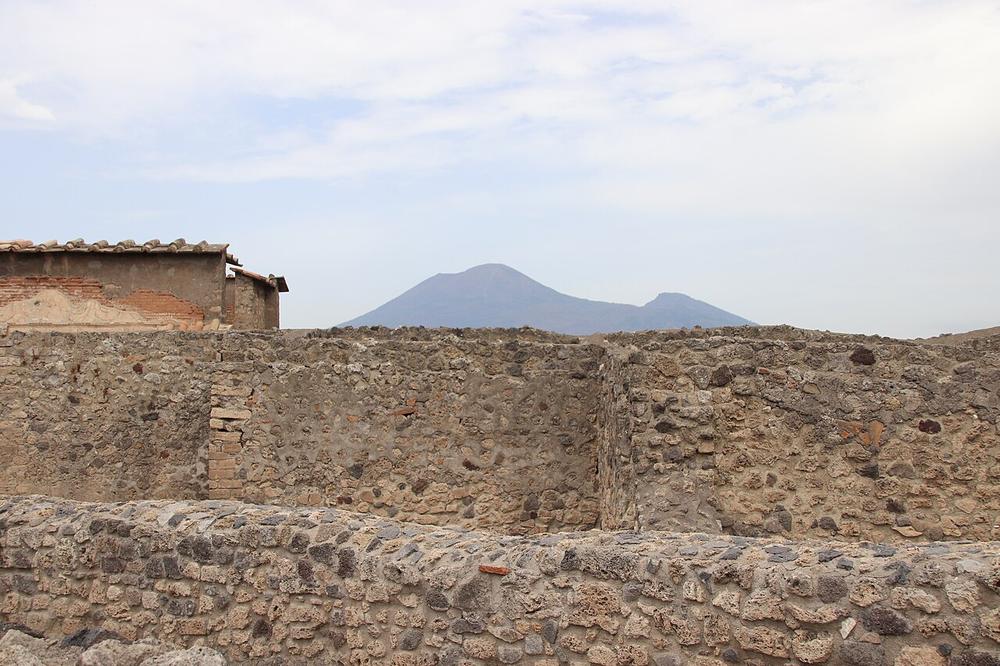 Gary Todd from Xinzheng, China (Public domain)
The ruins of Pompeii with Mount Vesuvius behind them
Lake Como
Must-visit
- Bellagio: the classic base, reached by ferry from Como town
- Villa del Balbianello: gardens open seasonally, by guided tour
- Getting around: ferry and bus; the lake road jams like the Amalfi Coast's
- Plan it: 3-day Lake Como itinerary
Lake Como's shore is a run of 19th-century villas and lakeside villages, with Como town itself holding a Gothic cathedral and Palazzo Terragni, a striking example of 1930s Italian Rationalist architecture. Bellagio, on the promontory where the lake's two southern arms meet, is the town most people mean when they picture Lake Como.
Villa del Balbianello, with its terraced gardens dropping to the water, opens for tours on a limited schedule. Skip the drive around the lake if you can: ferries and buses reach every town, and the shore roads clog the same way Amalfi's does in high season.
 RaminusFalcon (CC BY-SA 3.0)
Bellagio on its promontory, Lake Como
Sicily
Must-visit
- Valley of the Temples, Agrigento: half a day; UNESCO (Archaeological Area of Agrigento, 1997)
- Mount Etna, near Catania: 3,326 m (10,912 ft), Europe's largest volcano; guided hikes on the upper slopes
- Ancient Theatre of Taormina: a working Greek theater with Etna in view behind the stage
- Plan it: 7-day Sicily itinerary, Palermo in June
Sicily is Italy's largest island and old enough to carry Greek, Roman, Arab and Norman layers in the same cities. The Valley of the Temples outside Agrigento holds Doric temples raised in the 5th century BCE, some of the best-preserved Greek temples anywhere outside Greece. Palermo's cathedral and markets show the Arab-Norman mix the rest of the island shares.
Taormina's ancient theater, still used for performances, frames Mount Etna in the distance behind its stage. Etna itself, a 3,326-meter (10,912-foot) stratovolcano and Europe's largest, is close enough to Catania and Taormina to climb its lower slopes on a half-day trip, weather and activity permitting.
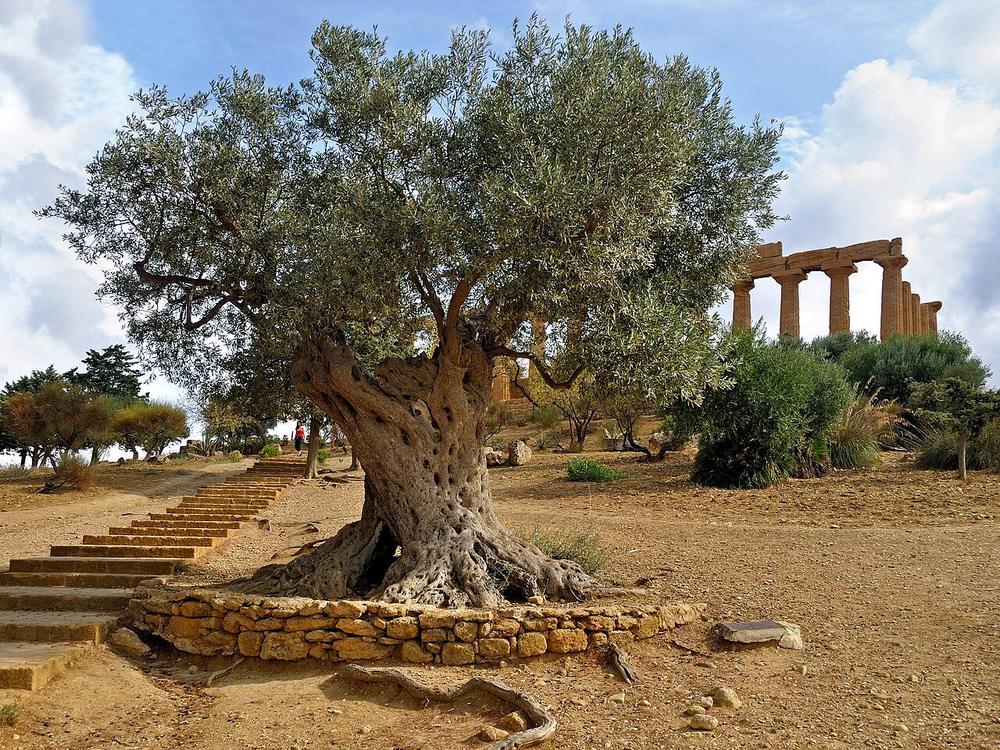 Ввласенко (CC BY-SA 3.0)
The Valley of the Temples at Agrigento
Pisa
Must-visit
- Leaning Tower: 294 steps; timed ticket, book weeks ahead in peak season; UNESCO
- Pisa Cathedral and Baptistery: 1 hour, in the same square; a combined ticket covers all four buildings
- Plan it: 7-day Italy itinerary
The Leaning Tower started tilting during construction in the 12th century, when the ground beneath it gave way. Decades of stabilization work have since fixed the lean at just under 4 degrees. Climb its 294 steps and you can feel the angle shift as you go.
The tower shares its square, the Field of Miracles, with the cathedral and a round, domed baptistery, both worth the short walk around them even if you skip the climb. Direct trains link Pisa with Florence in about an hour, which is how most visitors see it: a half-day trip rather than an overnight stop.
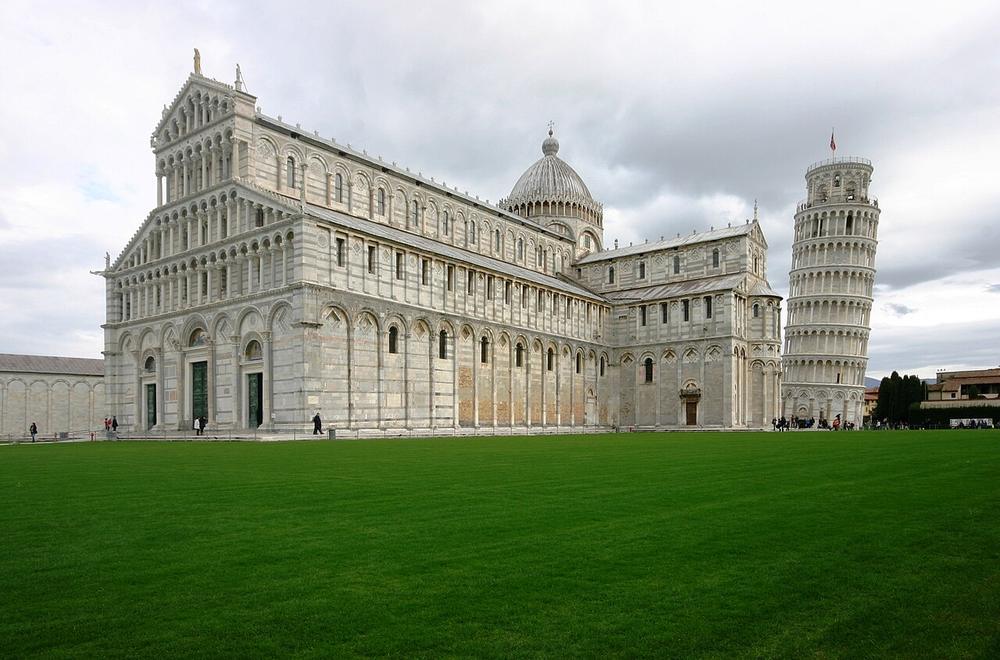 José Luiz (CC BY-SA 3.0)
The Leaning Tower of Pisa and the cathedral
Verona
Must-visit
- Verona Arena: a Roman amphitheater still used for opera; UNESCO
- Casa di Giulietta (Juliet's House): 30 minutes; the balcony is a 20th-century addition, not original
- Piazza delle Erbe: the old Roman forum, now a market square
- Plan it: Italy honeymoon itinerary
Verona's Roman arena, built in 30 AD, is one of the best-preserved amphitheaters anywhere and still seats an opera audience every summer. Casa di Giulietta, the house Shakespeare borrowed for Juliet's family, draws crowds for its courtyard and famous balcony, added in the 20th century for the tourists rather than carried over from the play's own era.
Piazza delle Erbe, built over the old Roman forum, is still a working market by day and a place to sit with a spritz by evening. Verona pairs naturally with a Lake Garda detour or a quieter counterpoint to Venice, an hour and a half away by train.
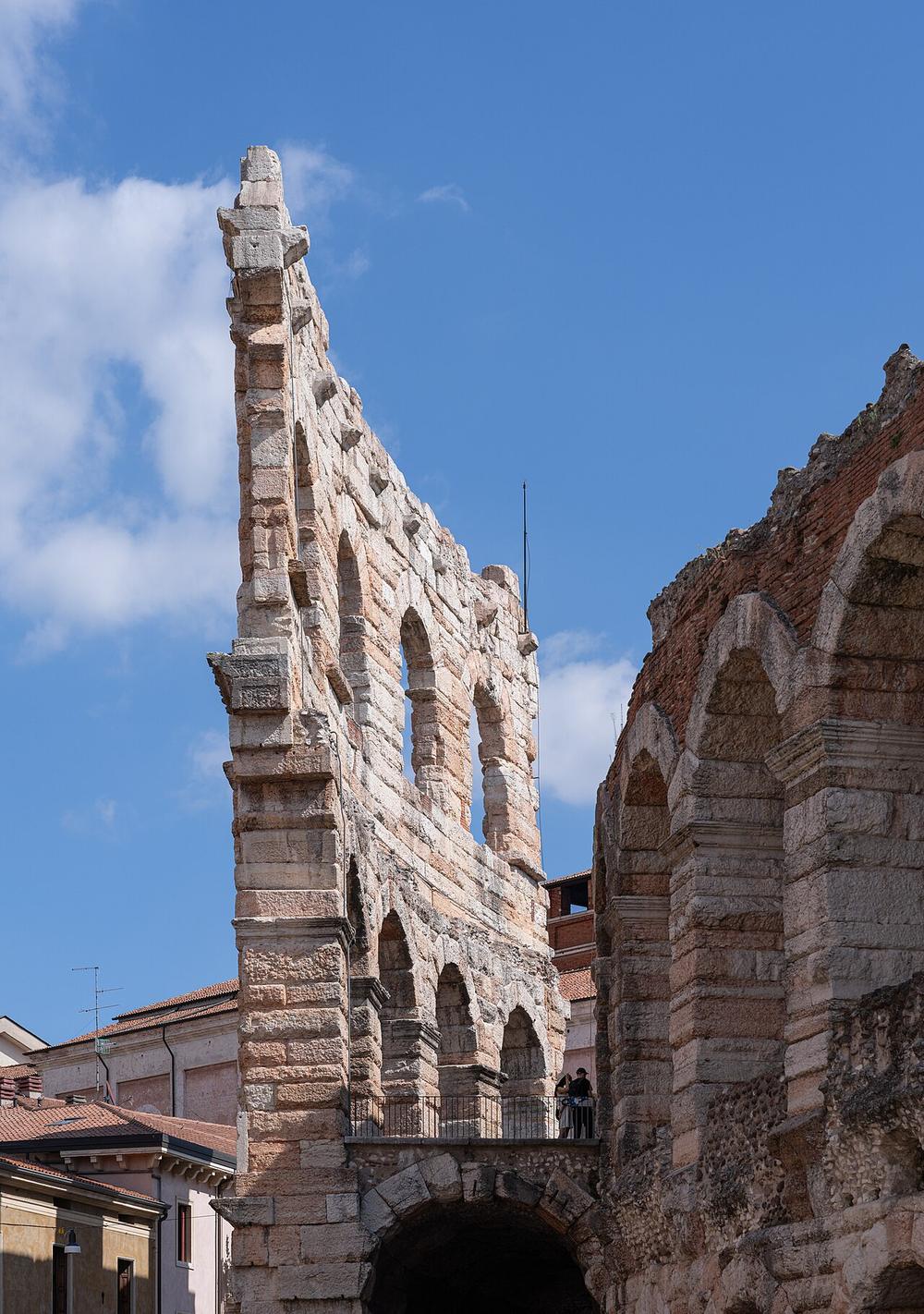 NorbertNagel (CC BY-SA 4.0)
The Verona Arena, a Roman amphitheater
Siena
- Piazza del Campo: the shell-shaped main square, free to sit in; UNESCO (Historic Centre of Siena, 1995)
- Siena Cathedral: 1 hour; Gothic facade and striped marble interior
- Plan it: 10-day Italy itinerary
Siena kept its medieval, Gothic character almost intact from the 12th to the 15th century, built around the shell-shaped Piazza del Campo rather than a grid. Painters born or working here, including Duccio and Simone Martini, shaped an entire school of early Italian art before Florence's Renaissance eclipsed it.
The cathedral, striped in bands of black and white marble, rewards a slow look at its facade before you step inside. Siena is close enough to Florence for a day trip, but an evening in the Campo, once the crowds thin, is worth staying over for.
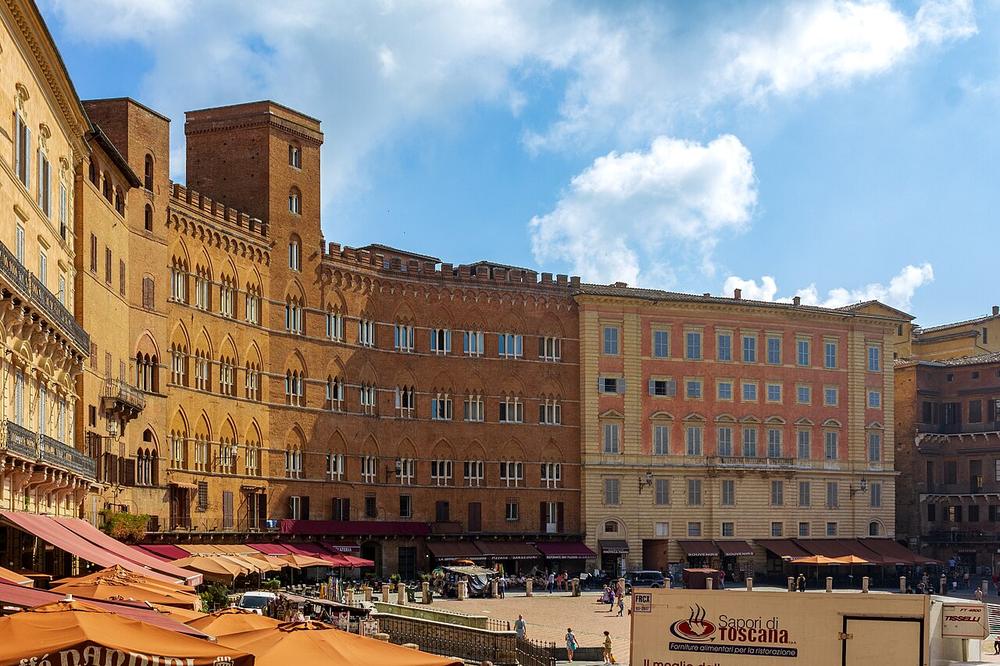 Perituss (CC0)
Piazza del Campo, Siena's shell-shaped main square
Things to do across Italy
Taste wine in Tuscany and Piedmont
- Tuscany: Chianti, between Florence and Siena
- Piedmont: the Langhe hills around Barolo, built on a single grape, Nebbiolo
- Best months: September and October, during the grape harvest
Chianti's vineyards fill the hills between Florence and Siena, close enough to add a half-day of tastings onto either city. Piedmont's Langhe region, around the town of Barolo, works almost entirely in one grape, Nebbiolo, and rewards a slower, multi-day visit by car.
Agriturismi, working farms that also take guests for lunch or a stay, are common in both regions and often the best way to taste alongside the people who grow the grapes.
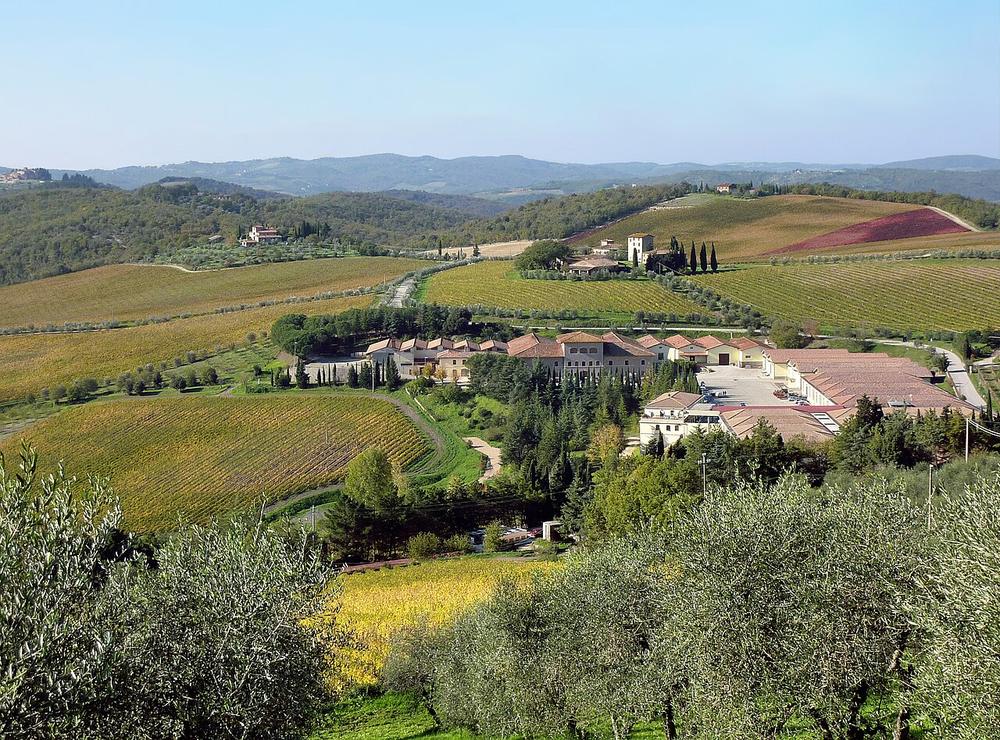 Adbar (CC BY-SA 3.0)
Vineyard rows in Chianti, Tuscany
Hike the Path of the Gods on the Amalfi Coast
- Sentiero degli Dei: about 4 hours, Agerola to Nocelle (or Positano)
- Best months: spring and fall; avoid midday in summer
- UNESCO: Amalfi Coast (Costiera Amalfitana), 1997
- Plan it: Amalfi Coast hiking and beach itinerary
The Path of the Gods traces the cliffs above the Amalfi Coast road, high enough that the switchbacks and the traffic below disappear and the only sound left is the sea. Most walkers start in Agerola and finish in Nocelle, above Positano, descending into town on a long flight of steps at the end.
Carry water and start early; there's little shade on the exposed sections, and the view is the same reason everyone else is walking it too.
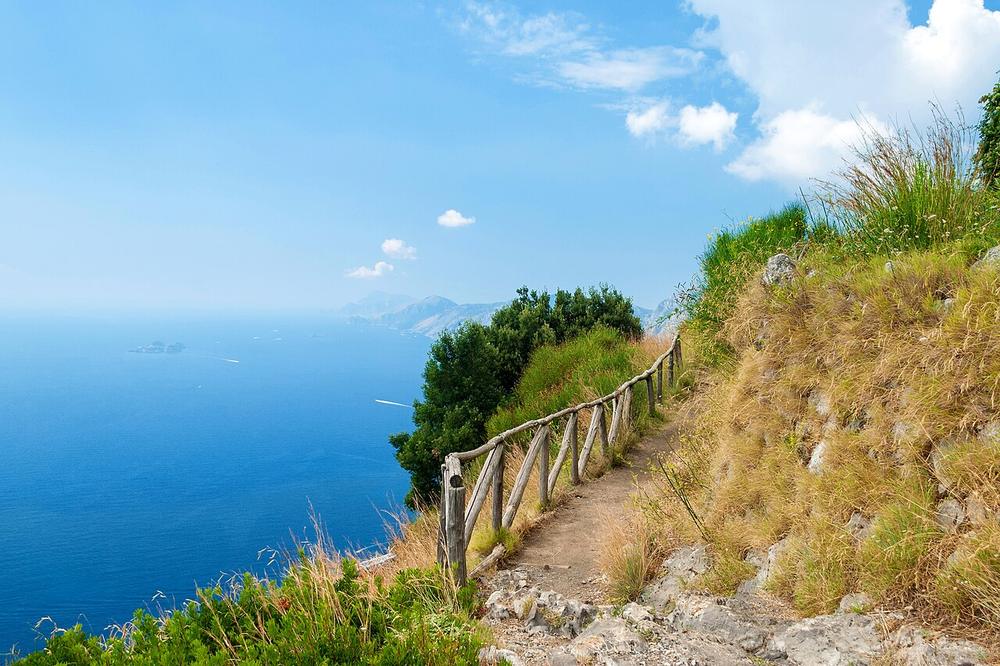 Mihael Grmek (CC BY-SA 4.0)
A hiker on the Path of the Gods trail above the Amalfi Coast
Ski the Dolomites
- Alpe di Siusi and Seceda: cable car access; hiking in summer, skiing in winter
- Tre Cime di Lavaredo: three distinctive peaks, a classic day hike in summer
- UNESCO: the Dolomites, 2009
- Best months: December to March for skiing, June to September for hiking
The Dolomites, a limestone range across Trentino-South Tyrol and Veneto, carry 18 peaks over 3,000 meters (9,800 feet) within the UNESCO-listed site. At sunset the rock turns pink, a glow locals call enrosadira. Alpe di Siusi, Europe's largest high-altitude alpine meadow, and the Seceda ridge above it work for both a summer hike and a winter ski run, depending on the season.
Tre Cime di Lavaredo, three sheer rock towers rising out of a high plateau, is the range's single most-photographed hike, doable as a loop in half a day in summer. Skiers base themselves in Cortina d'Ampezzo or the Val Gardena resorts instead.
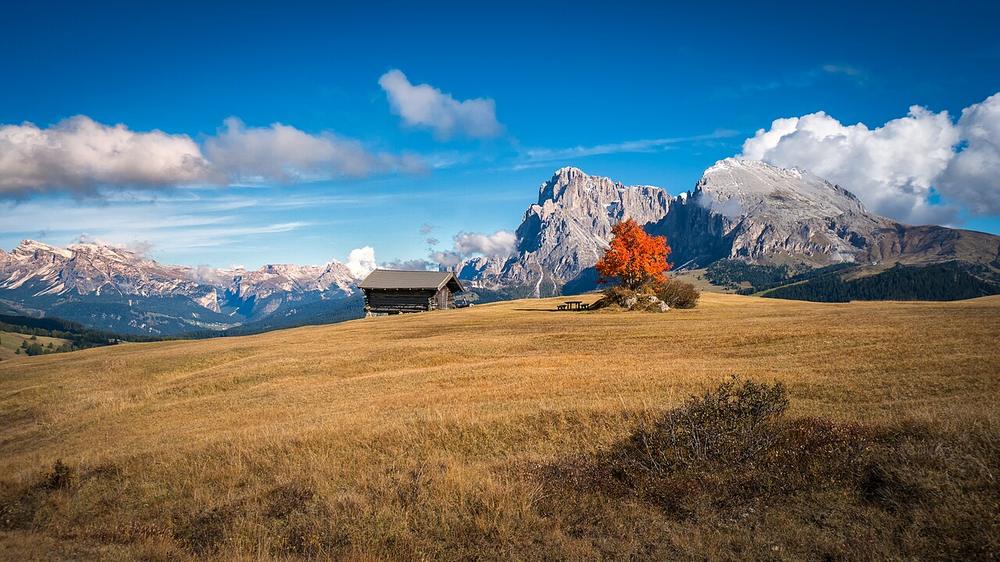 mendhak (CC BY-SA 2.0)
Alpe di Siusi meadow with the Dolomite peaks behind it
Hunt truffles in Piedmont and Umbria
- Piedmont: white truffles around Alba, peak season October and November
- Umbria and Tuscany: black truffles, available most of the year
- Best months: October and November for white truffles
Piedmont's white truffles, dug up by trained dogs around Alba, are the most prized and most expensive version of the fungus, and only in season in the fall. Umbria and parts of Tuscany produce black truffles for much of the rest of the year, shaved over pasta at a fraction of the white truffle's price.
A truffle hunt with a local hunter and their dog, followed by a lunch built around whatever they find, is the usual way to try it firsthand rather than just ordering it off a menu.
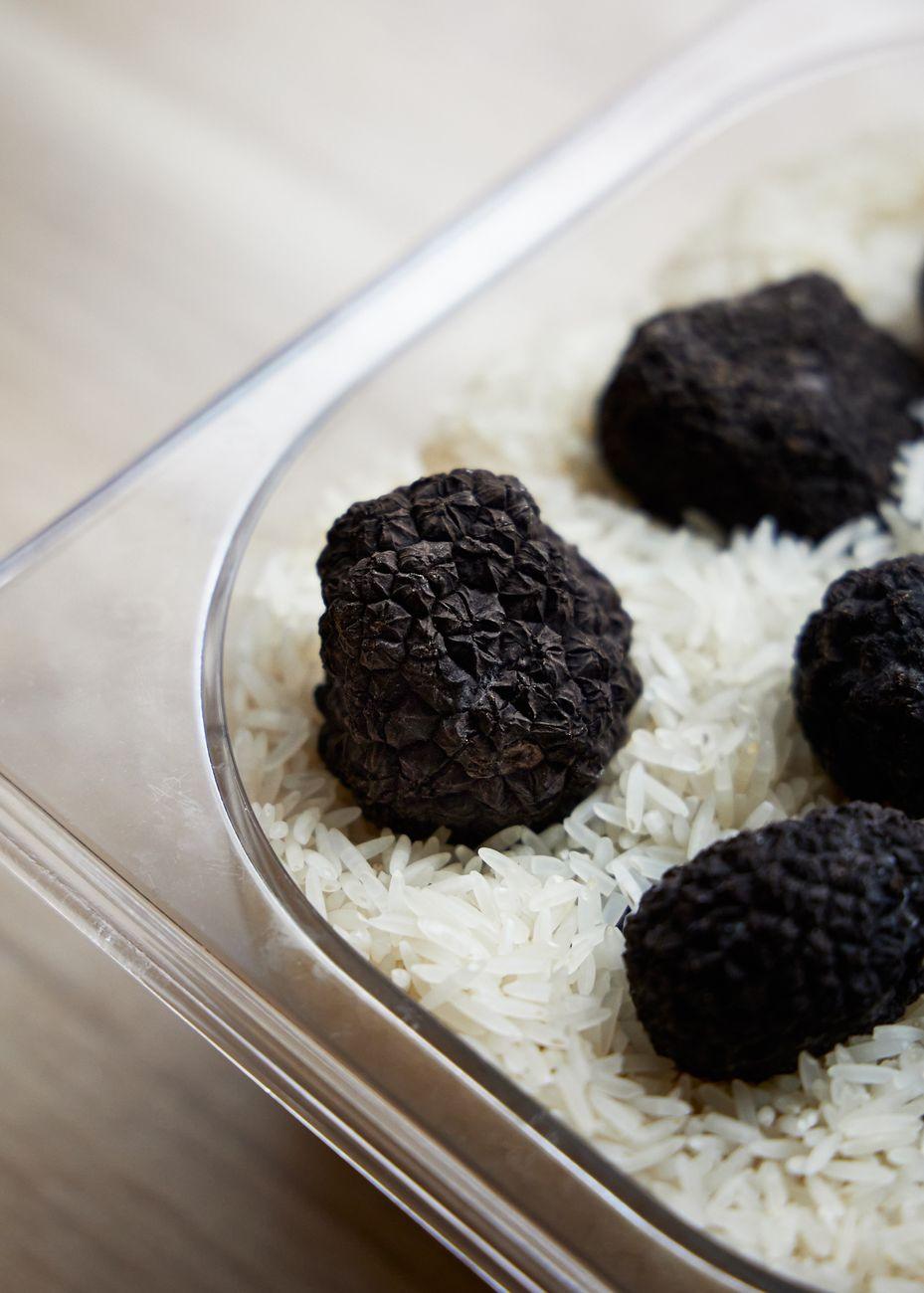 Photo by Max Griss on Pexels
Fresh black truffles
Soak in Tuscany's hot springs
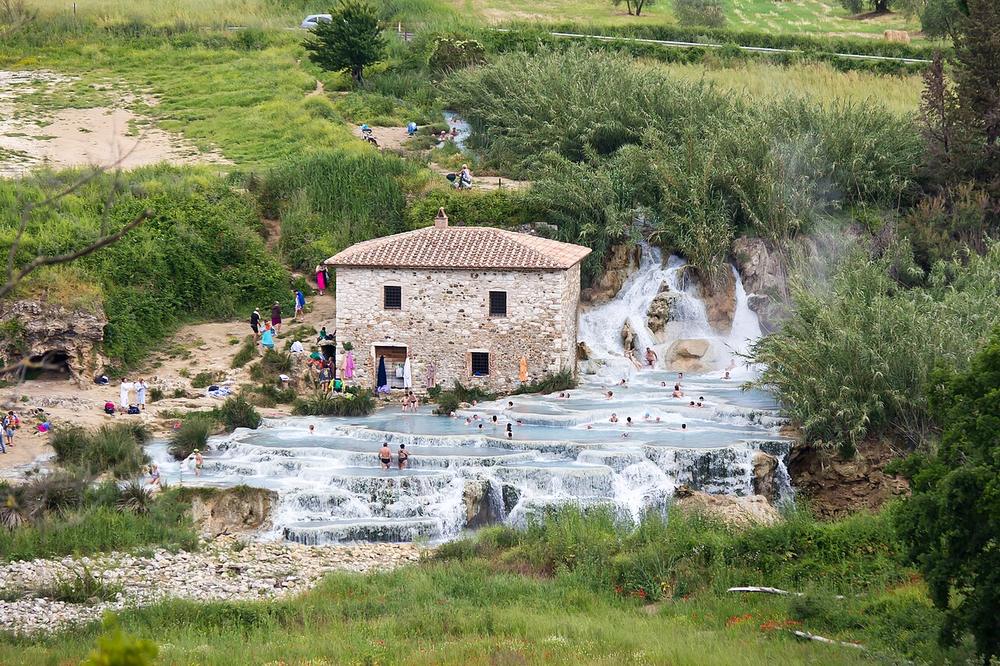
- Saturnia (Cascate del Mulino): free, open-air sulfur pools, busiest on weekends
- Montecatini Terme: a classic European spa town; UNESCO (The Great Spa Towns of Europe, 2021)
- Best months: year-round; cooler months make the warm water more of a draw
Saturnia's Cascate del Mulino, a series of warm, sulfur-rich pools cut into travertine terraces, cost nothing to visit and need no booking. That's exactly why they fill up on weekends. A volcanic spring keeps the water warm year-round, so the pools draw a crowd in winter as much as summer.
Montecatini Terme, a formal spa town in the same region, joined the UNESCO list in 2021 as one of Europe's Great Spa Towns, for visitors who want a treatment room over a free roadside pool.
 Raimond Spekking (CC BY-SA 4.0)
The travertine pools of Saturnia's Cascate del Mulino
See an opera at the Verona Arena
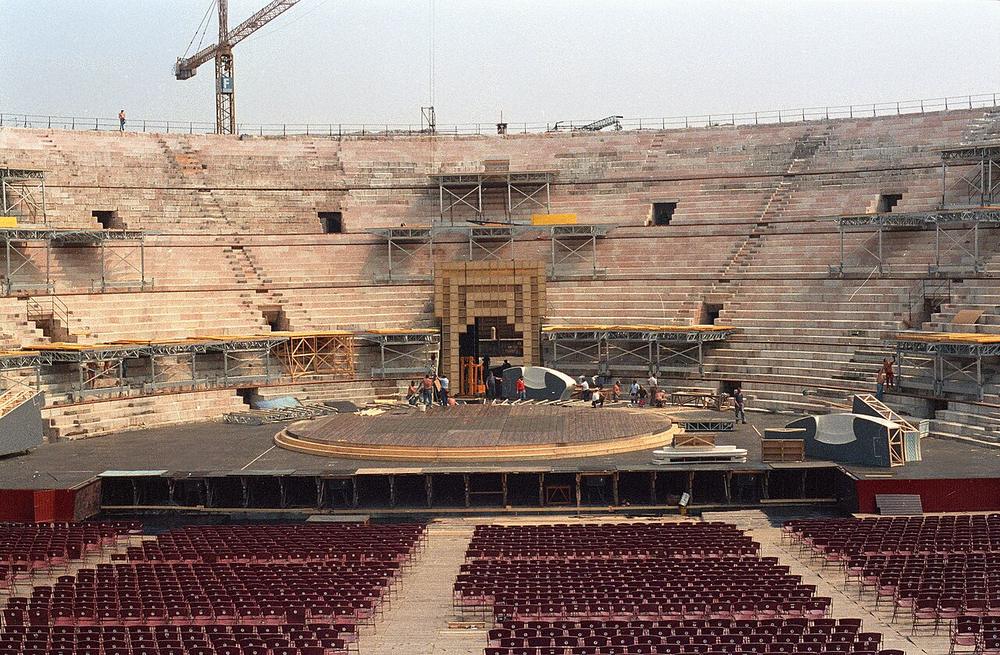
- Verona Arena: outdoor summer opera season, June to September
- Teatro alla Scala, Milan: the indoor season runs September to July
- UNESCO: City of Verona, 2000
Full opera productions run outdoors at the Verona Arena every summer, under its own festival. Seating is either on the old stone steps or in numbered chairs closer to the stage, and the stone keeps the evening air warm long after sunset.
Milan's La Scala, one of the world's best-known opera houses, runs its own indoor season the rest of the year. Expect a dress code and a program that leans toward premieres and the classic Italian repertoire.
 Dagmar Hollmann (CC BY-SA 3.0)
An opera performance at the Verona Arena at night
Walk among the trulli of Alberobello in Puglia
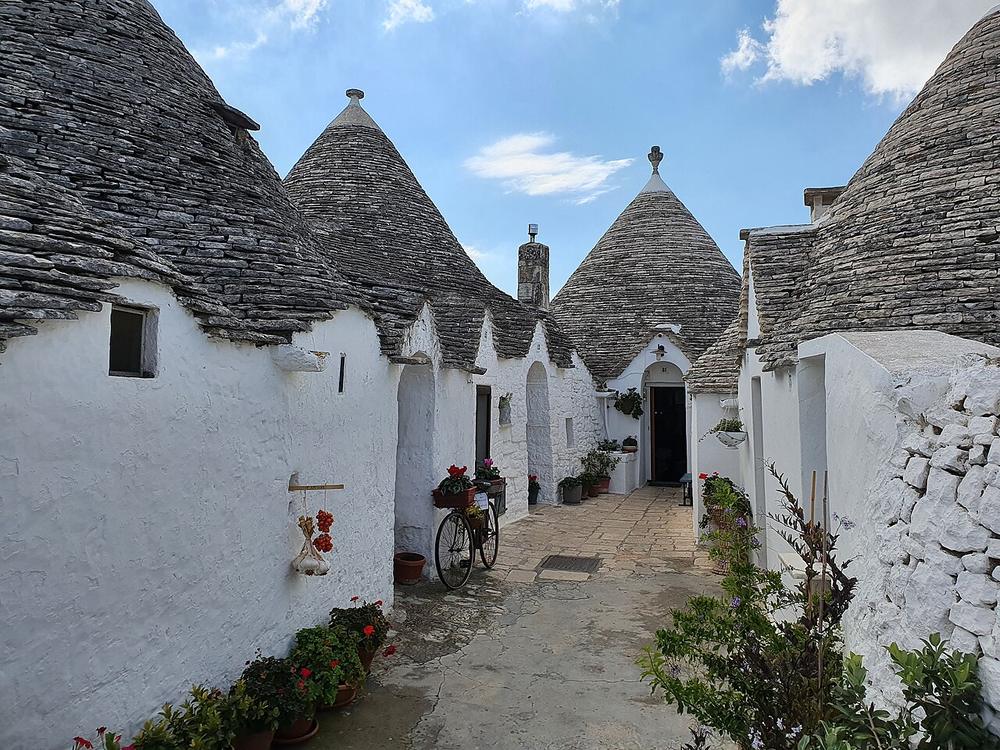
- Trulli of Alberobello: a town built almost entirely of the conical stone houses; UNESCO (The Trulli of Alberobello, 1996)
- Polignano a Mare: a town built on limestone cliffs over the Adriatic
- Best months: spring and fall, to skip the summer coastal crowds
Alberobello's trulli, whitewashed cone-roofed houses built without mortar, fill the Rione Monti district alone with around 1,000 of them, with more in the quieter Aia Piccola district next door. Many are now shops, cafes or rooms to rent rather than homes.
Polignano a Mare, on Puglia's Adriatic coast, is built straight onto limestone cliffs with a small beach wedged into a cove below the old town. Puglia's flat country roads and olive groves make it one of the easier Italian regions to explore by rental car.
 MPhernambucq (CC BY-SA 4.0)
The conical trulli houses of Alberobello
Discover Sardinia's beaches and nuraghi
- Costa Smeralda: the island's best-known stretch of coast
- Nuraghi: Bronze Age stone structures found across the island
- Best months: May, June and September, outside the peak summer crowds
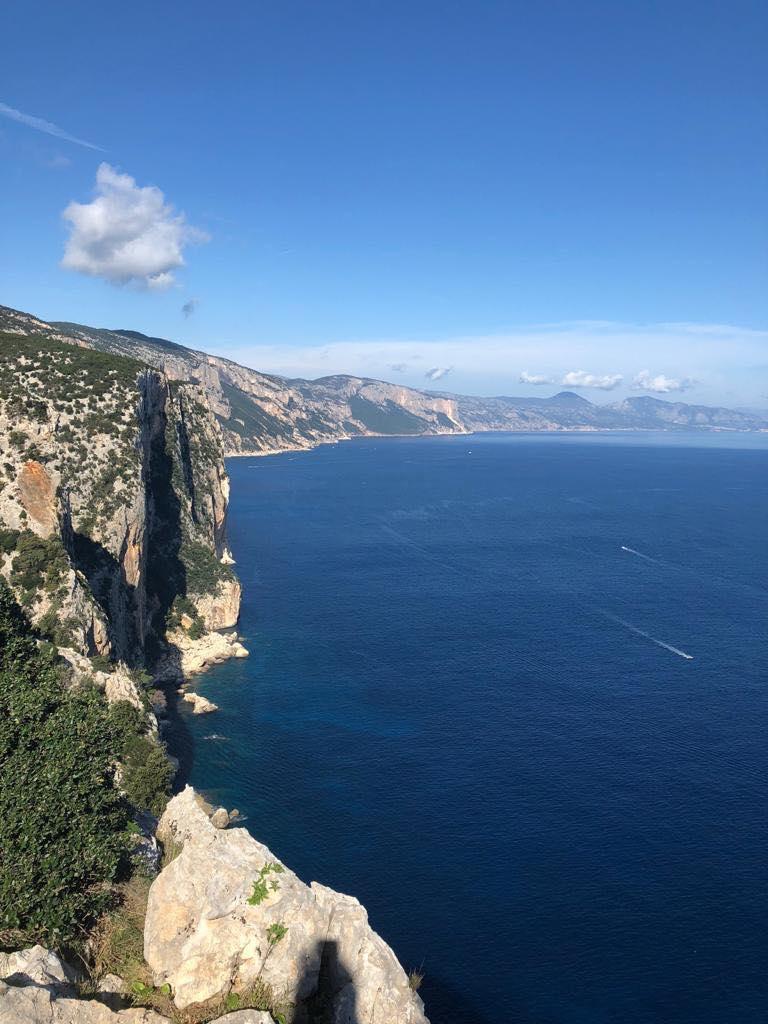
Sardinia is the Mediterranean's second-largest island after Sicily. Its coast runs from the Costa Smeralda in the northeast to the cliffs of the Golfo di Orosei and the dune-backed beaches of the Costa Verde. A rental car does more for Sardinia than for almost anywhere else in Italy, since the coast is long and the good beaches aren't always near a town.
Inland, thousands of nuraghi dot the hills: Bronze Age stone towers whose original purpose is still debated. Beside them sit burial sites locals call "giants' tombs." The mountain villages of the Barbagia region, further inland still, keep traditions that have mostly faded from the coast.
 Joos1697 (CC BY-SA 4.0)
The cliff coast of Sardinia's Selvaggio Blu trail
Ride a gondola on Venice's Grand Canal
- Gondola ride: a shared or private tariff set by the city, varies by time of day
- Best time: early morning or after sunset, away from the day-trip crowds
- Alternative: the vaporetto (water bus) covers the same canal for a fraction of the cost
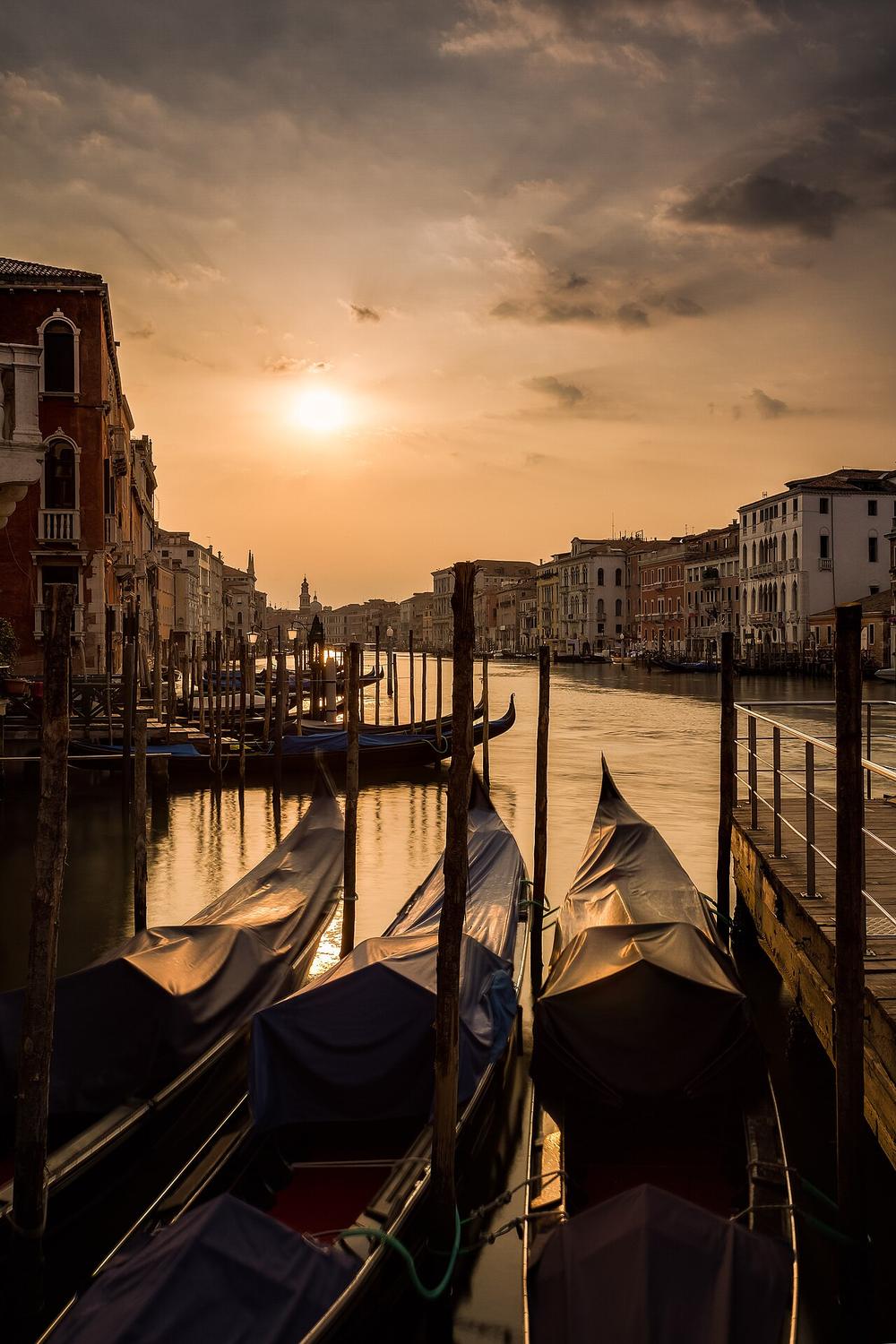
A gondola ride down the Grand Canal passes under the Rialto Bridge and along palazzo facades that have faced the water since Venice was a maritime republic. The gondolier steers the whole way with a single oar. Private rides cost more than a shared one and run on your own schedule rather than a fixed route.
For the same water view without the cost, ride the number 1 vaporetto line end to end instead; it stops at nearly every major palazzo along the canal.
 Benh LIEU SONG (Flickr) (CC BY-SA 4.0)
A gondola on Venice's Grand Canal passing under a bridge
Eat gelato across Italy
- Florence: often credited as gelato's birthplace
- How to tell the good from the bad: pale, uneven colors and metal tubs with lids beat neon mounds piled above the tub's rim
- Price: varies by city and size; a small cup or cone is usually the cheapest size on the board
Real gelato churns slower and holds less air than factory ice cream, which is why it tastes denser and melts faster in the cup. Florence is often credited as its birthplace, but good gelaterie run in every Italian city and town, usually a short walk from whichever piazza you're already standing in.
Judge a gelateria by its colors before you judge the flavor list: pistachio should look pale and grayish-green, not bright, and banana shouldn't glow yellow. Both are signs of added color standing in for real fruit and nuts.
Try free
Plan your Italy trip in about 2 minutes
Tap through 8 quick cards for a complete itinerary with budget, maps, and packing lists. No account required.
Plan your Italy trip →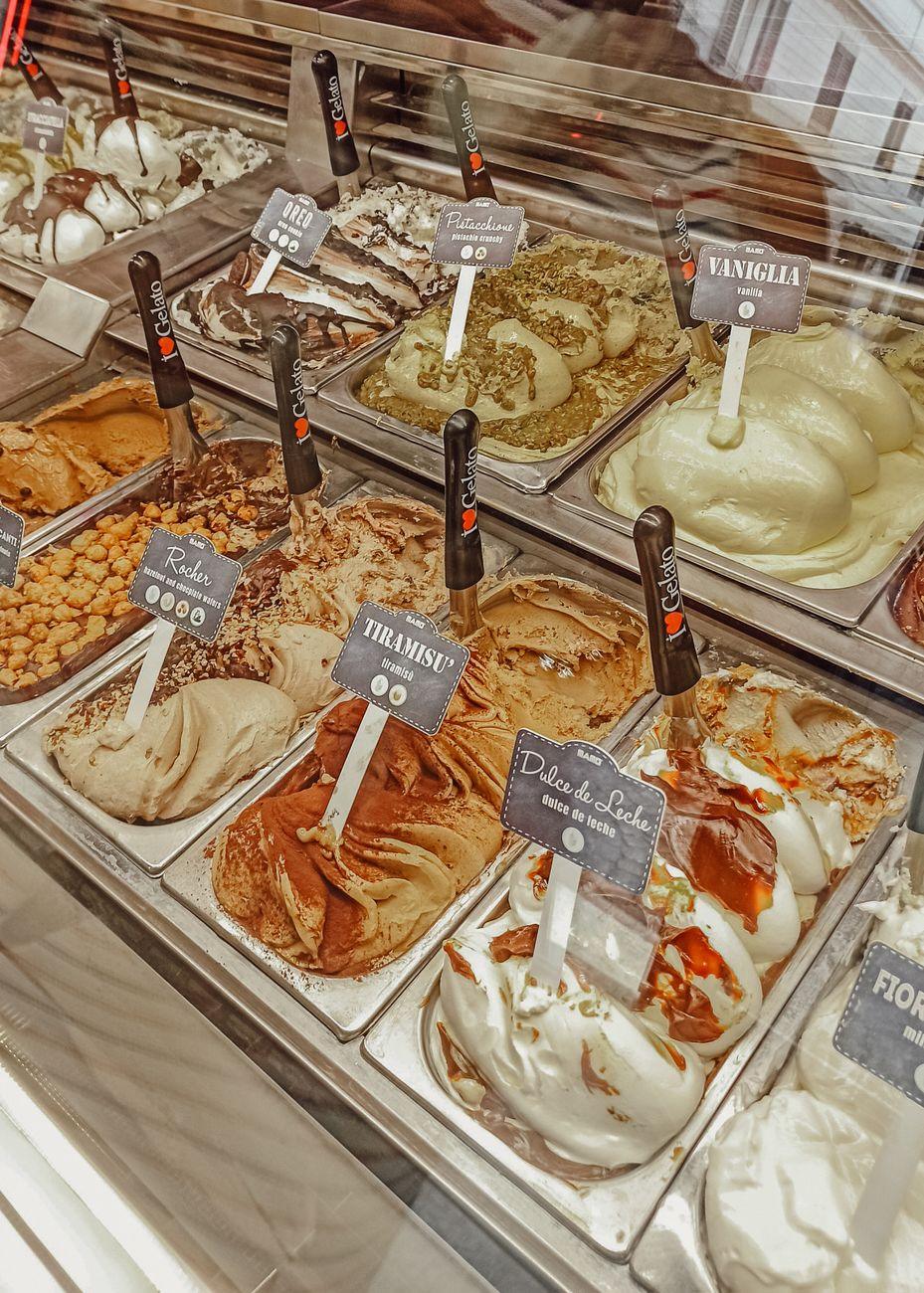 Photo by Oksana Bulgaru on Pexels
Gelato flavors on display in a Rome gelateria
More places to add to a trip
| Place | Go for | Region | UNESCO |
|---|---|---|---|
| Bologna | porticoed streets and the Two Towers | Emilia-Romagna | yes (2021) |
| San Gimignano | medieval stone towers above the Tuscan hills | Tuscany | yes |
| Lucca | a walled old town, its ramparts now a walking path | Tuscany | no |
| Ravenna | Byzantine mosaics in its early Christian churches | Emilia-Romagna | yes |
| Assisi | the Basilica of St Francis, built into the hillside | Umbria | yes |
| Matera | cave dwellings (sassi) cut into the rock | Basilicata | yes |
| Val d'Orcia | cypress-lined roads through rolling farmland | Tuscany | yes |
| Civita di Bagnoregio | a hilltop town of 12 full-time residents, reached by a 500-meter footbridge | Lazio | no |
| Mantua | Renaissance palaces built for the Gonzaga dukes | Lombardy | yes (2008) |
Day trips from Rome, Florence and Venice
| Base | Day trips |
|---|---|
| Rome | Pompeii, Herculaneum, Tivoli |
| Florence | San Gimignano, Lucca |
| Venice | Padua, Murano and Burano |
The best places to visit in Italy at a glance
| Place | Go for | Book ahead |
|---|---|---|
| Rome | the Colosseum, the Vatican Museums, the Pantheon | Colosseum, Vatican Museums |
| Florence | the Uffizi, the Duomo, Michelangelo's David | Uffizi, Accademia |
| Venice | St Mark's Basilica, the Grand Canal, Murano and Burano | no |
| Cinque Terre | five cliffside villages linked by coastal trails | no |
| Milan | the Last Supper, the Duomo, La Scala | the Last Supper |
| Amalfi Coast | Positano, Capri's Blue Grotto, the Path of the Gods | ferries in summer |
| Naples | the gateway to Pompeii and Herculaneum, pizza | no |
| Lake Como | lakeside villas and villages by ferry | no |
| Sicily | the Valley of the Temples, Mount Etna, Taormina | no |
| Pisa | the Leaning Tower | no |
| Verona | the Arena, Juliet's House | opera nights |
| Siena | the Piazza del Campo, Gothic streets | no |
Plan your Italy trip
For trip length, getting around and costs, start with the Italy travel guide. When you build a trip with MonkeyEatingMango, the booking checklist lists what to book and how many weeks ahead. Every sight on a day's plan is marked Must-do, Maybe or Skip if tired.
Common questions
What is the best place to visit in Italy?
Rome, Florence and Venice are the best places to visit in Italy for a first trip. Rome has the Colosseum and the Vatican, Florence has the Uffizi and Michelangelo's David, and Venice has St Mark's Basilica and the Grand Canal.
Where should I go in Italy for the first time?
A first trip to Italy usually pairs Rome with Florence and Venice, sometimes with a few days on the Amalfi Coast or in Cinque Terre added on. Those three cities hold most of Italy's headline sights, from the Colosseum to the Uffizi and the Grand Canal.
What is the number one attraction in Italy?
The Colosseum in Rome is Italy's best-known sight, and most first trips build a day around it. Book it in advance; its combined ticket also covers the Roman Forum and Palatine Hill.
Do I need to book the Colosseum, the Vatican Museums or the Uffizi in advance?
Yes. The Colosseum, the Vatican Museums and the Uffizi Gallery all sell timed tickets that sell out in spring and summer. The Last Supper in Milan is the tightest of all: its 15-minute viewing slots in a small room go weeks ahead.
Is 7 days enough to see Italy?
Seven days covers Rome, Florence and Venice at a reasonable pace, or Rome with the Amalfi Coast. Add Milan, Cinque Terre or Sicily when you have ten days to two weeks.
What are the best day trips from Rome?
Pompeii, Herculaneum and Tivoli are the classic day trips from Rome. High-speed trains reach Naples, the gateway to Pompeii and Herculaneum, in about an hour.
What are the best day trips from Florence?
San Gimignano and Lucca are the classic day trips from Florence, both under an hour and a half away. Pisa and Siena are close enough to add to a Florence base too.
Is the Amalfi Coast walkable, or do I need a car?
The Amalfi Coast's one coastal road is narrow and jammed in summer, so most visitors get around by ferry or local bus rather than driving themselves. The Path of the Gods, the region's classic hike, covers much of the coast on foot instead.
How many UNESCO World Heritage Sites does Italy have?
Italy has 62 UNESCO World Heritage Sites, more than any other country. Among them are the historic centers of Rome, Florence, Siena and Naples, Venice and its lagoon, the Amalfi Coast and the Dolomites.
Is Sicily or Sardinia worth a separate trip?
Sicily and Sardinia both work better as their own trip than as a side trip from the mainland. Sicily pairs ancient Greek ruins at Agrigento with Mount Etna and Taormina; Sardinia is built around its beaches and prehistoric nuraghi.
Which Italian region is best for wine tasting?
Tuscany and Piedmont are Italy's best-known wine regions. Tuscany centers on Chianti, between Florence and Siena; Piedmont's Langhe hills around Barolo are built around a single grape, Nebbiolo.

Written by Shobhit Shrivastava · Founder
Related reading
Italy travel guide
5 Days on the Amalfi Coast: Positano and Amalfi
5 days split between Positano and Amalfi: 3 nights in Positano (Franco's Bar, Arienzo Beach Club, linen shopping) followed by 2 nights in Amalfi (Duomo di Amalfi, Museo della Carta, Pasticceria Pansa). Comfortable pace with a mix of beach clubs, coastal hiking, and hands-on pasta classes....
A Week on the Amalfi Coast: Positano, Amalfi and Ravello
This 7-day comfortable trip for a couple explores the iconic Amalfi Coast, beginning in Positano for cliffside views and Spiaggia Grande beach, then moving to Amalfi for its Duomo di Sant'Andrea and historic center. The journey concludes in the elevated gardens of Ravello at Villa Rufolo,...
10 Days in Italy: Rome and Florence, from the Colosseum to the Vatican
10 days across Rome and Florence: 6 nights in Rome exploring the Colosseum, Pantheon, and Trastevere, followed by 4 nights in Florence for the Uffizi Gallery, Duomo, and Oltrarno district. Comfortable pace with 5-7 activity hours daily, relying on walking and local metro, featuring private...
Two Weeks in Italy: Rome, Florence and Sorrento on the Amalfi Coast
14 days covering Rome, Florence, and Sorrento. Experience the Colosseum, Uffizi Gallery, and cliffside views of the Tyrrhenian Sea. Comfortable pace with 5-6 hours of daily sightseeing, blending urban historical sites with coastal relaxation. Includes one base per city, frequent walking, and...
Things to Do in Scotland and the Best Places to Visit
Where to go in Scotland: Edinburgh and the Lothians, Glasgow and the central belt, the Highlands, the islands, and the whisky-region choice no single answer settles. Every stop carries its top sights, the official price where one exists, and what to book ahead.
Things to Do in Ireland and the Best Places to Visit
Where to go in Ireland by region, from Dublin to Northern Ireland. Every stop carries its top sights, the official price where one exists, and what to book ahead.
Things to Do in Croatia and the Best Places to Visit
Where to go in Croatia by region: Split, Dubrovnik and the Dalmatian islands, Istria and the Kvarner coast, Zagreb and the national parks. Every stop carries its top sights, the official price where one exists, and what to book ahead.