Which places in Japan are worth the trip, and what has to be booked before you land? Pair Tokyo with Kyoto on a first trip, and add Osaka or Hiroshima once you have a week to spend. The Ghibli Museum sells out its advance-reservation tickets well ahead of a visit, and Fushimi Inari Taisha draws crowds dense enough at midday that timing the visit matters almost as much as booking does elsewhere.
Tokyo
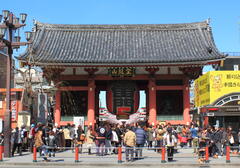
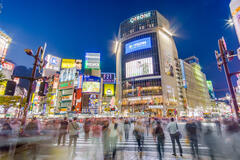
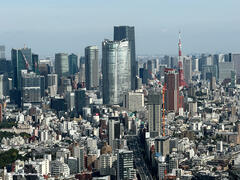
Must-visitGo for Senso-ji, Shibuya Crossing, teamLab, the Ghibli Museum
Top sights
- Senso-ji and Kaminarimonabout 1 hour; free; Tokyo's oldest temple
- Shibuya Crossing and Shibuya Skythe crossing is free any time; the observation deck runs from JPY 2,700 before 3pm to JPY 3,400 after
- teamLab Planets, Toyosu2 to 3 hours; wear shorts, you'll wade through water barefoot
- Tokyo Skytreethe Tembo Deck alone starts at JPY 1,800, the combo with Tembo Galleria at JPY 3,000; book online, the counter adds a JPY 500 fee
Book ahead: Ghibli Museum
Read the full sectionShowing Tokyo
Hokkaido and Okinawa sit far enough from Tokyo and Osaka that each works better as its own trip than as a side trip. Mount Fuji's climbing season is shorter than a glance at the calendar suggests: it ends every year on September 10, after which the mountain huts and rescue stations close for the winter. Every entry names its UNESCO status, where it has one, and the specific thing to reserve.
- Book the Ghibli Museum the moment your dates are fixed. It sells advance-reservation tickets only, with nothing available at the door.
- Treat September 10 as a deadline, not a guideline. Mount Fuji's official climbing season ends that day every year.
- Hokkaido and Okinawa are their own trips, not add-ons: budget flight time and a separate base for each.
Where to go in Japan
Tokyo and Kyoto anchor almost any Japan trip; the rest fill in as the days add up.
Tokyo
Must-visit
- Senso-ji and Kaminarimon: about 1 hour; free; Tokyo's oldest temple
- Shibuya Crossing and Shibuya Sky: the crossing is free any time; the observation deck runs from JPY 2,700 before 3pm to JPY 3,400 after
- teamLab Planets, Toyosu: 2 to 3 hours; wear shorts, you'll wade through water barefoot
- Tokyo Skytree: the Tembo Deck alone starts at JPY 1,800, the combo with Tembo Galleria at JPY 3,000; book online, the counter adds a JPY 500 fee
- Ghibli Museum, Mitaka: JPY 1,000 for ages 19 and up, JPY 700 for ages 13 to 18, JPY 400 for ages 7 to 12; reservation only, nothing sold at the door
- Plan it: 3-day Tokyo itinerary, Tokyo in March
Tokyo's oldest temple, Senso-ji, sits at the end of Nakamise-dori, a market street of souvenir stalls that starts at the Kaminarimon gate. A few train stops away, Shibuya Crossing moves thousands of pedestrians across its intersection at once, and Shibuya Sky's open-air deck puts the whole scramble, Tokyo Tower and the Shinjuku skyline in one view.
teamLab Planets in Toyosu turns entire rooms into projected light and water you walk through barefoot. The Ghibli Museum in nearby Mitaka does the same for Studio Ghibli's films, building the museum itself like a movie set. Shinjuku's Omoide Yokocho, a tangle of alleys lined with tiny yakitori counters, and Akihabara's arcades and electronics stores fill an evening on either side of those two.
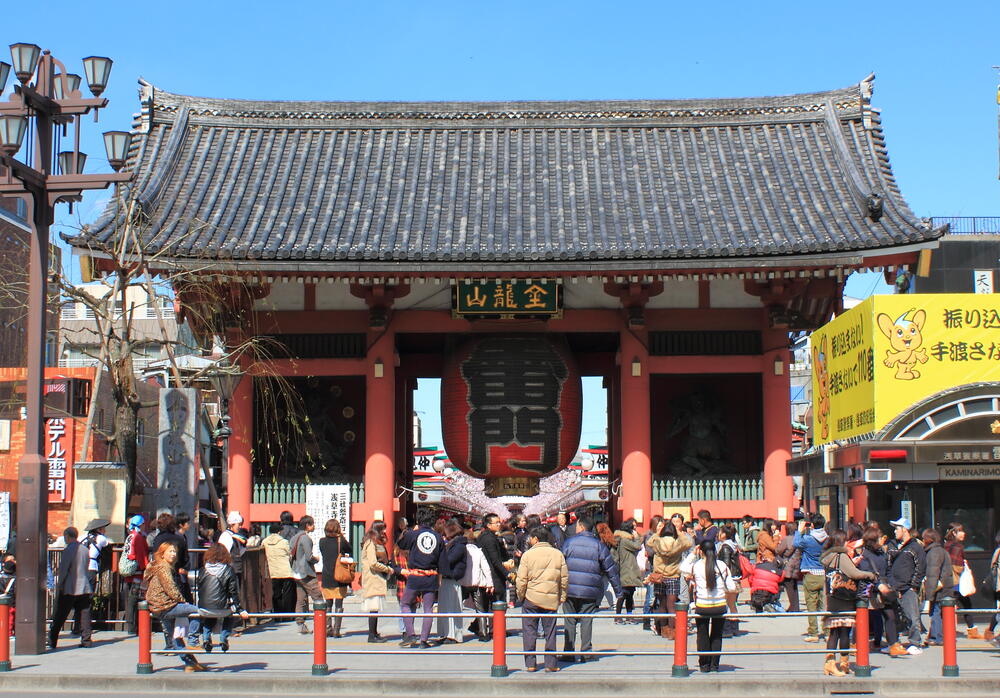 Kakidai (CC BY-SA 3.0)
Kaminarimon, the outer gate of Senso-ji, Asakusa
Kyoto
Must-visit
- Fushimi Inari Taisha: 2 to 3 hours for the full hike; free; busiest midday, quietest at night
- Kinkaku-ji (the Golden Pavilion): 30 to 45 minutes; JPY 500 general admission, JPY 300 for primary and middle school students; UNESCO
- Arashiyama Bamboo Grove: 20 to 30 minutes to walk through; free; lit up on select evenings
- Kiyomizu-dera and Gion: half a day combined; UNESCO (Kiyomizu-dera)
- Plan it: 7-day Japan itinerary, Kyoto in April
Kyoto's Fushimi Inari Taisha sends a tunnel of thousands of vermilion torii up the forested slope of Mount Inari, and the crowd thins the higher you go. Kinkaku-ji's gold-leaf top floors catch the sun over the pond in front of it, a mirror image that makes the temple look doubled on a still day. Kinkaku-ji is one of 17 separate properties that together make up Kyoto's UNESCO listing, alongside Ryoan-ji, Nijo Castle and Kiyomizu-dera.
Arashiyama's bamboo grove runs from near Tenryu-ji north toward the Okochi Sanso villa, the stalks closing overhead into green light. Gion, Kyoto's best-known geisha district, is for an evening walk down Hanamikoji-dori rather than a destination with a ticket, and Kiyomizu-dera's wooden stage looks out over the hillside below it.
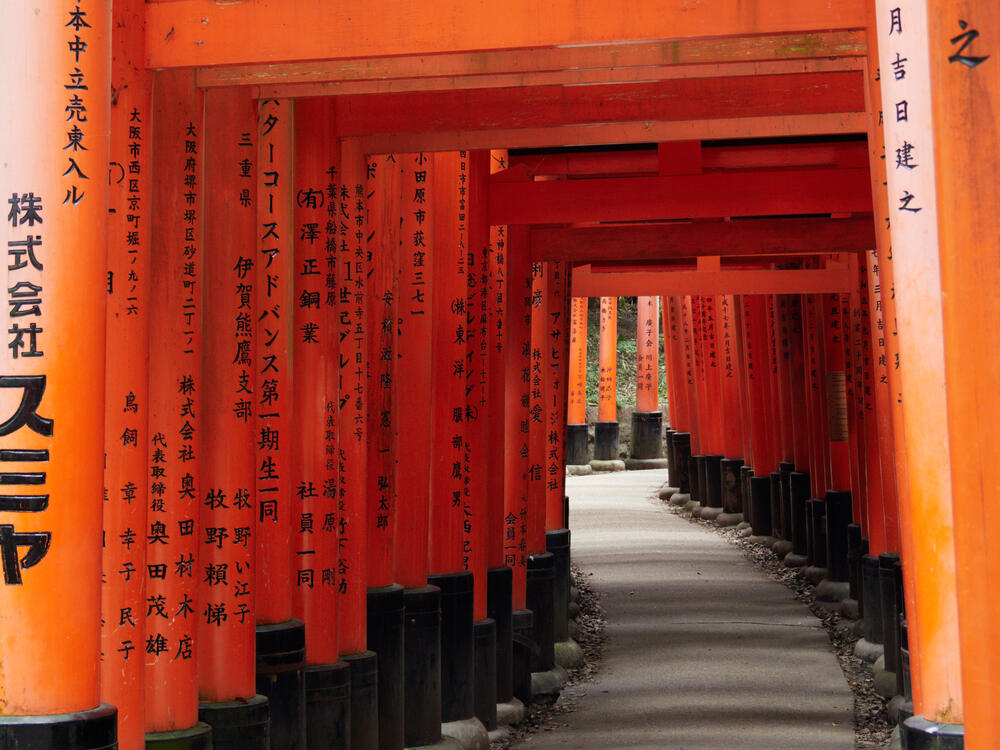 lumoplank (CC0)
The torii tunnel at Fushimi Inari Taisha
Hiroshima
Must-visit
- Peace Memorial Park and Museum: 2 to 3 hours; museum admission JPY 200 for adults, JPY 100 for high schoolers, free for junior high and younger; the park itself has no gate or fee; UNESCO (Hiroshima Peace Memorial, 1996)
- Miyajima (Itsukushima Shrine): half a day from Hiroshima by ferry; JPY 100 visitor tax per crossing, collected with the boat fare since October 2023; UNESCO (Itsukushima Shinto Shrine, 1996)
- Plan it: 7-day Japan itinerary
The Atomic Bomb Dome, the skeletal shell left standing closest to the 1945 blast, anchors Hiroshima's Peace Memorial Park. The Peace Memorial Museum next to it holds the artifacts and testimony that make the park's history concrete rather than abstract, and both sit inside a rebuilt city of wide, tree-lined boulevards.
Miyajima, a short ferry ride from Hiroshima, carries Itsukushima Shrine's torii gate, which appears to float on the water at high tide and stand on exposed sand at low tide. Deer wander the island's streets and paths the way they do in Nara, and a cable car climbs partway up Mount Misen behind the shrine.
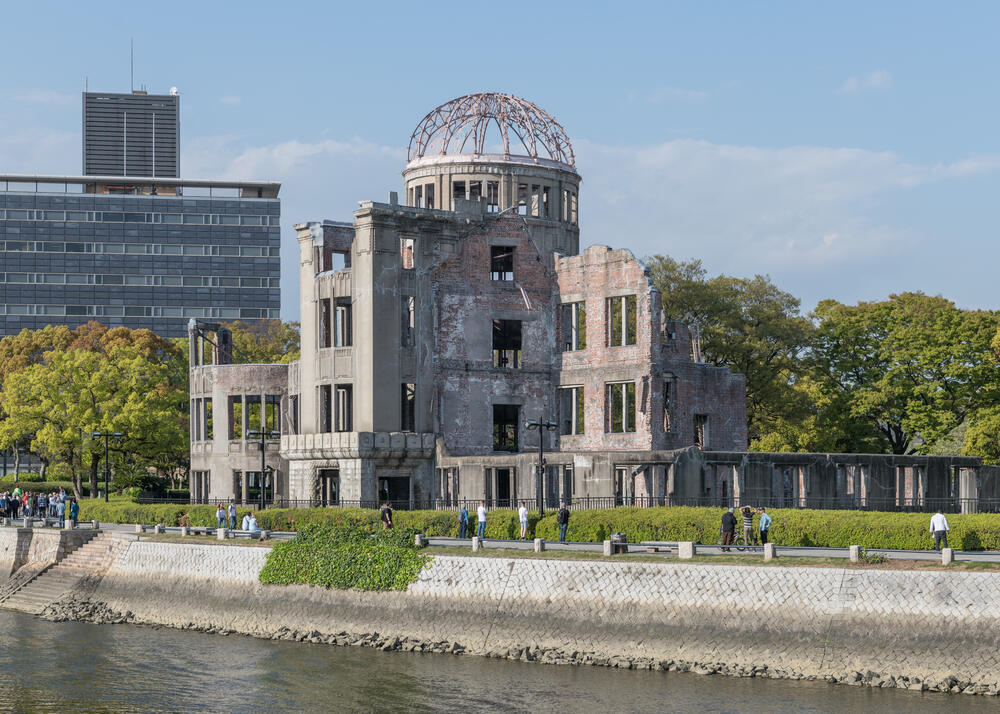 DXR (CC BY-SA 4.0)
The Atomic Bomb Dome in Hiroshima Peace Memorial Park
Mount Fuji and the Fuji Five Lakes
Must-visit
- Chureito Pagoda: the classic pagoda-and-mountain photo, near Fujiyoshida; a steep stair climb to reach it
- Lake Kawaguchiko: the most visited of the five lakes for its Fuji reflections
- Climbing season: ends every year on September 10; mountain huts and rescue stations close for the winter after that date
- UNESCO: Fujisan, sacred place and source of artistic inspiration (2013)
- Plan it: 5-day Tokyo itinerary
UNESCO's own listing for Fujisan says the mountain "has inspired artists and poets and been the object of pilgrimage for centuries." Chureito Pagoda, reached by a long stair climb above Fujiyoshida, frames that same mountain behind its five red-and-white tiers. The shot ends up on more Japan travel photos than almost any other view in the country.
Lake Kawaguchiko carries Fuji's reflection on a calm morning and anchors the Fuji Five Lakes region, a cluster of towns built around hiking, hot springs and the mountain itself. Climbers should plan around the short official season: it ends every September 10, and outside that window the trails lose their mountain huts, rescue stations and cell coverage.
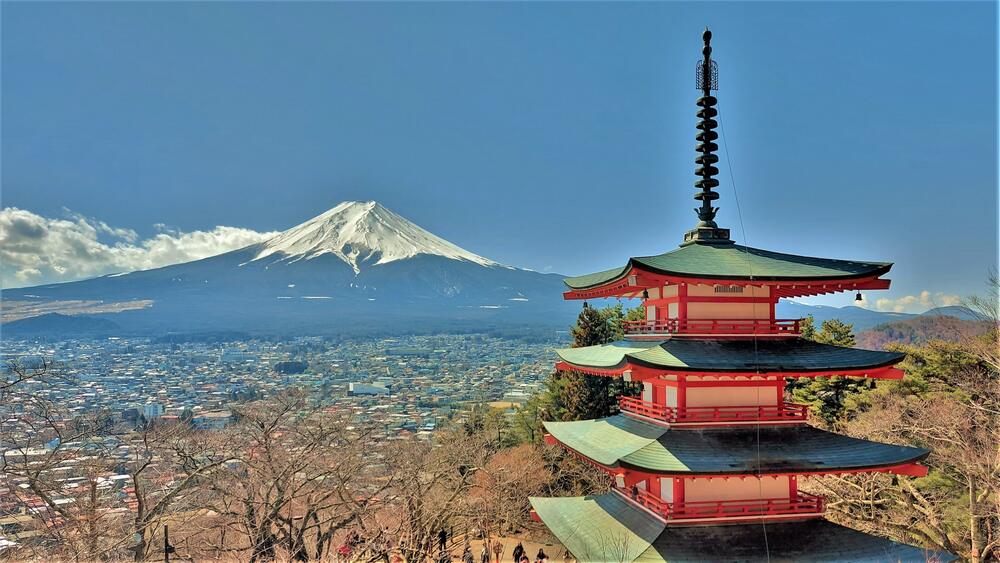 Stjepko Krehula (CC BY 4.0)
Chureito Pagoda with Mount Fuji behind it
Kanazawa
- Kenroku-en: 1 to 2 hours; one of the Three Great Gardens of Japan, alongside Kairaku-en in Mito and Koraku-en in Okayama
- Higashi Chaya district: 1 hour; a former geisha quarter of wooden teahouses, now shops and cafes
- Kanazawa Castle: 30 to 45 minutes for the grounds and Ishikawa Gate
- Plan it: 7-day Japan itinerary
Kenroku-en was laid out as the castle's outer garden from the 1670s onward and opened to the public in 1871. Few Edo-period daimyo gardens survive in a form this close to what their designers intended.
The Higashi Chaya district's wooden facades and latticed windows survive from Kanazawa's geisha era, and several of the old teahouses now serve tea and gold-leaf sweets to visitors instead. Kanazawa Castle, across the moat from Kenroku-en, lost most of its buildings to repeated fires, most recently in 1881, and today's keep and towers are reconstructions. The Ishikawa Gate, built in 1788, is one of the few original structures still standing.
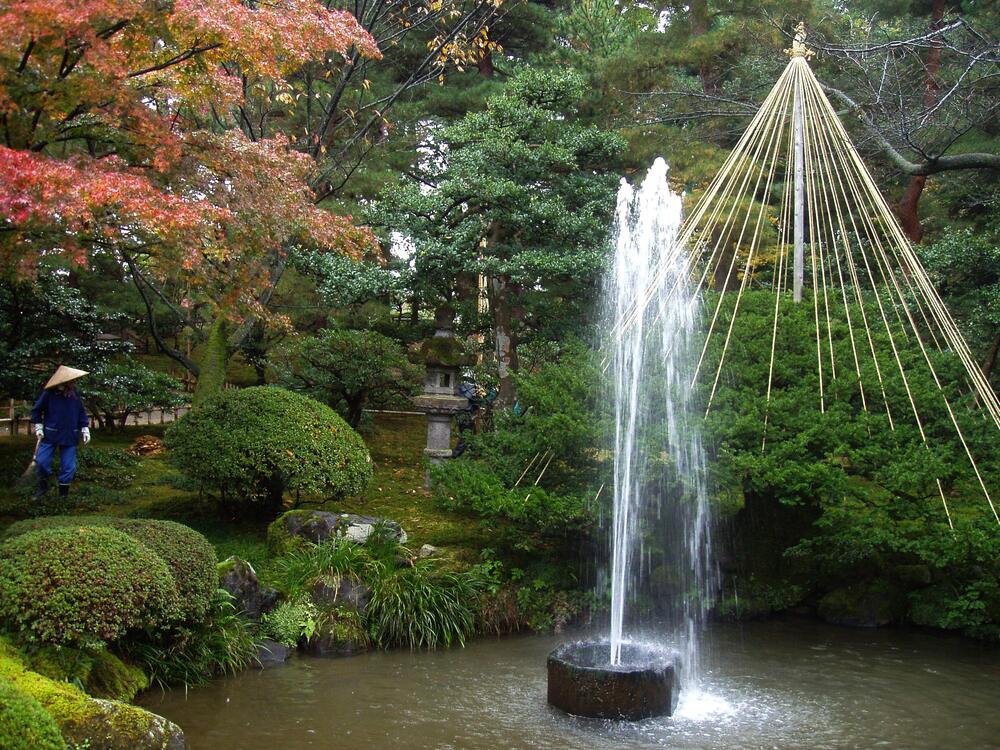 Jovandav (CC BY-SA 3.0)
The fountain at Kenroku-en, one of Japan's Three Great Gardens
Nara
- Todai-ji and the Great Buddha: 1 to 1.5 hours; one of the world's largest wooden halls; UNESCO (Historic Monuments of Ancient Nara, 1998)
- Nara Park: free-roaming; home to around 1,200 sika deer
- Kasuga Taisha: 30 to 45 minutes; stone and bronze lanterns line the approach; UNESCO
- Plan it: 7-day Japan itinerary
Nara was Japan's first permanent capital, and Todai-ji's Great Buddha Hall still holds a nearly 50-foot bronze Buddha inside one of the largest wooden structures anywhere. For many visitors, though, it's Nara Park's roughly 1,200 sika deer, tame enough to bow for a cracker, that leave the stronger impression.
Kasuga Taisha, Nara's holiest shrine, lines its approach with stone and bronze lanterns donated over centuries, set among a forest the shrine has protected from logging for just as long. All three sights sit close enough together on the park's eastern edge to cover in a single day from Kyoto or Osaka.
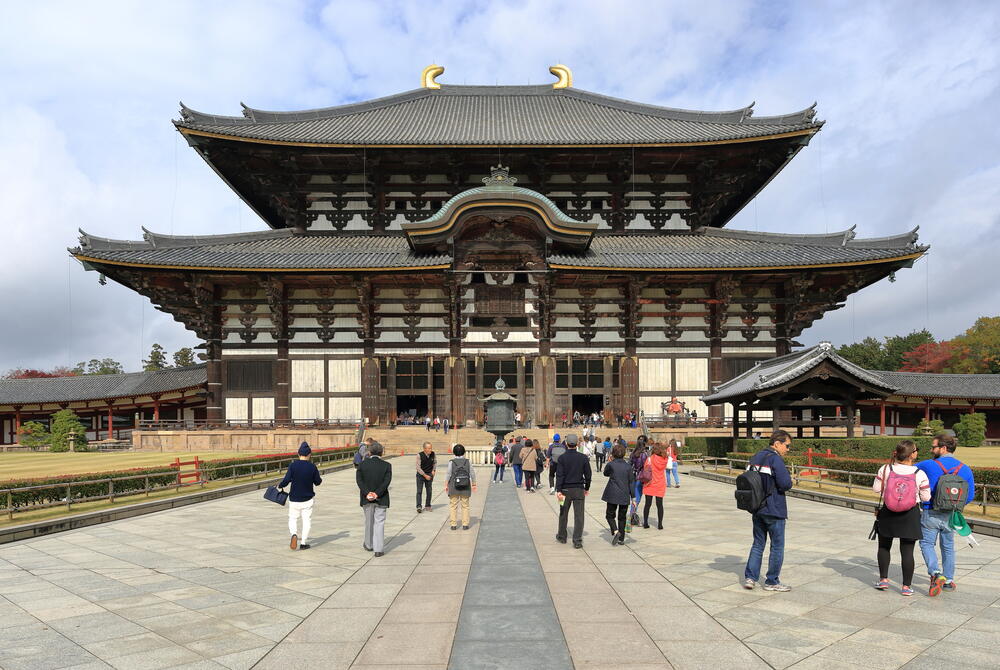 Martin Falbisoner (CC BY-SA 4.0)
The Great Buddha Hall of Todai-ji in Nara
Osaka
- Dotonbori: best after dark; free to walk; the neon signs and canal-side food stalls
- Osaka Castle: 1.5 to 2 hours for the grounds and keep
- Universal Studios Japan: a full day; book tickets online ahead of a visit
- Plan it: 3-day Osaka itinerary
Osaka's liveliest stretch after dark is Dotonbori, a canal-side strip of oversized signs with the running Glico man among them. Takoyaki stalls sell octopus-filled batter balls from open windows along the street. Osaka Castle's current keep, raised in ferroconcrete in 1931 on the site's original stone foundations, survived bombing damage in World War II. The moat and park around it are big enough for a full afternoon away from the crowds.
Universal Studios Japan, on the western edge of the city, draws enough visitors on its own that same-day tickets can sell out, especially around school holidays. Osaka's reputation as Japan's food capital shows up in Dotonbori's density of restaurants more than in any single sight.
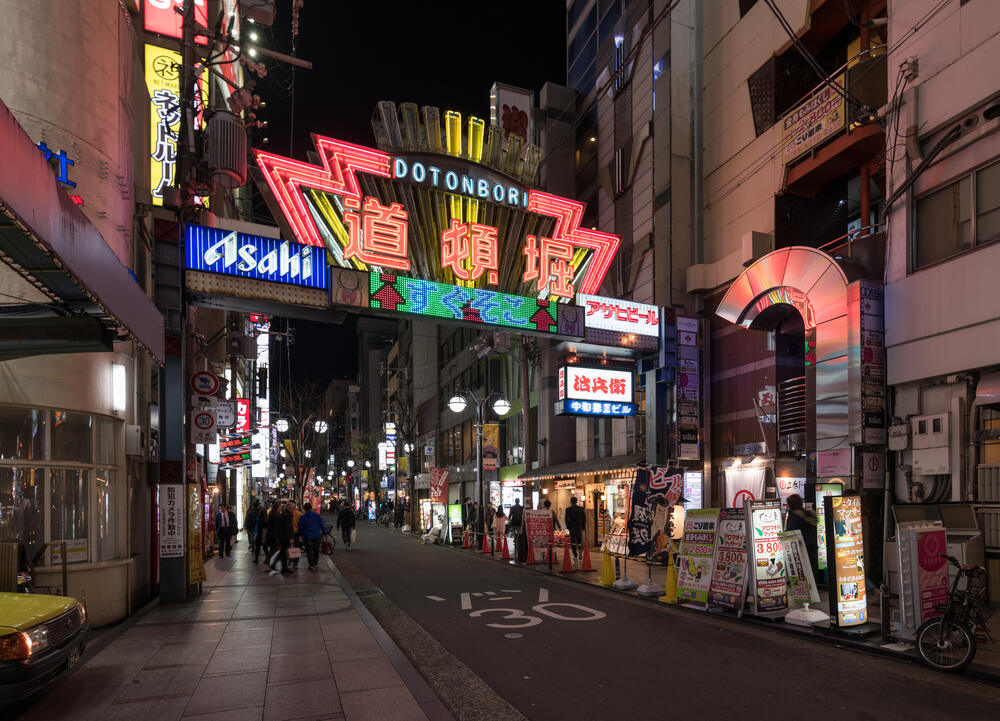 DXR (CC BY-SA 4.0)
Neon signs along the Dotonbori canal at night
Okinawa
- Shuri Castle: 1 to 1.5 hours; UNESCO (Gusuku Sites and Related Properties of the Kingdom of Ryukyu, 2000); the main hall, lost to fire in 2019, is being rebuilt with completion set for November 2026
- Churaumi Aquarium: 2 to 3 hours; the Kuroshio Sea tank holds whale sharks
- Emerald Beach, Motobu: a half day; inside Ocean Expo Park, the same grounds as the aquarium
- Plan it: 7-day Japan itinerary
Okinawa's main island carries a history separate from the rest of Japan: it was the independent Ryukyu Kingdom until its annexation in 1879. Shuri Castle was that kingdom's royal seat, and fire has destroyed it five times, most recently in 2019; its red-lacquered main hall is due to reopen with a completion ceremony in November 2026. The architecture, red tile roofs and dragon motifs among them, reads closer to a blend of Chinese and Japanese styles than to a mainland castle.
The Churaumi Aquarium's Kuroshio Sea tank held the world's largest aquarium tank title until 2005, and still holds whale sharks swimming alongside manta rays behind a single wall of glass. Emerald Beach, inside the same Ocean Expo Park, gives visitors a stretch of the white sand and turquoise water Okinawa is known for without leaving the park grounds.
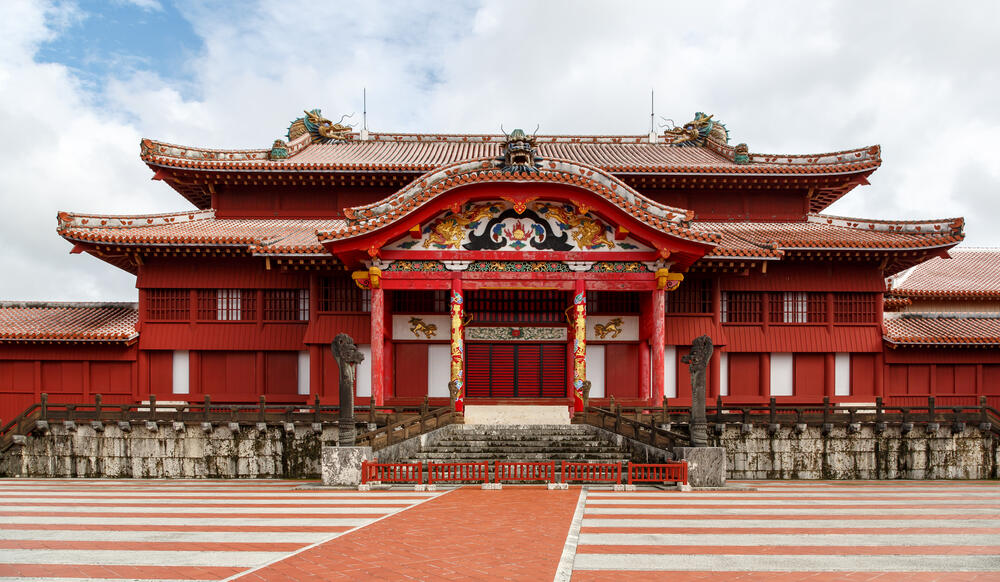 CEphoto, Uwe Aranas (CC BY-SA 3.0)
Shuri Castle's main palace building in Naha
Shirakawa-go
- Gassho-zukuri farmhouses: some more than 250 years old; built without a single nail; UNESCO (Historic Villages of Shirakawa-go and Gokayama, 1995)
- Observation deck: a short uphill walk for the overview photo of the whole village
- Plan it: 7-day Japan itinerary
Shirakawa-go's steep, thatched gassho-zukuri roofs were built to shed the region's heavy snowfall and to free up attic space for raising silkworms, a trade the village depended on for generations. Some of the farmhouses standing in Ogimachi, the village's main cluster, are more than 250 years old and were assembled entirely without nails.
A handful of the farmhouses now take overnight guests, who get the village's narrow lanes to themselves once the day-trip buses leave in the late afternoon. The short climb to the observation deck above Ogimachi gives the postcard view down over the thatched roofs and the Sho River valley around them.
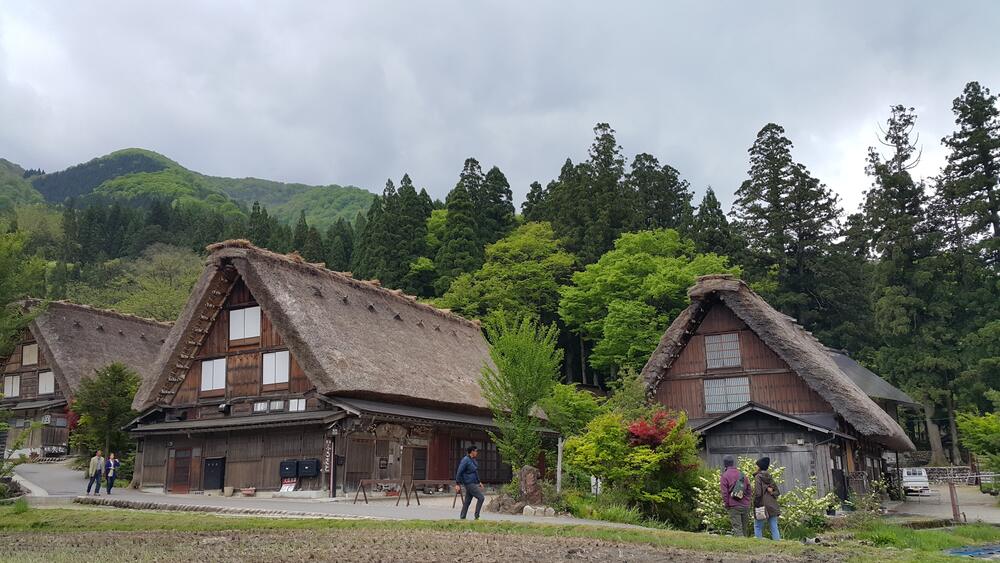 Chainwit. (CC BY 4.0)
An overview of Shirakawa-go's gassho-zukuri village
Hakone
- Lake Ashi: a sightseeing cruise passes the Hakone Shrine torii, with Mount Fuji visible on clear days
- Owakudani: a volcanic valley reached by ropeway; the black eggs boiled in its sulfurous water are said to add seven years to your life
- Hakone Open-Air Museum: 2 to 3 hours; more than 100 sculptures outdoors, plus a Picasso pavilion
- Plan it: 5-day Tokyo itinerary
Lake Ashi sits in the crater of Mount Hakone, a volcano that last erupted in 1170 CE at Owakudani, the same valley the Hakone Ropeway crosses on its way up. A sightseeing boat crosses the lake past the red torii of Hakone Shrine, framed by Fuji on a clear day. Owakudani still vents sulfurous steam, and a roadside stall there sells eggs boiled black in the hot spring water.
The Hakone Open-Air Museum spreads more than 100 sculptures by Henry Moore and other artists across its hillside grounds, with a dedicated pavilion for Picasso's work indoors. Most visitors cover Hakone as a loop by train, ropeway and boat rather than backtracking the same route twice.
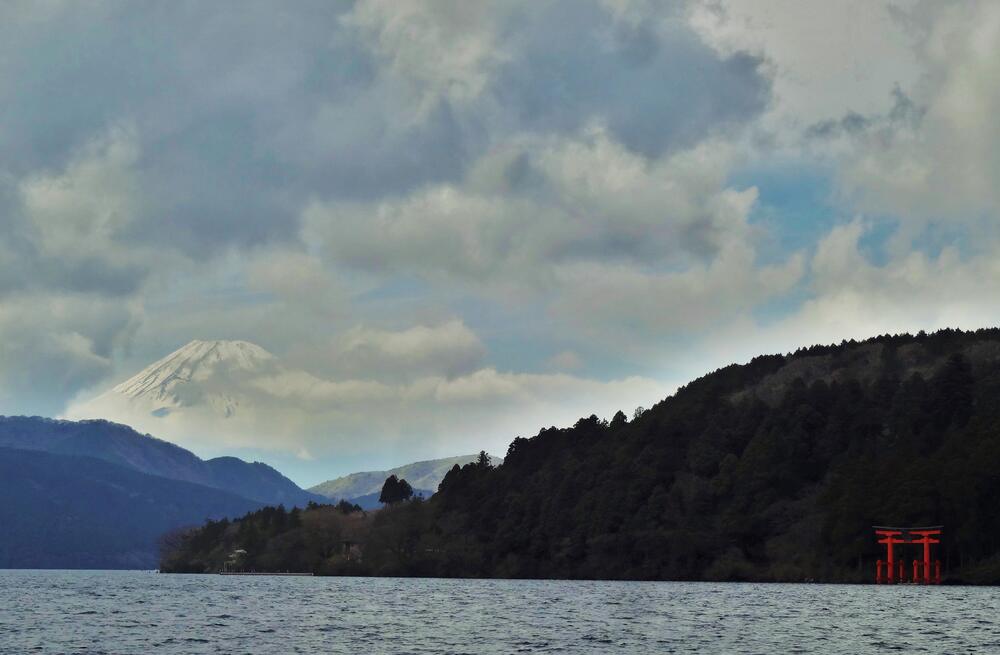 WorldContributor (CC BY-SA 4.0)
Mount Fuji and the Hakone Shrine torii seen from Lake Ashi
Sapporo and Hokkaido
- Odori Park: the mile-long green belt through Sapporo's center; site of the Sapporo Snow Festival
- Sapporo Clock Tower: 20 to 30 minutes; a 19th-century wooden landmark
- Niseko and Furano: Niseko for powder skiing in winter, Furano's Farm Tomita for lavender fields in July
- Plan it: 7-day Japan itinerary
Sapporo anchors Hokkaido the way Tokyo anchors Honshu. A wooden 19th-century clock tower still stands downtown, and Odori Park runs through the city center as both a public square and the main site of the winter Snow Festival. Hokkaido's biggest draws, though, sit outside the city.
Niseko, a couple of hours away, holds some of the most reliable powder snow in Japan and draws skiers from well beyond the country each winter. Furano switches seasons entirely: by July, Farm Tomita's rows of lavender turn the hills around the town purple, drawing a different crowd than Niseko's does in January.
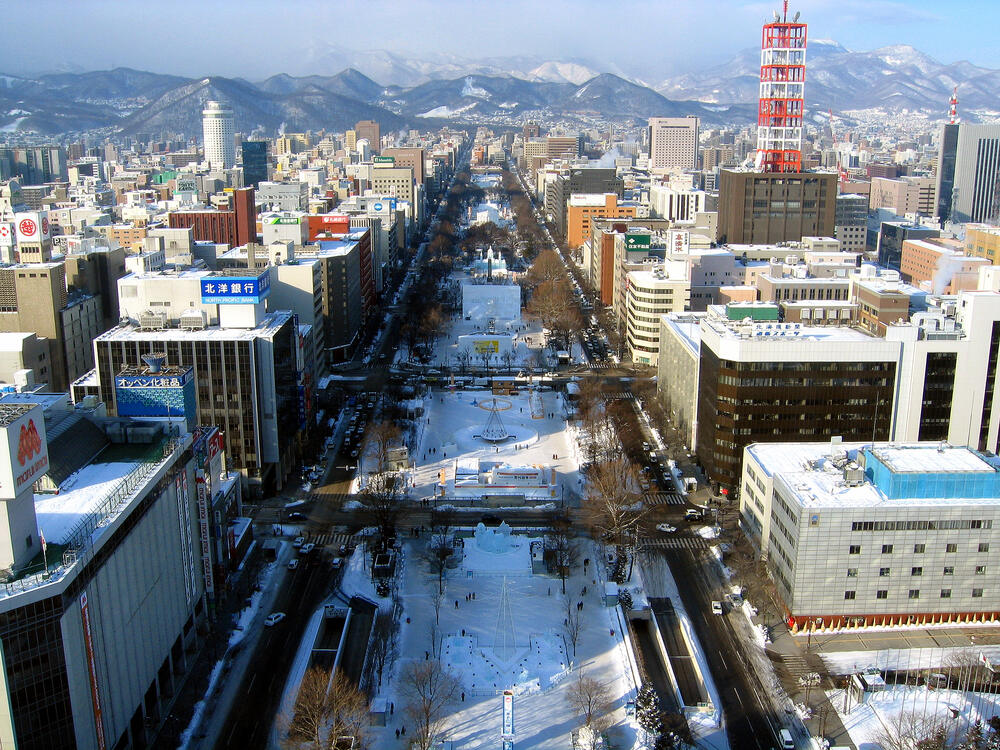 Nkns (CC BY-SA 3.0)
Odori Park in central Sapporo
Naoshima
- Benesse House: a hotel and museum in one building, designed by Tadao Ando
- Chichu Art Museum: JPY 2,500 online on weekdays (JPY 2,800 on-site), JPY 2,700 online on weekends and holidays; free for ages 15 and under; permanent works by Claude Monet, James Turrell and Walter De Maria
- Getting there: by ferry from Uno or Takamatsu; check return times before heading out for the day
- Plan it: 7-day Japan itinerary
Naoshima was a quiet island on the edge of becoming a ghost town before the Benesse Art Site turned it into a center for contemporary art. Yayoi Kusama's giant polka-dot pumpkin sculptures are now the island's unofficial mascots. Tadao Ando designed several of the buildings that followed, Benesse House and the Chichu Art Museum among them, both built to work with the island's coastline rather than against it.
The Chichu Art Museum sits mostly below ground so its construction wouldn't disturb the Seto Inland Sea view above it. Natural light still shifts the mood of its Monet water-lily room through the day. Ferries to Naoshima run from Uno on the mainland and from Takamatsu on Shikoku, and the island is small enough to cross most of it by bicycle in an afternoon.
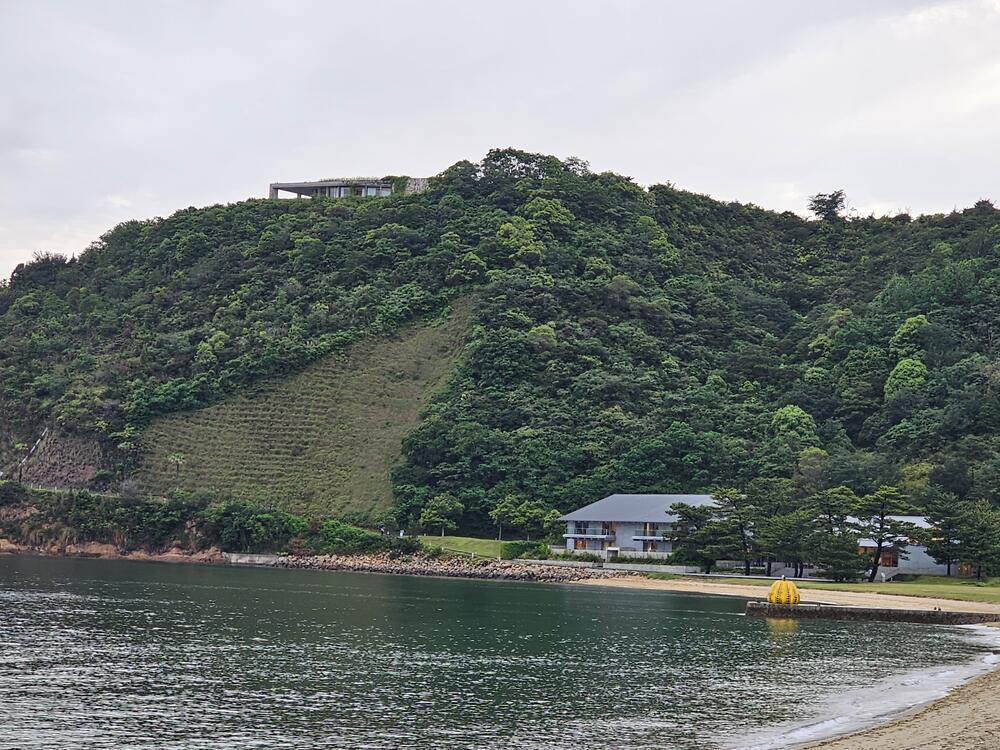 Renate Hano (CC BY-SA 4.0)
Benesse House Museum on Naoshima, seen from the sea
Himeji
- Himeji Castle: half a day; UNESCO (Himeji-jo, 1993); also called Shirasagi-jo, the White Heron Castle, for its shape
- Getting there: a direct train from Osaka or Kyoto, under an hour
- Plan it: 7-day Japan itinerary
Himeji Castle survived the World War II air raids that leveled much of the surrounding city, and it has been a UNESCO World Heritage Site since 1993. Its white plastered walls and stacked, curving roof lines earned it the nickname Shirasagi-jo, the White Heron Castle, for its resemblance to a bird about to take flight.
A renovation completed in 2015 restored the keep's white walls to something closer to their original brightness, and visitors can now walk through the interior's steep wooden staircases up to the top floor. The castle is close enough to both Osaka and Kyoto for a half-day trip without an overnight stay.
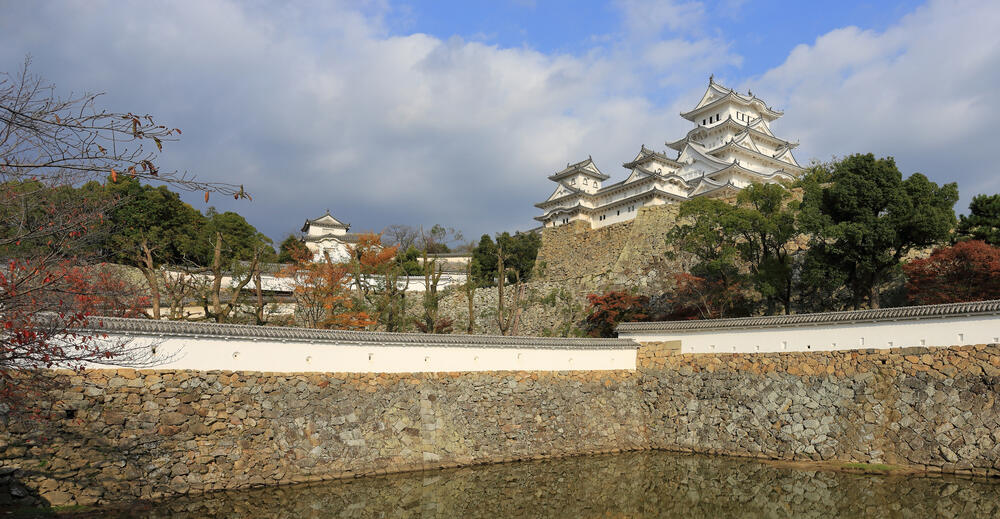 Martin Falbisoner (CC BY-SA 4.0)
Himeji Castle's main keep
Ishigaki and the Yaeyama Islands
- Kabira Bay: glass-bottom boat tours over coral and turquoise water; swimming is not allowed in the bay itself
- Yonehara Beach: a swimming beach, quieter than Kabira Bay
- Taketomi Island: a short ferry from Ishigaki; traditional Ryukyuan houses and sand-covered lanes
- Plan it: 7-day Japan itinerary
Ishigaki is the gateway to the Yaeyama Islands, Okinawa prefecture's farthest-flung chain, known for beaches pale enough and water clear enough that snorkelers can see fish without putting a mask on. Kabira Bay is the group's best-known stop, its mix of coral and current making swimming off-limits but a glass-bottom boat tour the standard way to see it.
Taketomi Island, a short ferry ride from Ishigaki's port, keeps its traditional red-tile Ryukyuan houses and coral-sand streets largely intact. The wider Yaeyama Islands hold some of Japan's most reliable diving, reef and current conditions that draw divers back year after year.
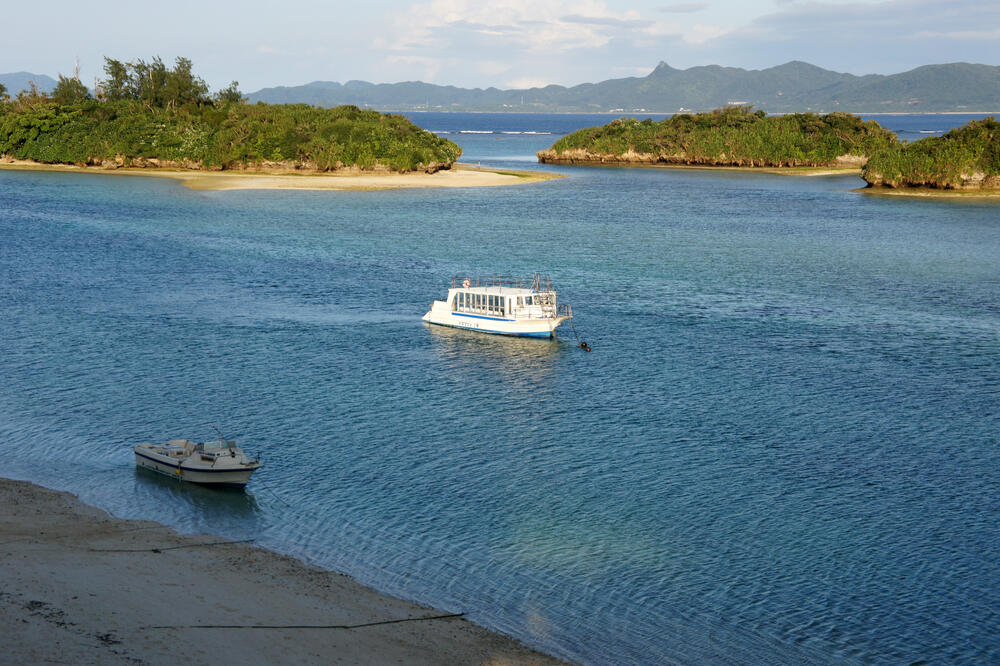 663highland (CC BY 2.5)
Kabira Bay on Ishigaki Island
Nikko
- Toshogu: 1.5 to 2 hours; the mausoleum of shogun Tokugawa Ieyasu; UNESCO (Shrines and Temples of Nikko, 1999)
- Kegon Falls: a 318-foot drop, reached by an elevator down to the viewing platform
- Plan it: 5-day Tokyo itinerary
Nikko's Toshogu, the mausoleum built for shogun Tokugawa Ieyasu, carries far more carved and gilded detail than most Japanese shrines, down to the dense carving covering the Yomeimon gate. A small panel on one of the shrine's stable buildings carves three monkeys covering their eyes, ears and mouth. The carving is the origin of the "see no evil, hear no evil, speak no evil" image known well beyond Japan.
Kegon Falls, a short trip from the shrine complex, drops about 318 feet into a gorge below Lake Chuzenji. An elevator carries visitors down to a platform at its base for the full-height view. Nikko works as a long day trip from Tokyo or an overnight stop paired with a soak in one of the hot-spring towns nearby.
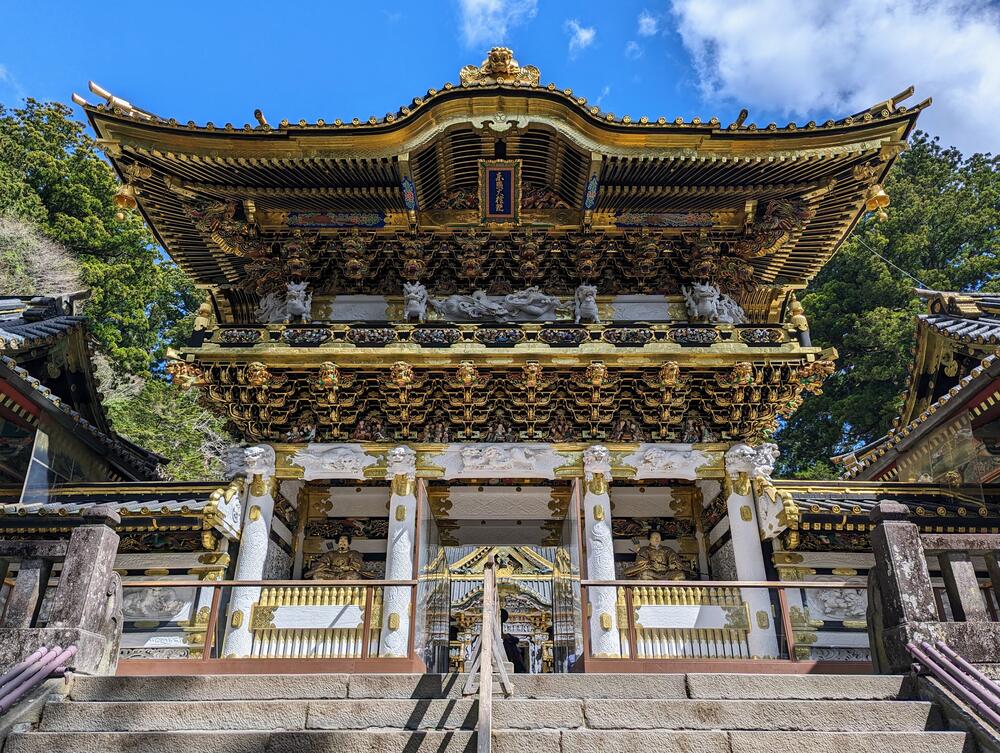 Jpatokal (CC BY-SA 4.0)
The Yomeimon gate at Nikko Toshogu
Things to do across Japan
Soak in an onsen and stay in a ryokan
- Where: hot-spring towns nationwide, from Hakone and Kusatsu to Beppu and Kurokawa Onsen
- Tattoo policy: many onsen and public bathhouses still turn away visible tattoos; a private onsen booked through a ryokan sidesteps the rule
- Best paired with: a ryokan stay, which usually includes a kaiseki dinner and breakfast
An onsen town built its whole rhythm around the bath: check in by late afternoon, change into the inn's cotton yukata, and soak before and after a kaiseki dinner served in courses. A ryokan room swaps the hotel-room layout for tatami mats and a futon laid out while you're at dinner, which is as much the experience as the bathing is.
Tattoo policies catch first-time visitors off guard most often. Many onsen and sento still turn away visibly tattooed guests, a holdover rule meant to keep out organized-crime members who traditionally wore them. Booking a ryokan room with its own private bath is the easiest way around it.
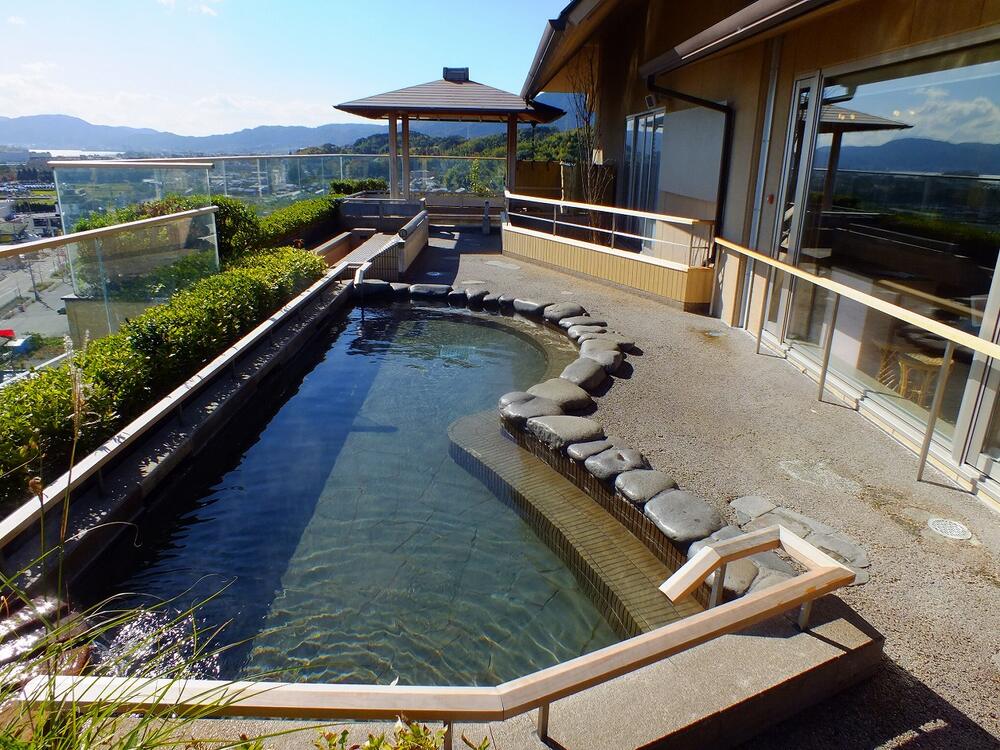 イーゴス108 (CC BY-SA 3.0)
An outdoor onsen bath, or rotenburo
See cherry blossoms and autumn leaves
- Cherry blossoms (sakura): peak timing shifts by region and year; Tokyo and Kyoto's parks fill fast once the first blooms open
- Autumn leaves (koyo): mid-November in Kyoto, when temples such as Ryoan-ji and Nanzen-ji light their maple trees in the evening
- Where to watch for either: Yoyogi Park and Ueno Park in Tokyo; the temple gardens of eastern Kyoto
Cherry blossom season turns Tokyo's Yoyogi Park into a weekend-long picnic under pink canopies, the trees' bloom window lasting barely a week or two before the petals fall. Kyoto's version runs quieter, its temple gardens built with trees chosen generations ago for exactly this moment.
Autumn flips the same calendar: by mid-November, Kyoto's maples turn red and gold around temples like Ryoan-ji and Nanzen-ji, some lit for evening viewing on a fixed schedule each year. Either season means booking accommodation well ahead, since both pull crowds that rival Golden Week.
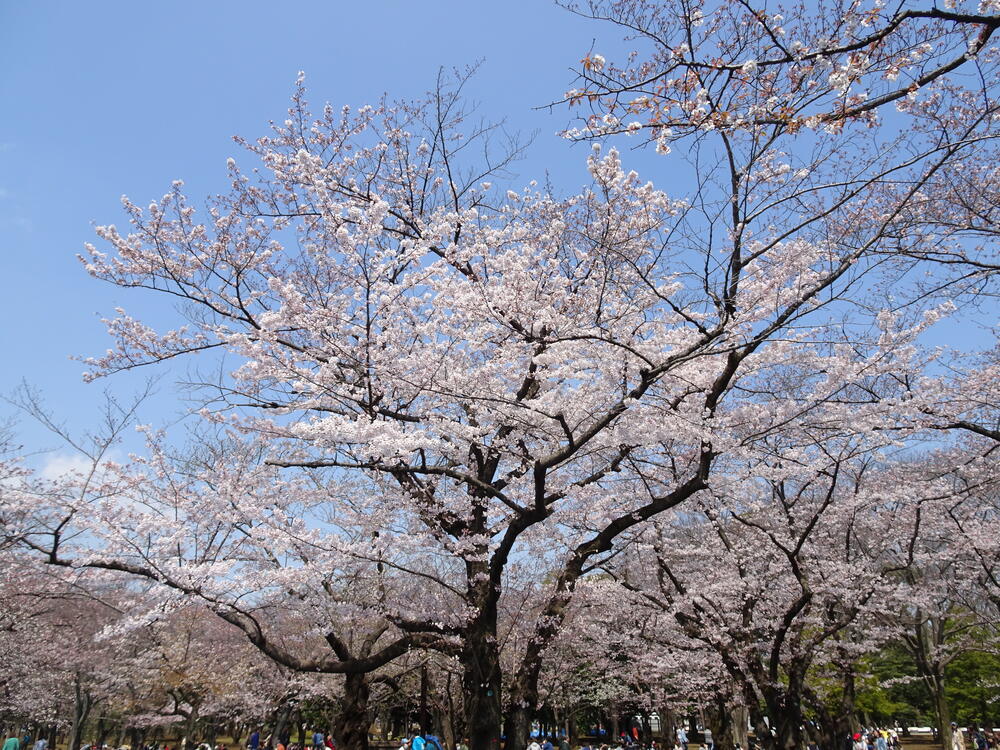 ウィキ太郎 (Wiki Taro) (CC0)
Cherry blossoms in Yoyogi Park, Tokyo
Ski powder snow in Hokkaido and Nagano
- Niseko, Hokkaido: some of the most reliable powder snow in Japan; a winter-only season
- Nozawa Onsen, Nagano: a ski village built around its own hot springs
- Best months: December through February for the deepest snow
Niseko's slopes draw skiers from well outside Japan for snow reliable enough that a lean year elsewhere barely registers there, and the resort town around it has grown an international apres-ski scene to match. Nagano's Nozawa Onsen takes a different approach, wrapping its runs around a traditional hot-spring village where skiers soak in public bathhouses between days on the mountain.
Both regions get their heaviest snowfall from December through February, and both sit close enough to an airport or shinkansen line to reach inside a single travel day from Tokyo.
 MIKI Yoshihito from Sapporo City (CC BY 4.0)
Skiers on the slopes near Niseko, Hokkaido
Watch a sumo tournament
- Where: the Ryogoku Kokugikan in Tokyo, plus tournaments in Osaka, Nagoya and Fukuoka through the year
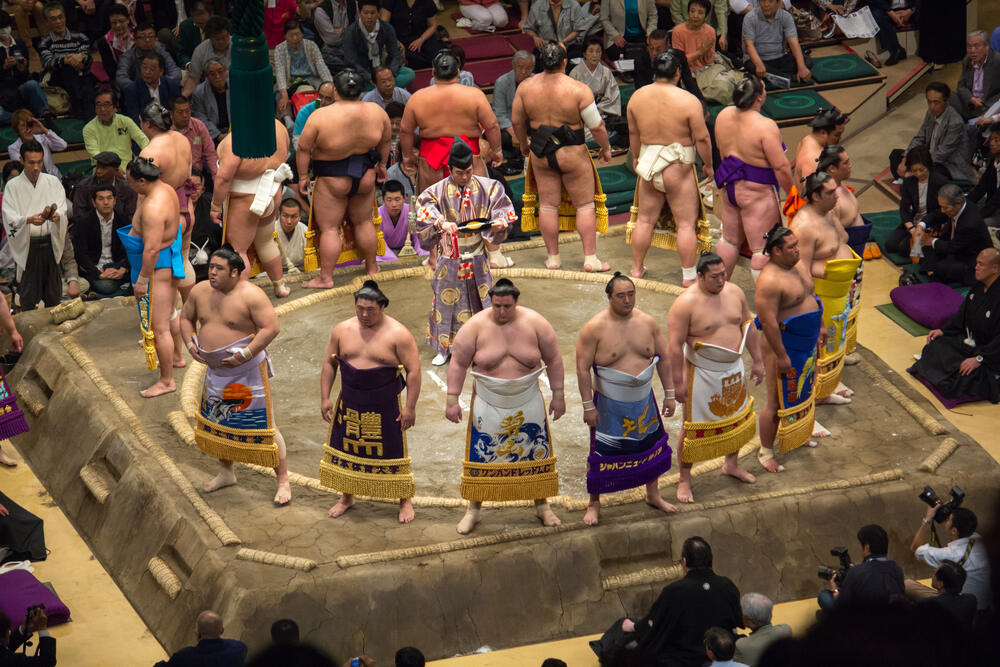
- What happens first: a ring-entering ceremony (dohyo-iri) before the top-division bouts begin
- Tickets: sold both in advance and, in limited numbers, at the venue on the day
A sumo tournament opens with the dohyo-iri, the top-ranked wrestlers filing into the ring in ceremonial aprons before the bouts themselves, which are usually over within seconds of the two wrestlers making contact. The Ryogoku Kokugikan hosts three of the year's six official tournaments; the other three rotate through Osaka, Nagoya and Fukuoka.
Seats close to the ring sell out first and cost more, but the cheaper upper-level seats still give a clear view of the dohyo and the ceremony around it.
 Simon Q (CC BY 2.0)
Wrestlers performing the dohyo-iri ring-entering ceremony
Climb Mount Fuji
- Season: ends every year on September 10; mountain huts, rescue stations and cell service on the upper trails close with it
- Main route: the Yoshida Trail, with mountain huts along the way for an overnight stop before a sunrise summit
- Why time it for sunrise: most climbers aim to reach the top, or close to it, for goraiko, the sunrise seen from above the clouds
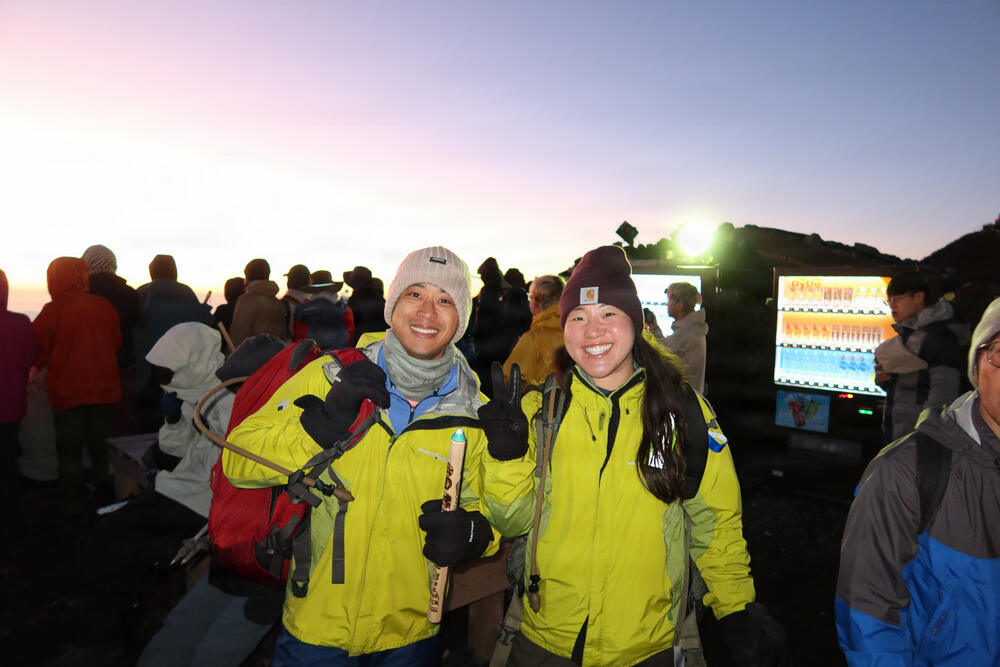
Most climbers start in the afternoon or evening and sleep a few hours in a mountain hut partway up the Yoshida Trail. From there, they push for the summit before dawn to catch goraiko, the sunrise that gives the climb its reputation. Mount Fuji's official climbing website is blunt about the alternative: climbing outside the short official season is dangerous. The huts, rescue stations and phone signal that make the climb survivable all shut down for the winter once the season ends.
The season itself runs only a few months a year and always closes on September 10, regardless of weather, which makes it one of the few Japan travel dates worth building an entire trip around.
 U.S. Navy photo by Sheryl Sullivan (Public domain)
Climbers near the summit of Mount Fuji at sunrise
Dive or snorkel off Okinawa and Ishigaki
- Where: the Kerama Islands and Yaeyama Islands, including Ishigaki and Kabira Bay
- What's in the water: coral reefs, manta rays and hammerhead sharks, migrating whales in winter
- Watch for typhoons: the season runs roughly June through November and can disrupt inter-island ferries and flights with little notice
Okinawa's reefs sit far enough south that the water stays warm for most of the year, with the Kerama Islands a short boat ride from Naha for a day trip. The Yaeyama Islands, Ishigaki's own chain, add manta ray and hammerhead sightings to the reef diving most visitors come for.
Snorkelers can see as much from the surface as divers do a few meters down in spots like Kabira Bay. The coral there starts close enough to shore that a mask and fins are the only gear most people need.
 そらみみ (CC BY-SA 4.0)
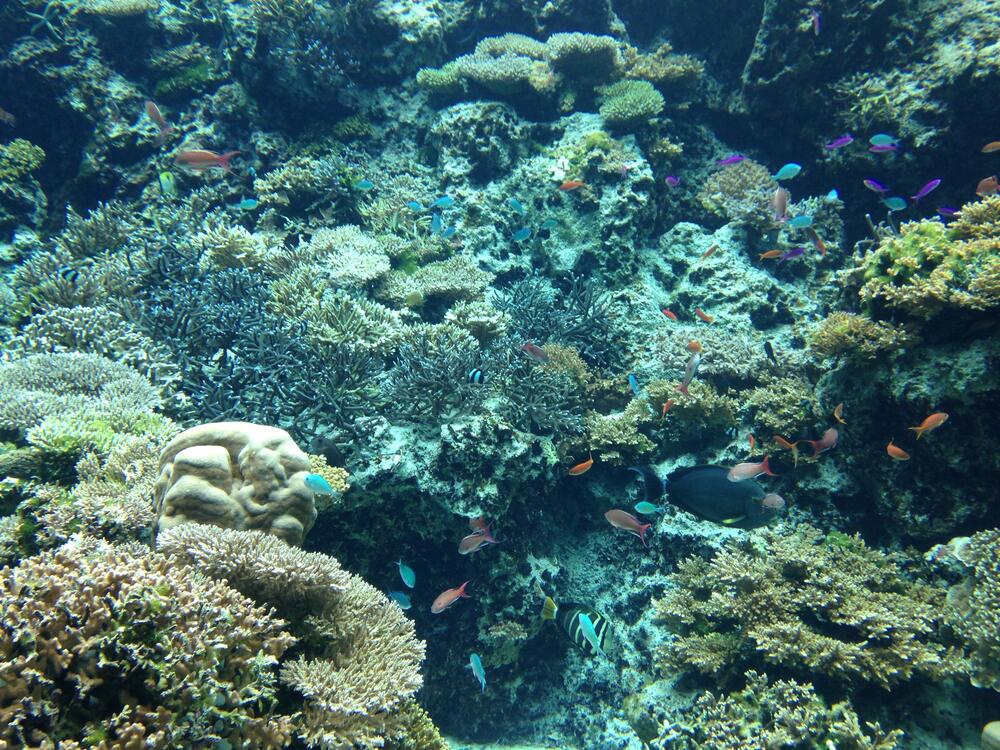
Coral in the Okinawa Churaumi Aquarium's tanks
Ride the Shinkansen
- Tokyo to Kyoto: 2 hours 24 minutes on the fastest timetabled Tokaido Shinkansen service
- Best seat for Mount Fuji: a right-hand window seat heading from Tokyo toward Osaka, on the stretch around Shin-Fuji station
- Reserve ahead: seats sell out on peak travel dates, especially around Golden Week and Obon
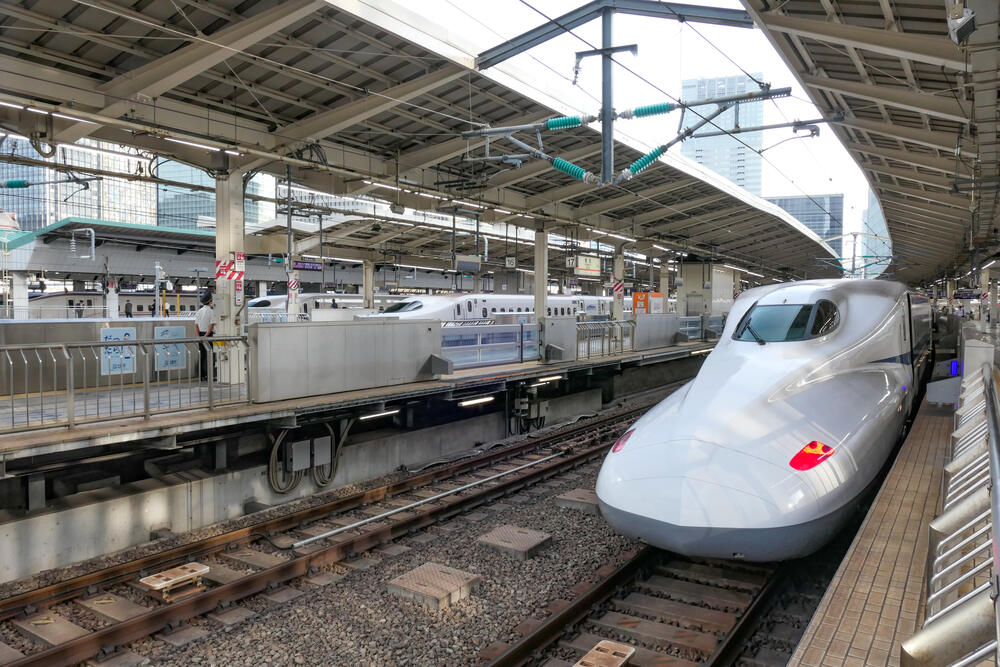
The Tokaido Shinkansen covers Tokyo to Kyoto in 2 hours 24 minutes on its fastest service, quick enough that it often beats flying once airport transfers are counted. A right-hand window seat heading toward Osaka gives the best chance at Mount Fuji on a clear day, with the mountain closest to the tracks around Shin-Fuji station.
Reserved seats cost a little more than unreserved ones but guarantee a spot, which matters most around Golden Week and Obon. Trains run full on both, and standing passengers fill the aisles of even the unreserved cars.
 MaedaAkihiko (CC BY-SA 4.0)
An N700 Shinkansen train waiting at a platform in Tokyo Station
Sleep in a capsule hotel
- What you get: a single stacked pod with a bed, light and power outlet; shared bathrooms and lockers down the hall
- Where they cluster: near major train stations in Tokyo and Osaka
- Good for: a cheap one- or two-night stop, not a full week
A capsule hotel room is a pod barely bigger than the mattress inside it, stacked two rows high along a corridor, with a curtain or hatch instead of a door. Everything else, luggage storage, bathrooms, sometimes a bath or sauna, sits in shared space down the hall, closer to a hostel's layout than a hotel's.
The format started in Osaka in the late 1970s and spread to station neighborhoods across the country, where it still works best as a low-cost night or two rather than a full stay.
Try free
Plan your Japan trip in about 2 minutes
Tap through 8 quick cards for a complete itinerary with budget, maps, and packing lists. No account required.
Plan your Japan trip →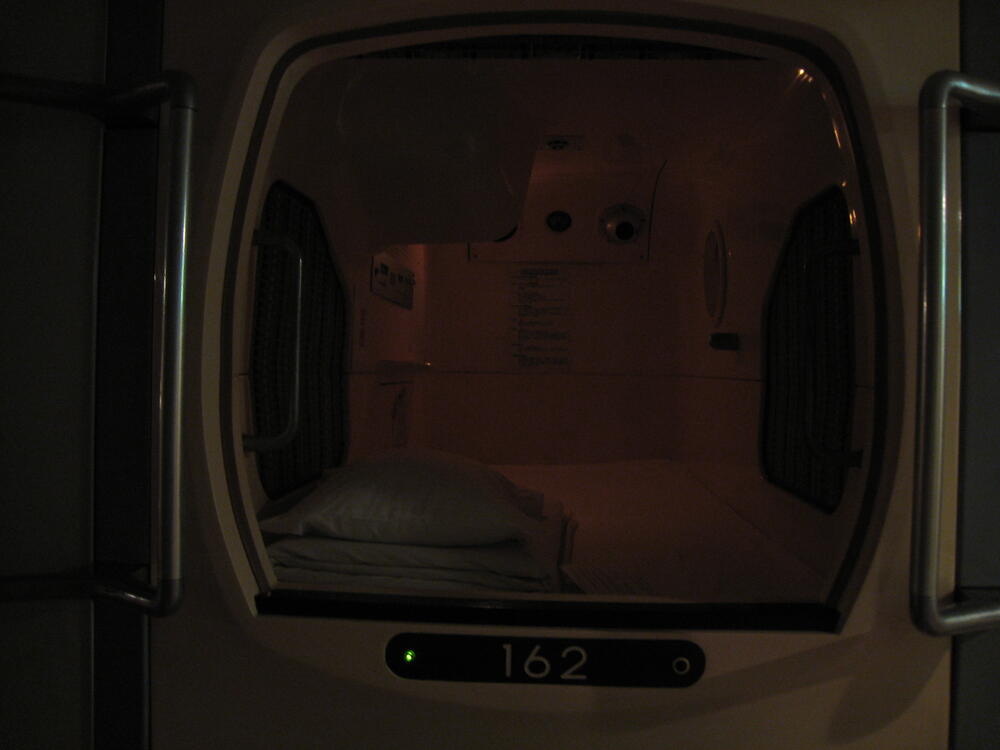 Syced (CC0)
Stacked capsule hotel pods in Osaka
More places to add to a trip
| Place | Go for | Region | UNESCO |
|---|---|---|---|
| Kamakura | the Great Buddha at Kotoku-in, temples, a beach town feel | Kanagawa | no |
| Koyasan | a mountaintop temple complex; overnight stays in working temples | Wakayama | yes (2004) |
| Takayama | a preserved Edo-period old town, paired with Shirakawa-go | Gifu | no |
| Nagasaki | a port city shaped by WWII history and early Christian contact | Nagasaki | yes (2018) |
| Yakushima | ancient cedar forests, said to have inspired Studio Ghibli's forests | Kagoshima | yes (1993) |
| Uji | the center of Japan's matcha tea production, near Kyoto | Kyoto | no |
| Matsumoto | one of Japan's few original wooden castle keeps | Nagano | no |
| Kumano Kodo | pilgrimage trails through the Kii Mountains | Wakayama | yes (2004) |
Day trips from Tokyo, Kyoto and Osaka
| Base | Day trips |
|---|---|
| Tokyo | Kamakura, Nikko, Hakone |
| Kyoto | Nara, Uji, Osaka |
| Osaka | Himeji, Nara, Kobe |
The best places to visit in Japan at a glance
| Place | Go for | Book ahead |
|---|---|---|
| Tokyo | Senso-ji, Shibuya Crossing, teamLab, the Ghibli Museum | Ghibli Museum |
| Kyoto | Fushimi Inari Taisha, Kinkaku-ji, Arashiyama Bamboo Grove | no |
| Hiroshima | the Peace Memorial Park and Museum, Miyajima's floating torii | no |
| Mount Fuji and the Fuji Five Lakes | Chureito Pagoda, Lake Kawaguchiko, the climbing season | permits in peak climbing season |
| Kanazawa | Kenroku-en, the Higashi Chaya teahouse district | no |
| Nara | Todai-ji's Great Buddha, Nara Park's free-roaming deer | no |
| Osaka | Dotonbori, Osaka Castle, Universal Studios Japan | Universal Studios Japan |
| Okinawa | Shuri Castle, the Churaumi Aquarium, Emerald Beach | no |
| Shirakawa-go | the gassho-zukuri farmhouse village | no |
| Hakone | Lake Ashi, Owakudani, the Open-Air Museum | no |
| Sapporo and Hokkaido | Odori Park, Niseko's powder snow, Furano's lavender | no |
| Naoshima | Benesse House, the Chichu Art Museum | ferry timing to the island |
| Himeji | Himeji Castle | no |
| Ishigaki and the Yaeyama Islands | Kabira Bay, diving, Taketomi Island | no |
| Nikko | Toshogu, Kegon Falls | no |
Plan your Japan trip
Start with the Japan travel guide for trip length, getting around and costs. A trip built with MonkeyEatingMango adds a booking checklist for what to reserve and how far ahead, plus a Must-do, Maybe or Skip if tired tag on every sight in the day plan. Set your own route and dates on the trip planner.
Common questions
What are the best things to do in Japan?
Walking Kyoto's Fushimi Inari Taisha and Arashiyama Bamboo Grove, soaking in an onsen, and crossing Tokyo's Shibuya Crossing top most Japan trip lists. Hiroshima's Peace Memorial Park and a night in a ryokan round out a typical first trip.
What is the best place to visit in Japan?
Tokyo and Kyoto are the two places most trips build around. Tokyo covers the modern city: Shibuya, Shinjuku and Akihabara. Kyoto covers the temples, shrines and gardens that define traditional Japan.
Where should I go in Japan for the first time?
A first trip to Japan usually pairs Tokyo with Kyoto, often with Osaka or Hiroshima added on. Those three cities and Hiroshima hold most of the country's best-known sights, from Shibuya Crossing to Fushimi Inari Taisha and the Peace Memorial Park.
Do I need to book the Ghibli Museum in advance?
Yes, for the Ghibli Museum. The Mitaka museum sells advance-reservation tickets only, with no tickets sold at the door. Fushimi Inari Taisha needs no ticket at any hour, but it is busiest at midday and quietest after dark, so timing a visit around that crowd pattern is worth planning for.
What are the best day trips from Tokyo?
Kamakura, Nikko and Hakone are the classic day trips from Tokyo. Kamakura holds the Great Buddha at Kotoku-in, Nikko has the Tokugawa shrine complex at Toshogu, and Hakone combines Mount Fuji views with hot springs.
What are the best day trips from Kyoto?
Nara, Uji and Osaka are the standard day trips from Kyoto, all under an hour away by train. Nara has Todai-ji's Great Buddha and its free-roaming deer, Uji is the center of Japan's matcha tea production, and Osaka adds Dotonbori's food streets.
Is Hokkaido or Okinawa worth a separate trip from the rest of Japan?
Yes. Hokkaido and Okinawa sit far enough from Tokyo and Osaka, by flight time, that both work better as their own trip than as a side trip bolted onto a Honshu itinerary. Hokkaido draws visitors for winter powder skiing and summer lavender fields; Okinawa draws them for beaches and diving.
How many UNESCO World Heritage Sites does Japan have?
Japan has 27 UNESCO World Heritage Sites: 22 cultural and 5 natural. Himeji Castle, the Hiroshima Peace Memorial, the historic monuments of Kyoto and Nara, and Mount Fuji are among them.
When is Mount Fuji's climbing season?
Mount Fuji's official climbing season ends every year on September 10. Outside that window, the mountain huts and rescue stations close and cell service on the upper trails disappears, which is why the official climbing website calls climbing outside the season dangerous.
Can I visit an onsen if I have a tattoo?
Many onsen and public bathhouses in Japan still turn away visitors with visible tattoos, a rule with roots in keeping out organized-crime members who traditionally wore them. Some ryokan get around this by offering a private onsen you can book for just your own group, which sidesteps the policy entirely.
Is Shirakawa-go worth the trip to see?
Yes. Shirakawa-go's gassho-zukuri farmhouses, some over 250 years old and built without a single nail, are a UNESCO World Heritage Site found nowhere else in Japan in this concentration. Their steep thatched roofs were designed to shed heavy snow and to create attic space for raising silkworms.

Written by Shobhit Shrivastava · Founder
Related reading
Japan travel guide
A Week in Japan: Tokyo and Kyoto, from teamLab to Kinkaku-ji
7 days across Kyoto and Tokyo. Begin with 3 nights in Kyoto (Fushimi Inari, Kiyomizu-dera, Arashiyama Bamboo Grove, based in Higashiyama), then ride the Shinkansen to Tokyo for 4 nights (Shibuya Crossing, Tsukiji Outer Market, teamLab Planets, Asakusa). Packed pace with 4-5 activities daily,...
Osaka in 3 Days: Dotonbori and Osaka Castle
3 days in Osaka: focus on the food and nightlife districts of Namba and Dotonbori, with a dedicated day for the modern installations at teamLab Botanical Garden. This trip uses a central Namba base to keep transport simple. Expect a packed pace with 4-5 activities daily, balancing neon-lit...
Tokyo in 3 Days: Sensō-ji, Shibuya Crossing and More
This packed 3-day Tokyo journey for a couple delves into contrasting districts, blending traditional spiritual sites like Sensō-ji Temple in Asakusa with the cutting-edge digital art of teamLab Planets TOKYO. Explore the iconic Shibuya Crossing, enjoy a performance at Kabuki-za Theatre, and...
5 Days in Tokyo: Senso-ji, Tsukiji Market and the Tokyo Skytree
5 days exploring Tokyo's diverse character through food, spiritual sites, and local culture. Experience the historic Senso-ji Temple and Meiji Jingu, browse the vintage shops of Shimokitazawa, and dine at Tsukiji Outer Market. Maintain a comfortable pace with one neighborhood focus per day and...
Things to Do in Scotland and the Best Places to Visit
Where to go in Scotland: Edinburgh and the Lothians, Glasgow and the central belt, the Highlands, the islands, and the whisky-region choice no single answer settles. Every stop carries its top sights, the official price where one exists, and what to book ahead.
Things to Do in Ireland and the Best Places to Visit
Where to go in Ireland by region, from Dublin to Northern Ireland. Every stop carries its top sights, the official price where one exists, and what to book ahead.
Things to Do in Croatia and the Best Places to Visit
Where to go in Croatia by region: Split, Dubrovnik and the Dalmatian islands, Istria and the Kvarner coast, Zagreb and the national parks. Every stop carries its top sights, the official price where one exists, and what to book ahead.