What should you buy in Thailand, and what can you actually bring home to the US? Buy what Thailand makes best: silk from a Jim Thompson shop, a sealed packet of curry paste, cold-pressed coconut oil, and herbal balms and compress balls from a Thai pharmacy or market. Silk and sealed curry paste clear US customs easily; declare the dried-herb and plant items, since an inspector makes the final call but won't penalize you for declaring something they turn away. A Buddha image or a genuine antique can't leave Thailand at all without a Fine Arts Department export permit.
- Buy silk and spices first. Jim Thompson sells Thai silk nationwide, and Big C, Makro and Lotus's all stock sealed curry paste.
- Declare liquids and plant-based buys. Pack any liquid over 3.4 ounces in your checked bag, and declare wood or dried-plant items, carvings and compress balls included.
- Skip the "government gem sale." No such sale exists; buy jewelry at a department store counter or a certified dealer instead.
Thai silk and curry paste
Thai silk
Must-buy
- From: Bangkok's Jim Thompson, sold at its shops nationwide; mudmee silk from Khon Kaen and Surin in the northeast
- Buy it at: any Jim Thompson shop, found throughout the country
- Look for: the resist-dyed mudmee pattern for the northeastern regional style
- Price: ฿800 for a scarf, ฿3,000 a meter for high-quality fabric
- Can it fly home to the US? Yes: CBP sets no limit on fabric and clothing bought for personal use or as gifts.
Scrunch a corner of Thai silk before you pay for it. Real silk feels cool at first, carries a natural sheen, and its wrinkles disappear quickly, where a synthetic copy shows a plastic shine.
Buy it at a Jim Thompson shop, found throughout the country, or choose mudmee, the resist-dyed silk whose heartland is Khon Kaen and Surin in the northeast.
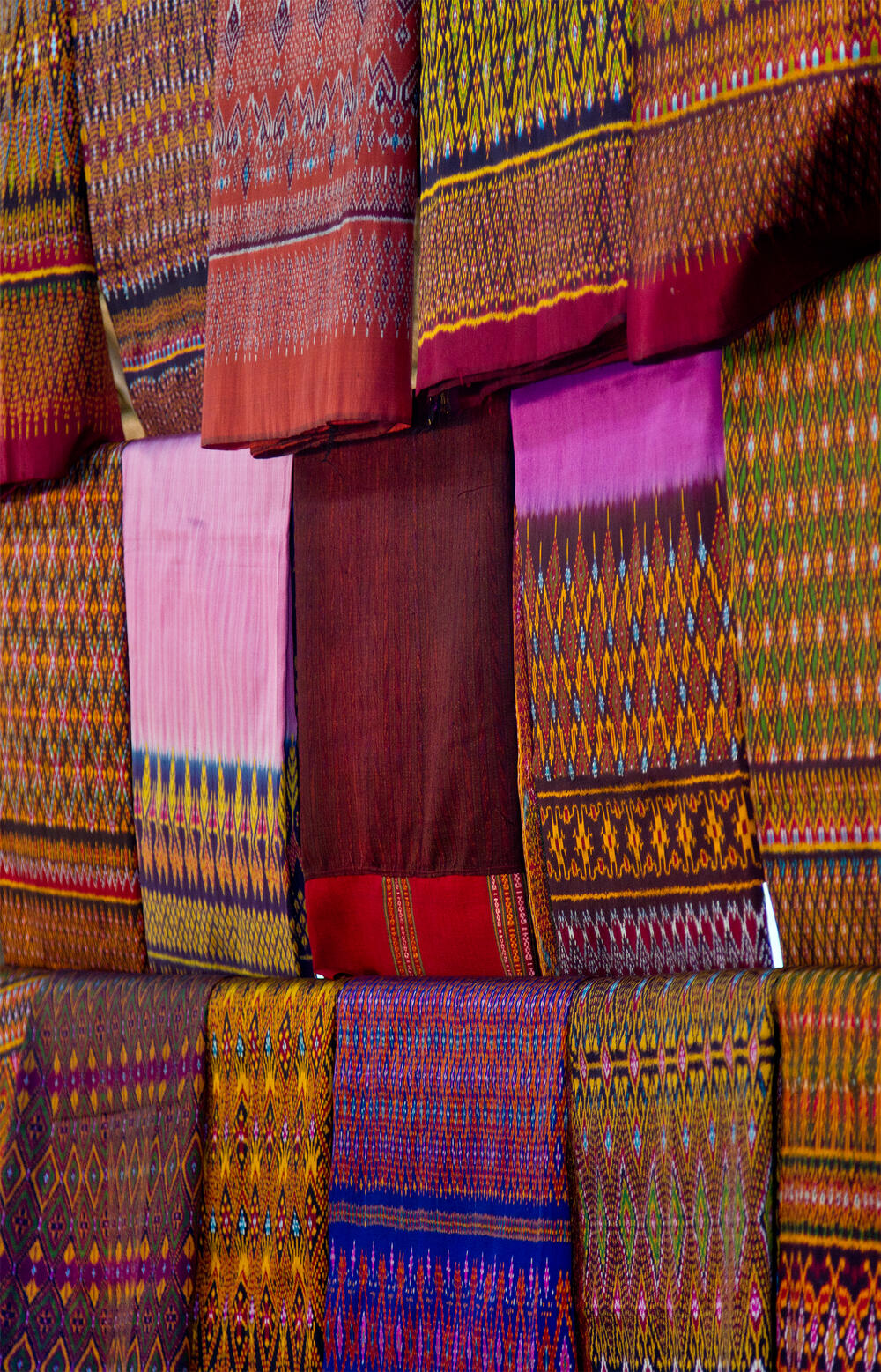 JJ Harrison (CC BY-SA 3.0)
Handwoven silk cloth colored with natural dyes, from Ban Tha Sawang in Surin Province
Curry paste and Thai spices
Must-buy
- From: nationwide; Mae Ploy and Maesri are the two brands to look for
- Buy it at: Big C, the Gourmet Market at Siam Paragon, Makro or Lotus's
- Look for: a sealed, commercially packaged pouch, the form CBP's spice rule covers
- Price: ฿120 to ฿180 for a 12-sachet pack
- Can it fly home to the US? Yes: CBP generally admits condiments, oils, packaged spices, honey, coffee and tea.
Look for curry paste under the Mae Ploy or Maesri label, sold in Thailand in stronger versions than the ones exported under the same names, in a sealed, commercially packaged pouch. A 12-sachet pack costs ฿120 to ฿180 at Makro or Lotus's, and Big C or the Gourmet Market at Siam Paragon stock it too.
Mae Ploy and Maesri sell separate pastes for green curry, massaman and tom yum; nam prik pao chili paste comes in its own sealed jar for ฿80 to ฿200.
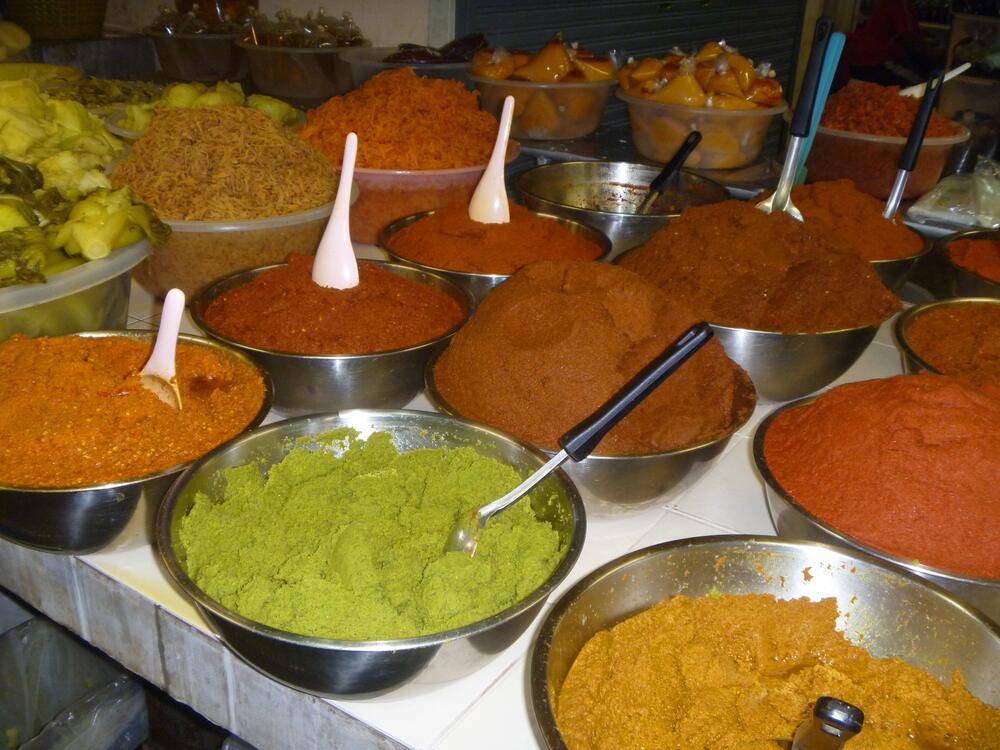 Ryan Snyder (CC BY 2.0)
Curry pastes for sale at a market in Phuket Town
Thai crafts: buy at the workshop, declare the wood
Wood carvings
- From: nationwide; the craft villages of Ban Tawai, about 15 kilometers south of Chiang Mai
- Buy it at: the workshops of Ban Tawai, in teak and mango wood
- Price: ฿300 and up for a small carving
- Can it fly home to the US? Yes, but declare it: every plant product, handicrafts included, must be declared and presented for CBP inspection.
Ban Tawai's craft villages, about 15 kilometers south of Chiang Mai, hold hundreds of woodworking workshops.
Buy direct from a workshop there, in teak or mango wood, and declare it at US customs like any wood product. Small carvings start at ฿300.
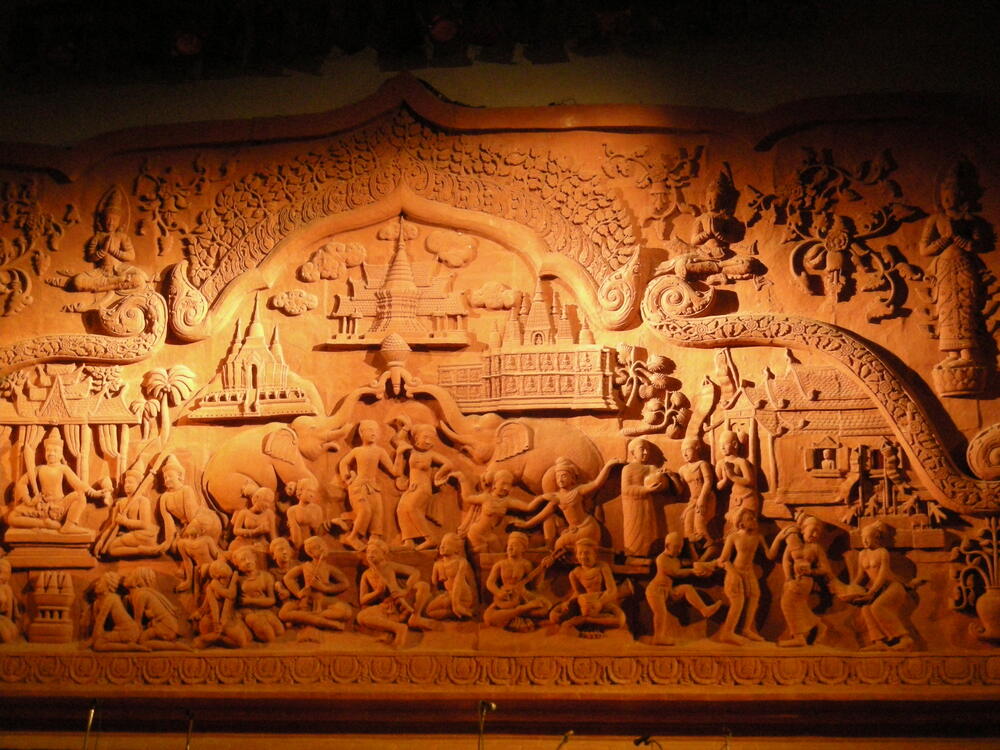 Noongsaao (CC BY-SA 3.0)
A traditional Thai wood carving, cut by hand from a single piece of wood
Lacquerware
- From: originated in northern Thailand; made in Chiang Mai
- Buy it at: Chatuchak in Bangkok, or Ban Tawai near Chiang Mai
- Look for: resin layered and polished over bamboo or wood, finished in gold leaf, paint or mother-of-pearl
- Price: ฿800 to ฿4,000 for a hand-done box
- Can it fly home to the US? Yes, but declare it like any plant product: every plant product, handicrafts included, must be declared and presented for CBP inspection; it is built over a bamboo or wood base.
Lacquerware layers resin over bamboo or wood, then builds up a finish of gold leaf, paint or mother-of-pearl, a craft that began in northern Thailand. Buy it at Ban Tawai near Chiang Mai, where it is still made by hand, or at Chatuchak in Bangkok, and treat ฿800 as the floor for a genuinely hand-done box.
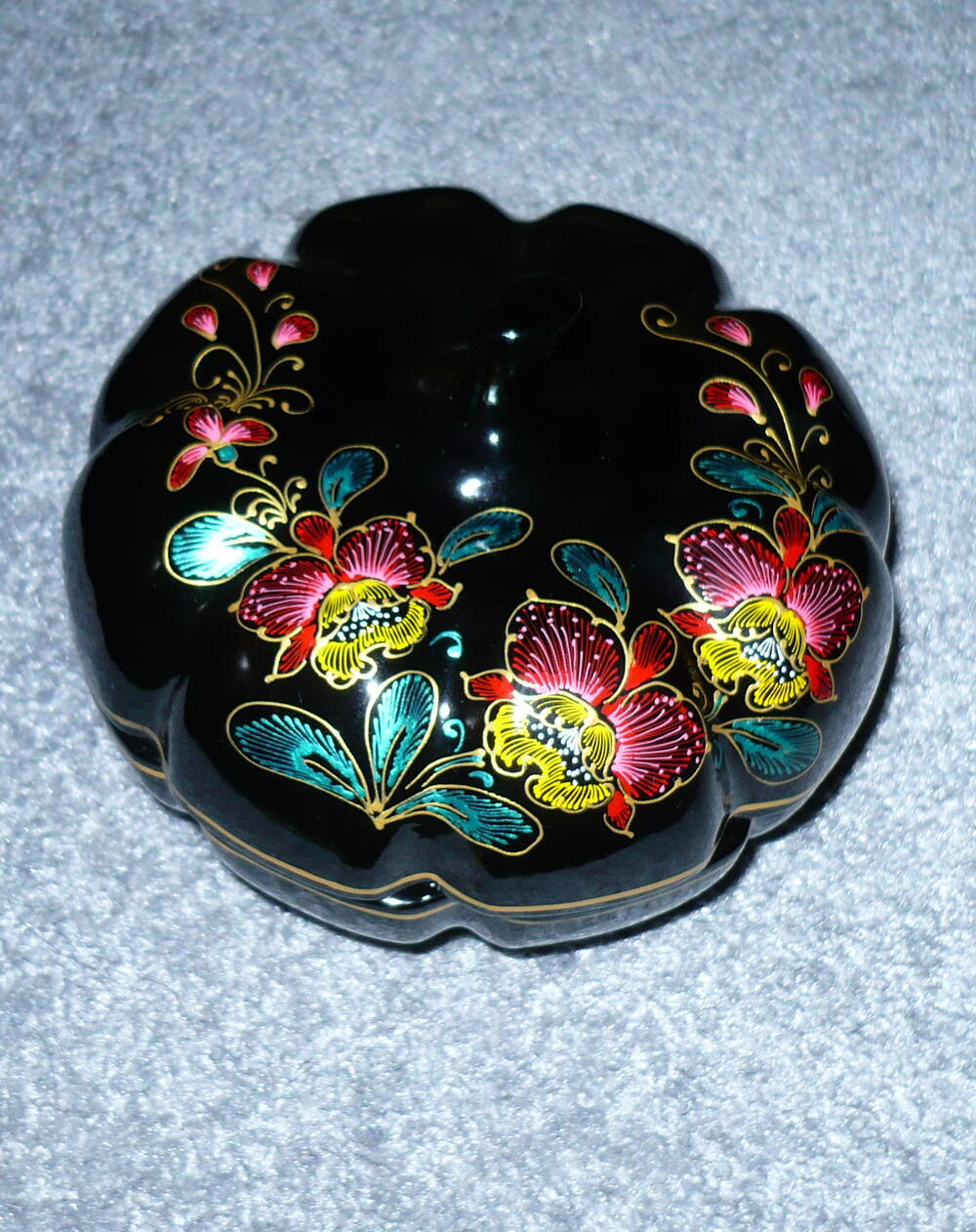 Gisling (CC BY-SA 3.0)
Lacquerware from Chiang Mai
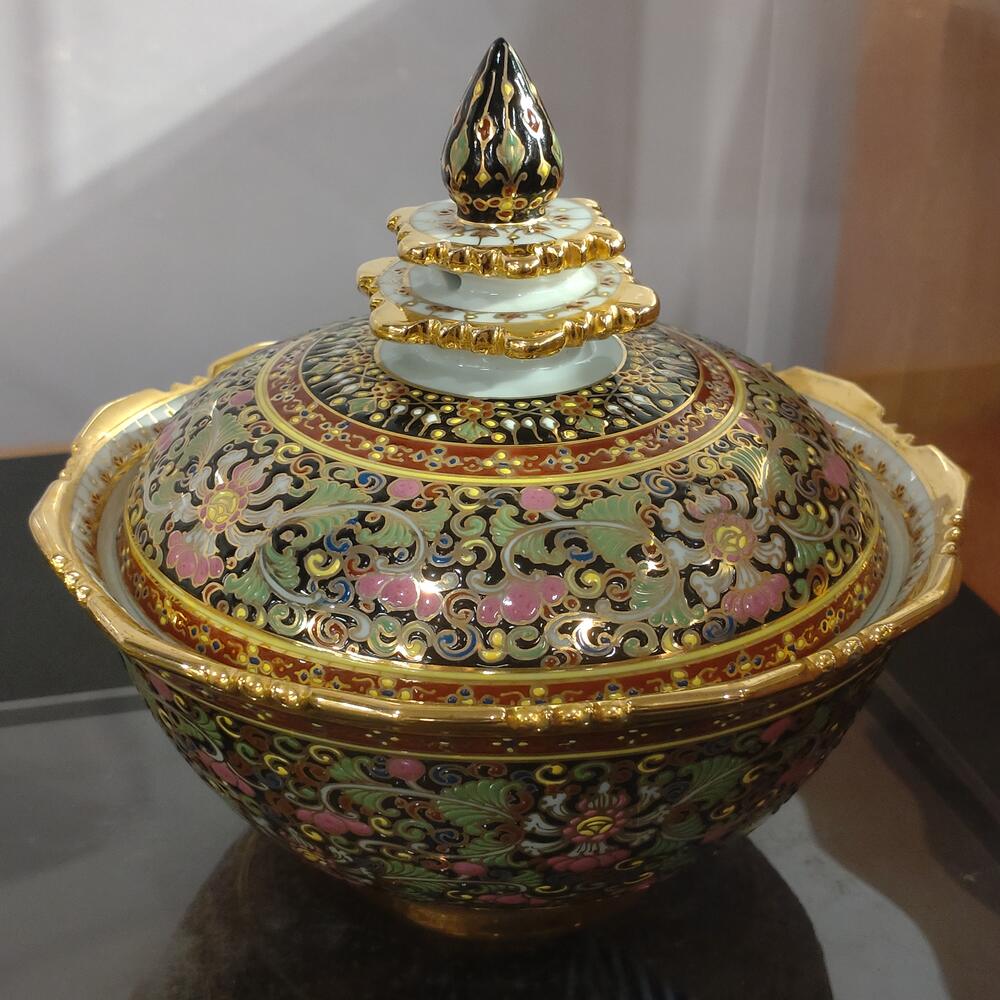
Benjarong porcelain
- From: historically made for the Thai royal court; sold nationwide today
- Buy it at: MBK Center's Thai Thai Shop, 6th floor, room 41-42, or Chatuchak Weekend Market
- Look for: the five colors, white, yellow, black, red and green, in clean lines that don't bleed together
- Price: ฿900 to several thousand baht a piece
- Can it fly home to the US? Yes, but ceramic tableware bought abroad can carry lead in its glaze; the FDA recommends testing it when you get home, or using it for display only.
Inspect the brushwork before you buy: benjarong's five colors, once reserved for the royal court, should sit in clean lines that don't bleed into each other.
Pieces run from ฿900 to several thousand baht at MBK Center's Thai Thai Shop or Chatuchak Weekend Market; an authentic teacup set costs ฿2,500 to ฿8,000.
 氏子 (CC0)
A benjarong covered bowl on a raised foot, from Bangkok
Celadon pottery
- From: northern Thailand; Chiang Mai and the city of Lampang
- Buy it at: workshops such as Mengrai Kilns in Chiang Mai
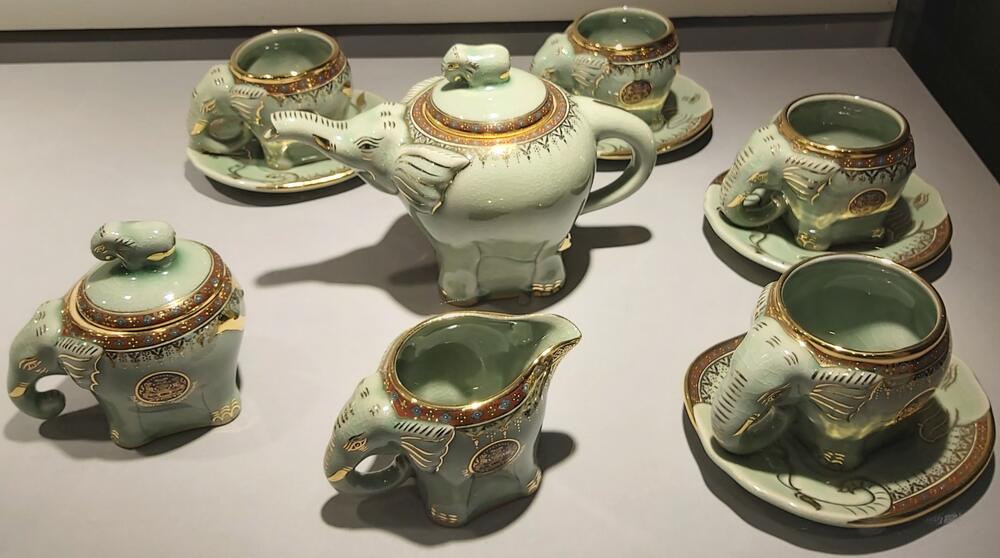
- Look for: the jade-green glaze
- Price: ฿300 to ฿2,500 a piece
- Can it fly home to the US? Yes, but like any ceramic tableware bought abroad, the FDA recommends testing the glaze for lead, or using the piece for display only.
Celadon, the jade-green glazed pottery of northern Thailand, is made in Chiang Mai and the city of Lampang. Buy it straight from a kiln workshop such as Mengrai Kilns in Chiang Mai, where a piece costs ฿300 to ฿2,500.
 阿道 (CC BY-SA 4.0)
A Thai celadon tea set in the jade-green glaze
Silver jewelry
- From: northern Thailand; hill tribe communities around Chiang Mai
- Buy it at: the shops along Wualai Road, Chiang Mai's Silver Street
- Look for: a 925 stamp, for 92.5% silver purity
- Price: ฿500 and up for a ring or small trinket
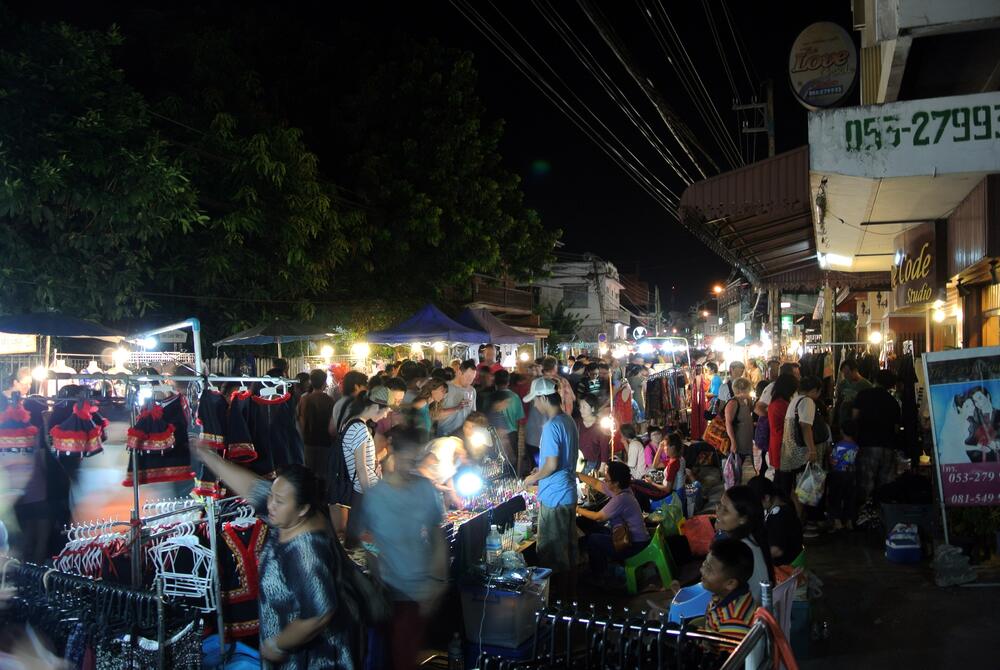
Buy silver jewelry on a Saturday evening, when Wualai Road becomes the Saturday Walking Street, alongside the shops that line it year-round.
Pass on any piece without a 925 stamp, the mark of 92.5% sterling silver; rings and small trinkets start at ฿500.
 Adbar (CC BY-SA 3.0)
The Saturday Walking Street market on Wua Lai Road, Chiang Mai
More Thai crafts and keepsakes
| Region | Buy | What it is |
|---|---|---|
| Nan and Lampang | Woven baskets and bags | Rattan, bamboo and water hyacinth weaving; declare it at customs like any plant product |
| Nationwide, night markets | Soap carvings | Hand-carved soap flowers, ฿80 to ฿200 each |
| Northern hill tribes | Hand-woven cotton | Doi Tung Development Project cotton and Akha/Hmong embroidery, ฿350 to ฿1,800 for a scarf or bag |
| Nationwide, night markets | Coconut shell crafts | Polished coconut-shell bowls, ฿80 to ฿100 each; declare it at customs like any plant product |
| Nationwide | Elephant-themed trinkets | Keychains, magnets and carvings, from ฿50 |
| Southern Thailand | Batik fabric | Thai and Malay patterns, sold in Bangkok markets too |
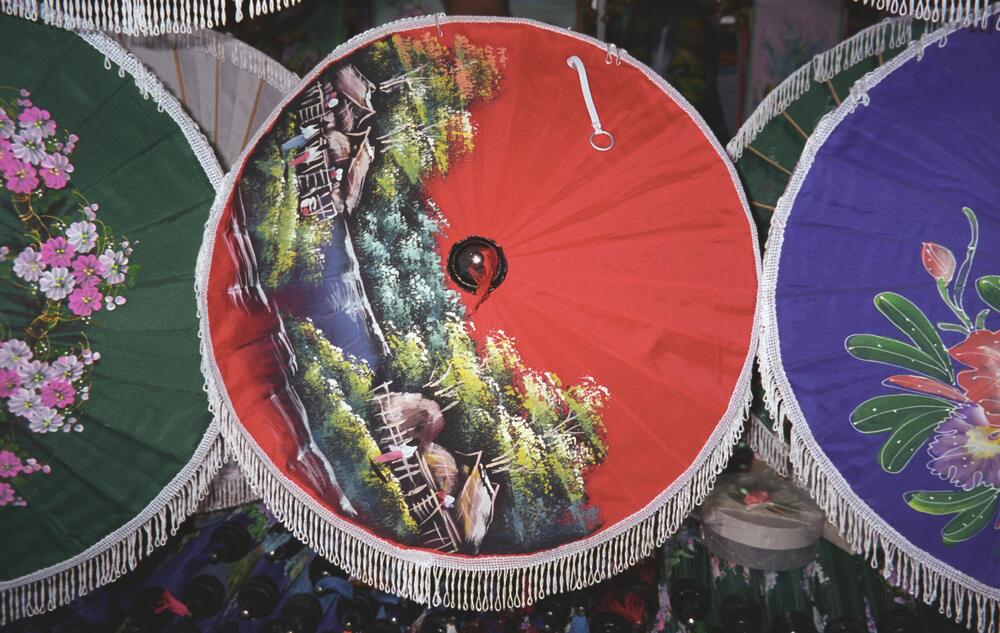
| Chiang Mai (Bo Sang village) | Paper umbrellas and lanterns | Hand-painted on mulberry-bark Saa paper; umbrellas from ฿200, lanterns ฿50 to ฿150 |
| Nakhon Si Thammarat | Nielloware | Silver inlaid with a black metal alloy, ฿400 to ฿1,800 for a ring or bracelet |
 Grossbildjaeger (CC BY-SA 3.0)
Painted paper umbrellas at Bo Sang, Chiang Mai
Food and drink to bring home
Dried fruit snacks
- From: nationwide
- Look for: dried mango, durian, banana, freeze-dried durian and mangosteen, or mango jelly
- Price: ฿150 to ฿300 a pack
- Can it fly home to the US? Declare it: the USDA doesn't penalize a traveler for declaring a food item it ultimately decides not to admit.
Declare a pack of dried mango, durian or tamarind at US customs. An inspector decides case by case: declaring it carries no penalty even if it is turned away, but CBP fines $300 for failing to declare an agricultural item. A standard pack costs ฿150 to ฿300.
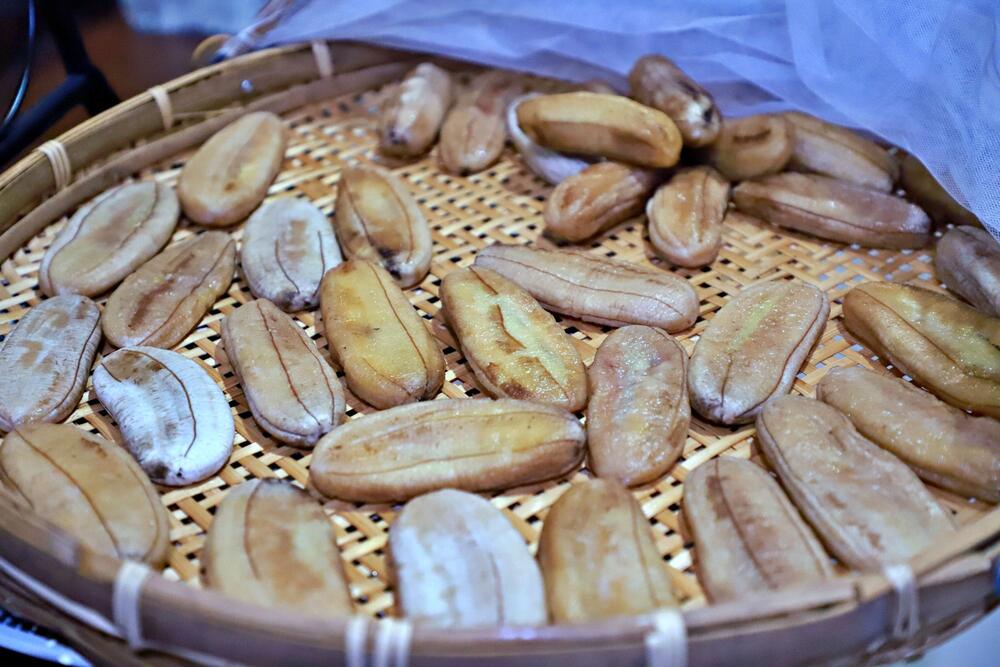 Photo by AuiSmith P. on Pexels
Sun-dried bananas on a woven bamboo tray in Thailand
Thai iced tea
- From: nationwide
- Buy it at: Chatuchak Market and supermarkets such as Tops and Big C
- Price: ฿100 to ฿250 for a box of instant sachets
- Can it fly home to the US? Yes: CBP generally admits tea.
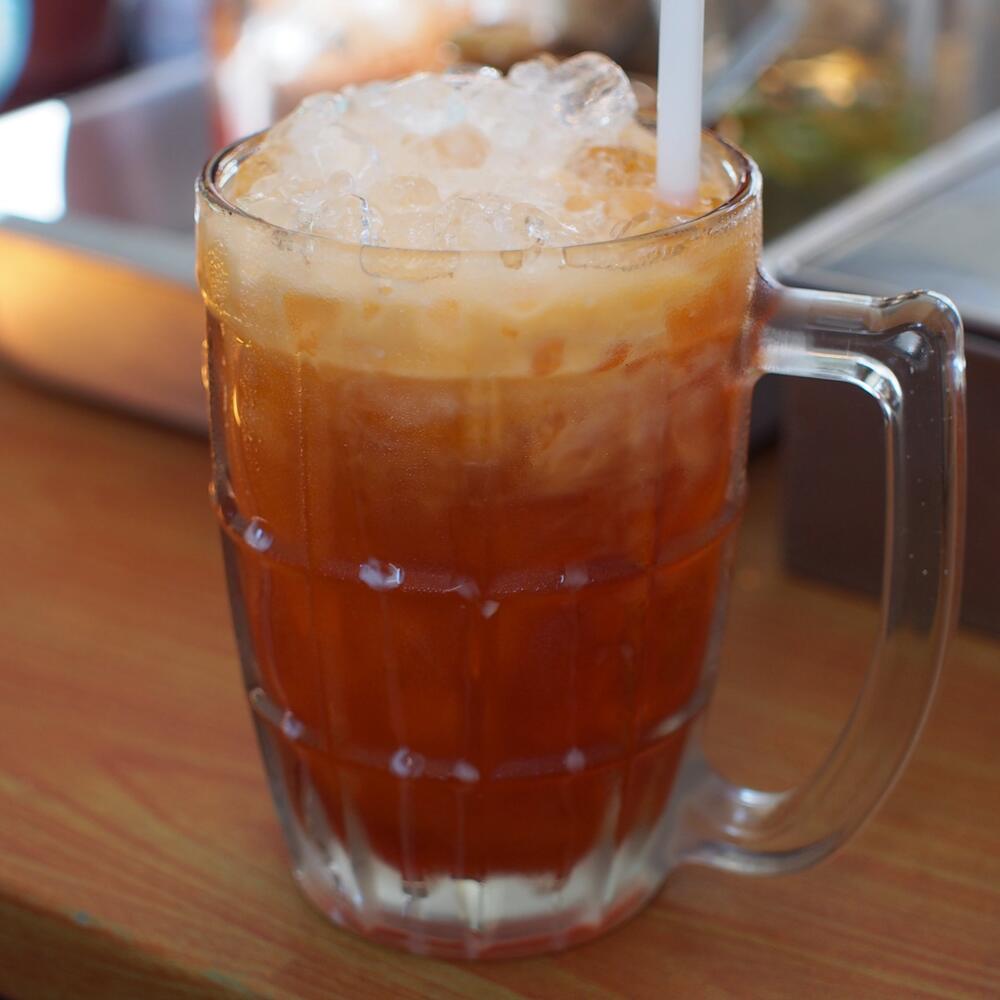
Cha yen, Thailand's iced milk tea, packs home as an instant powder. A box of sachets costs ฿100 to ฿250 at Chatuchak Market or a supermarket such as Tops or Big C.
 Takeaway (CC BY-SA 3.0)
A glass of cha yen, Thai iced tea with condensed milk, at a noodle shop in Chiang Mai
Northern Thai coffee
- From: Chiang Rai's northern hills (Arabica); Chumphon and Ranong in the south (Robusta)
- Buy it at: Doi Chaang Café or Ristr8to in Chiang Mai, or any supermarket
- Look for: Doi Chang or Doi Tung on the label, two of Thailand's 11 registered coffee geographical indications
- Price: premium Doi Chaang beans run up to ฿700 a bag
- Can it fly home to the US? Yes: CBP generally admits coffee.
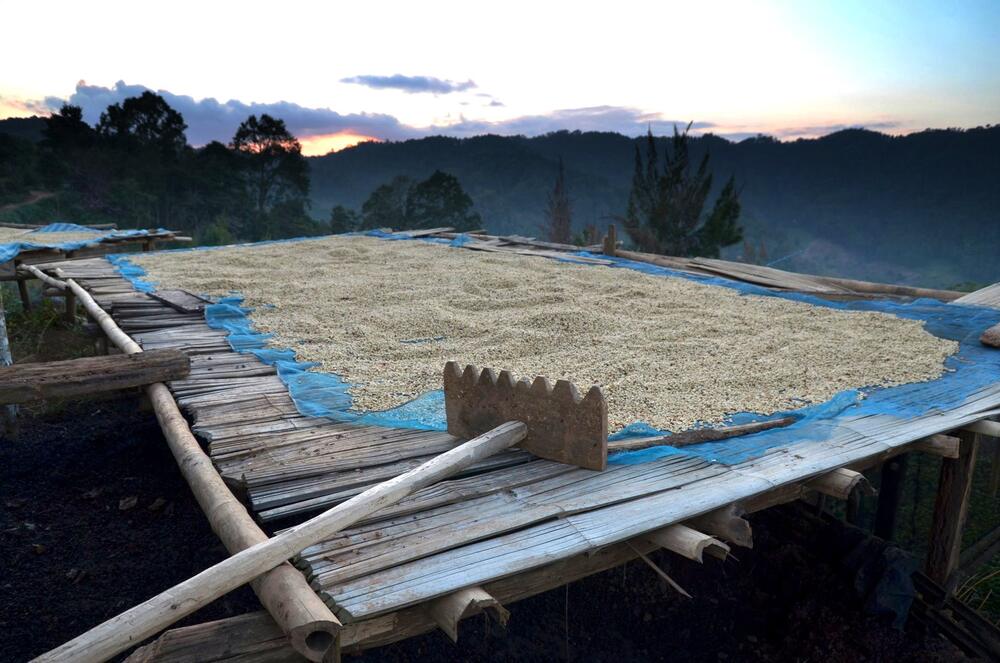
Thai coffee grows as Arabica in Chiang Rai's northern hills, and as Robusta in the south, around Chumphon and Ranong. Doi Chang, one of Thailand's 11 registered coffee geographical indications, names a Chiang Rai growing area.
Buy a bag with a named growing region on the label at Doi Chaang Café or Ristr8to in Chiang Mai, or from any supermarket. Premium Doi Chaang beans run up to ฿700 a bag.
 Takeaway (CC BY-SA 3.0)
Coffee beans drying in Maejantai village, Chiang Rai Province
What to buy at a Thai 7-Eleven or supermarket
| Buy | What it is |
|---|---|
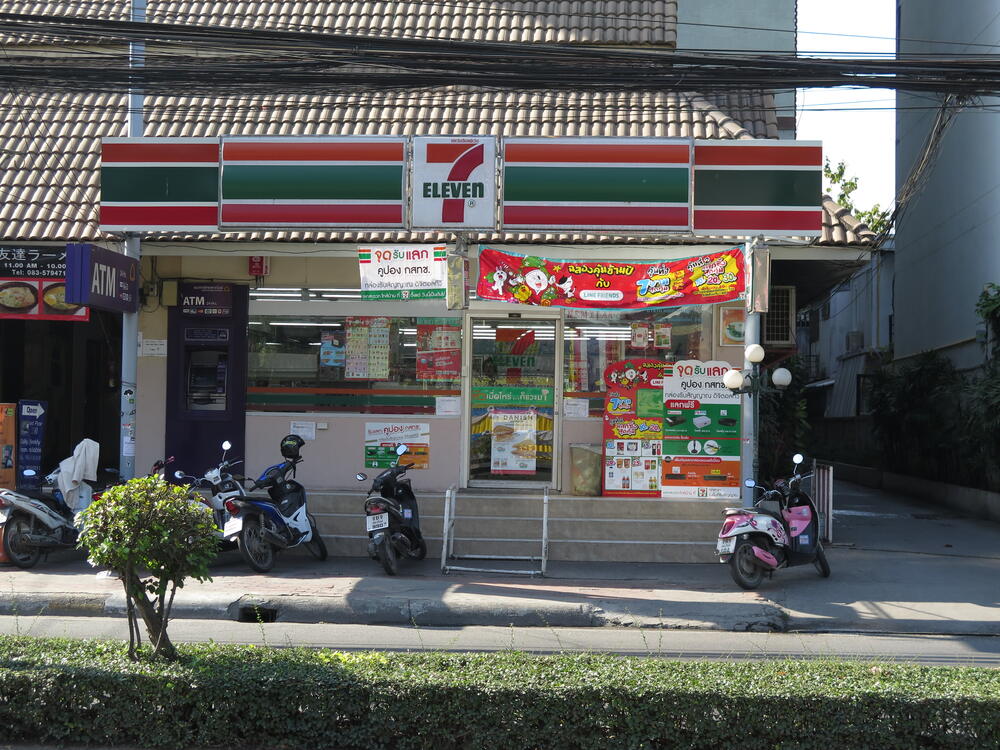
| Lay's Thailand chips | Flavors like seaweed, tom yum and grilled shrimp, sold at 7-Eleven for ฿50 to ฿150 a pack |
| Hom Mali jasmine rice | A vacuum pack from Surin province, ฿60 to ฿120 a kilo; CBP advises against bringing rice into the US, since it can harbor insects |
| MAMA instant noodles | Thailand's own instant noodle brand |
| Luk Chup | Miniature fruit-shaped sweets made from mung bean paste |
| Thai spirits | SangSom rum and Mekhong whiskey nationwide, plus Magic Alambic rum made on Koh Samui; pack a bottle in your checked bag |
| Bottled fish sauce | From coastal provinces; declare it as an animal product, and pack a bottle over 3.4 ounces in your checked bag |
| Cashew nuts | Chocolate-covered cashews from southern Thailand; Phuket is known for them |
 Douglas Perkins (CC BY 4.0)
A 7-Eleven storefront in Chiang Mai
Thai wellness buys
Herbal balms and inhalers
- From: nationwide pharmacies and convenience stores
- Buy it at: any 7-Eleven, Boots or Watsons
- Look for: Ya Dom for the menthol inhaler stick, or a balm built on the same camphor base
- Price: ฿30 to ฿80 for a single inhaler
- Can it fly home to the US? Yes, in a container of 3.4 ounces or less in your carry-on; pack a larger tin in your checked bag.
Keep a balm or inhaler under 3.4 ounces for your carry-on; pack anything larger in your checked bag. A single Ya Dom inhaler costs ฿30 to ฿80 at any 7-Eleven, Boots or Watsons.
Ya Dom, a small menthol inhaler stick, treats a stuffy nose or a long bus ride, and balms built on the same camphor base treat sore muscles, headaches and colds.
Herbal compress balls
- From: nationwide; bundles lemongrass, turmeric, kaffir lime and galangal
- Buy it at: markets in Chiang Mai and Bangkok
- Price: ฿150 to ฿400 for a good-quality ball
- Can it fly home to the US? Yes, but declare it: every plant product, handicrafts included, must be declared and presented for CBP inspection.
A Thai massage therapist steams a luk pra kob, a cotton bundle of dried lemongrass, turmeric, kaffir lime and galangal, and presses it into the skin. Buy one for ฿150 to ฿400 at a market in Chiang Mai or Bangkok, and declare it at US customs like any plant product.
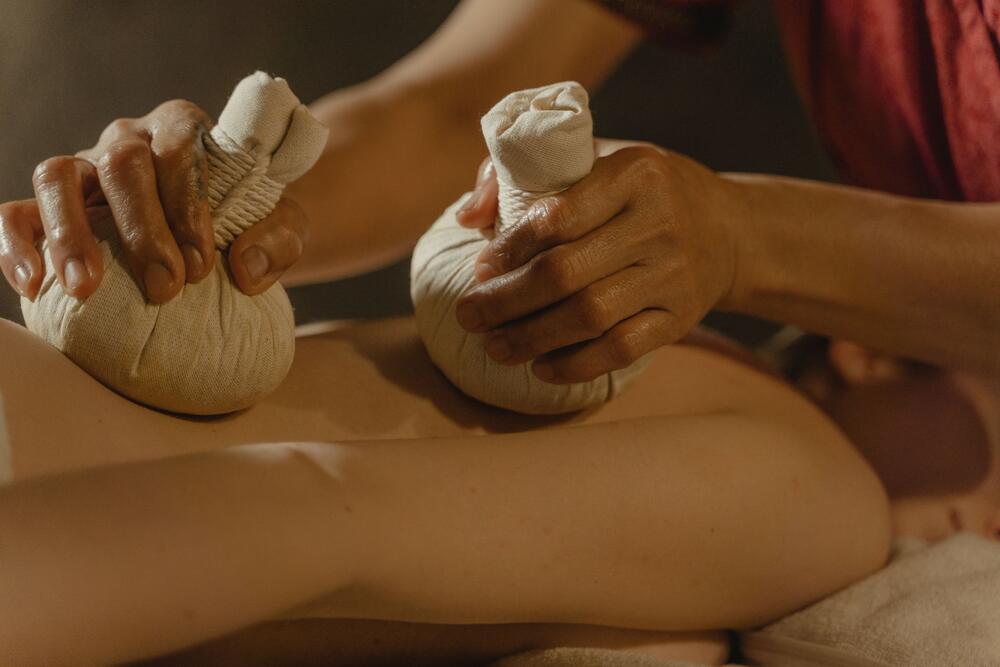 Photo by Tima Miroshnichenko on Pexels
Cloth-wrapped herbal compress balls used in a massage
Coconut oil products
- From: nationwide; grown in southern Thailand, Koh Samui and Surat Thani
- Buy it at: markets anywhere tourists shop; look for an English label
- Price: ฿180 to ฿350 for a 500ml bottle
- Can it fly home to the US? Yes: CBP generally admits oils. Pack it in your checked bag; a 500ml bottle is well over the 3.4-ounce carry-on limit.
Buy a bottle of cold-pressed coconut oil with an English label, grown in southern Thailand or on Koh Samui, for ฿180 to ฿350 for 500ml. Pack it in your checked bag; 500ml is well over the carry-on liquids limit.
Try free
Plan your Thailand trip in about 2 minutes
Tap through 8 quick cards for a complete itinerary with budget, maps, and packing lists. No account required.
Plan your Thailand trip →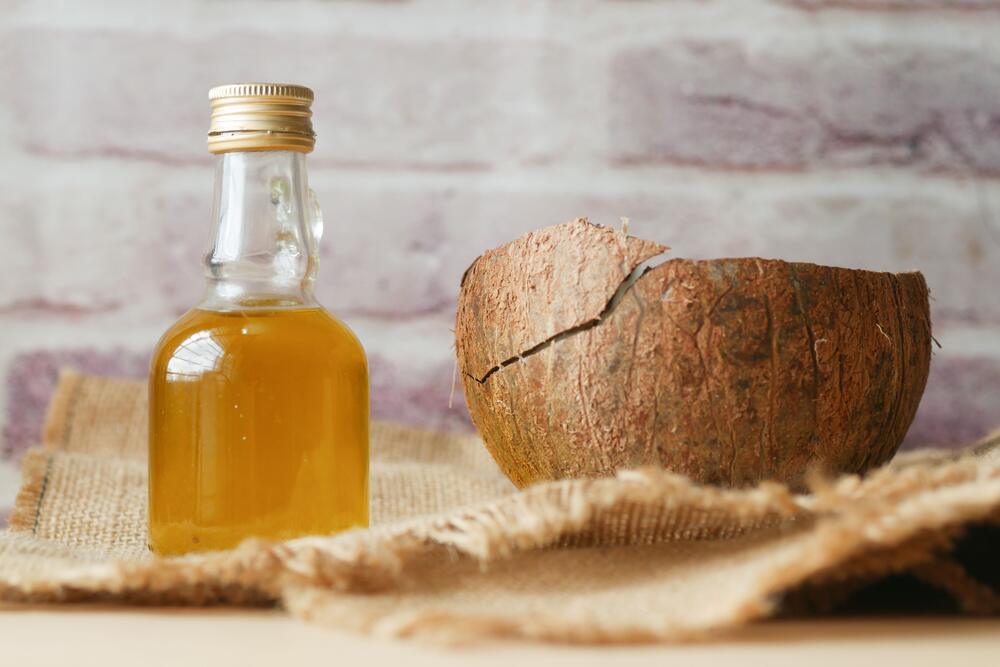 Photo by Towfiqu barbhuiya on Pexels
A bottle of coconut oil beside a cracked coconut shell
Everyday Thailand buys
Muay Thai shorts and gear
- From: nationwide; Thailand is where Muay Thai began
- Buy it at: MBK Center's Arunrat Boxing, 6th floor, Paco Zone
- Price: ฿299 to ฿1,290 for a pair of shorts
- Can it fly home to the US? Yes: CBP sets no limit on clothing bought for personal use or as gifts.
Go to the 6th floor of MBK Center, the Paco Zone's Arunrat Boxing, for a pair of Muay Thai shorts, from the martial art's own birthplace.
Expect ฿299 for a basic pair and up to ฿1,290 for a branded one.
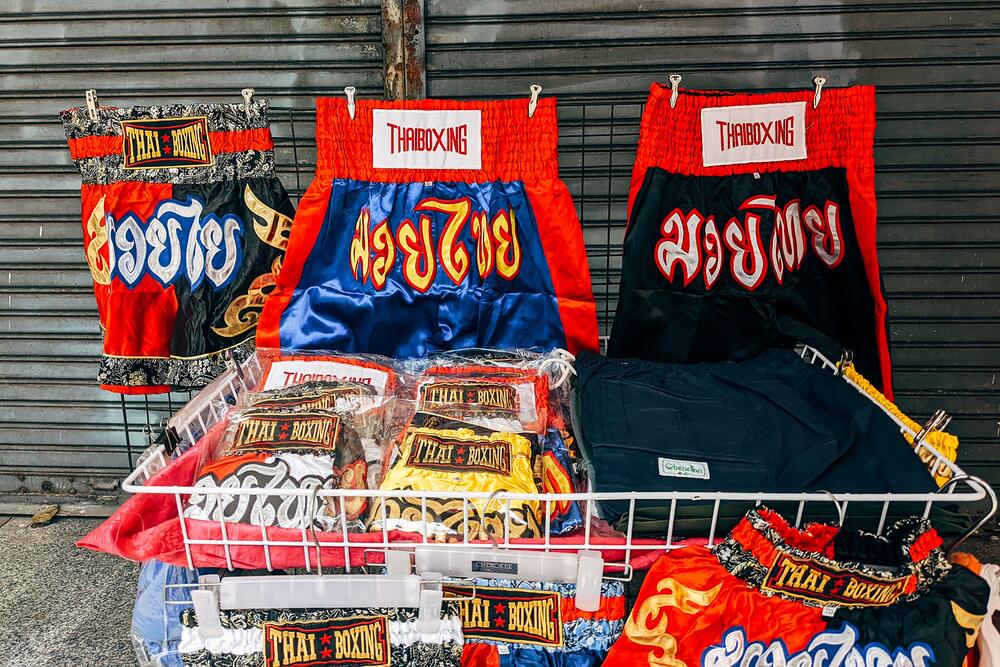 Photo by Markus Winkler on Pexels
Thai boxing shorts on display at a market in Bangkok
Elephant pants
- From: nationwide, sold at backpacker markets
- Buy it at: Khao San Road in Bangkok, or any night market
- Price: ฿100 to ฿300 a pair
- Can it fly home to the US? Yes, the same clothing rule applies: no limit for personal use or gifts.
Elephant pants pull on. Fisherman pants, named for the southern Thai fishermen who wear them daily, wrap and tie instead, and sell for ฿199 at MBK's 4th floor, Zone AA.
Expect ฿100 to ฿300 a pair at Khao San Road or any night market.
Where to shop: Chatuchak and the night markets
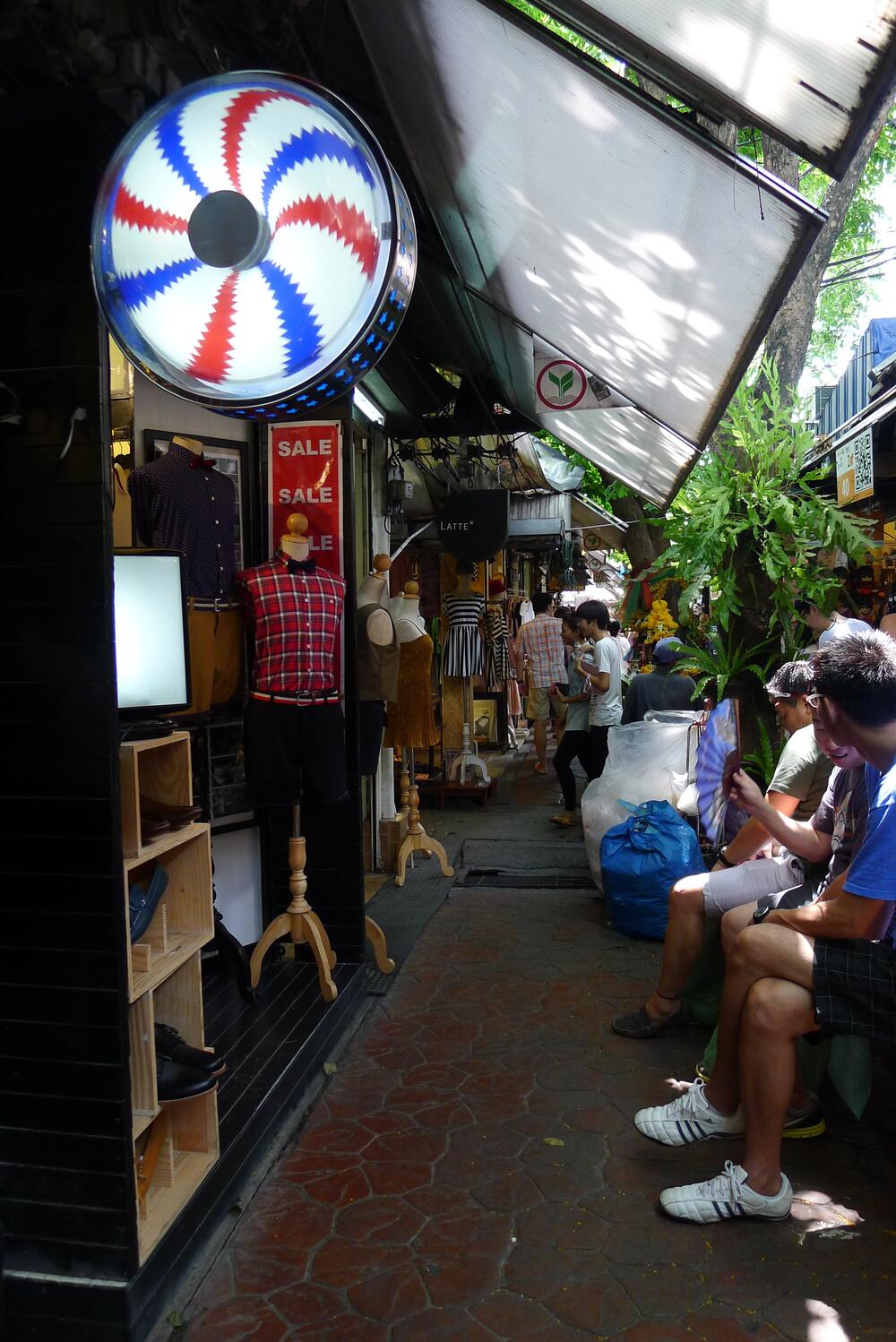
Chatuchak Weekend Market, Thailand's largest with more than 8,000 stalls in 27 sections, is open Saturday and Sunday. Go for Benjarong and lacquerware, or for clothing and fabric in Sections 22 through 26. Browse Section 7's antiques and decorative arts knowing a genuine piece needs a Fine Arts Department export permit to leave the country. For food, cross to Or Tor Kor Market next door.
In Chiang Mai, the same Saturday evening crowd fills Wualai Road for both the silver shops and the Walking Street built around them.
Shops that display a "VAT Refund for Tourists" sign, which malls and department stores usually do, refund the 7% value added tax. Spend at least ฿2,000 in one shop on one day, ask for a P.P.10 form, and show the goods to customs at the airport before you check in your bag.
 Azreey (CC BY-SA 3.0)
A narrow lane of stalls at Chatuchak Weekend Market, Bangkok
How to bargain, and the gem scam to avoid
Bargaining works at open markets and street stalls, including Chatuchak, Khao San Road and the night markets; malls and fixed-price shops such as Jim Thompson hold their price. One shopper's rule: open about 30% below the asking price.
Buy gold or gemstone jewelry only at a department store counter, such as Central, EmQuartier or ICONSIAM, or from a dealer listed with the Thai Gem and Jewelry Traders Association. The classic Bangkok scam sends a tuk-tuk driver or a friendly stranger to steer you toward a government gem sale that doesn't exist. The stones sold that way are low-grade or glass, and the money is nearly impossible to get back.
What not to buy in Thailand
Skip a genuine Buddha image or antique, unless you are ready to apply for a Fine Arts Department export permit first. Thailand's Customs Department lists "Buddha image, artifact/objects, antique" as a restricted export requiring that permit.
Skip ivory and any other wildlife product. CBP says endangered wildlife species and products made from them generally may not be imported, and importing almost any type of ivory needs a US Fish and Wildlife Service permit first. Thailand's own customs list separately bans the export of reserved animals and CITES-listed wildlife.
Thailand's customs list bans the export of counterfeit trademark goods, though they are sold openly at markets such as Pratunam. On arrival, CBP may let a traveler keep one article of each type bearing a counterfeit mark, for personal use only and no more than once every 30 days.
Plan your Thailand trip
For trip length and which cities to see, read the Thailand travel guide. The 4-day Chiang Mai itinerary builds in time for the city's craft markets, and the 10-day Thailand itinerary crosses several regions in one trip.
A trip you plan on MonkeyEatingMango comes with a shopping guide that lists what to buy in every city you stop in, and where. The packing list generator, free for now, builds the list for your destination and month.
Common questions
What are the best things to buy in Thailand?
Thai silk and curry paste or spice blends are both widely sold and light enough to pack. Herbal balms, Benjarong porcelain and cold-pressed coconut oil are also sold at pharmacies, malls and local markets nationwide.
What's cheap to buy in Thailand?
A Ya Dom menthol inhaler costs ฿30 to ฿80 at any 7-Eleven, Boots or Watsons, and a jar of balm ฿40 to ฿120. A packet of curry paste starts at ฿50, and small wood carvings start at ฿300.
What is the most popular souvenir to buy in Thailand?
Thai silk scarves start around ฿800, and Jim Thompson shops nationwide are the benchmark for quality. Curry paste and Thai spice blends are sold at supermarkets everywhere, light, sealed and ready to cook with at home.
Is it safe to buy gems and jewelry in Thailand?
Yes, from a certified source: department store counters at Central, EmQuartier and ICONSIAM sell at fixed, certified prices, and dealers listed with the Thai Gem and Jewelry Traders Association are vetted. Avoid anyone who approaches you on the street or in a tuk-tuk about a government gem sale, since no such sale exists and the stones sold that way are low-grade or glass.
Is bargaining normal in Thai markets?
Yes, at open markets and street stalls, but not at malls or shops with fixed prices. One shopper's rule: open about 30% below the asking price.
How can I tell if Thai silk is real?
Scrunch a corner of the fabric in your hand: real silk feels cool at first, carries a natural sheen, and its wrinkles disappear quickly. A synthetic copy shows a plastic shine instead.
Is Chatuchak cheaper than the malls?
Usually, since at Chatuchak you can bargain, which you can't do at a mall. Malls keep fixed prices, which makes a VAT refund easier to claim on a bigger purchase.
Can I bring Thai coffee, tea and spices home to the US?
Yes. CBP generally admits condiments, packaged spices, oils, honey, coffee and tea, which covers curry paste, Doi Chaang coffee beans and instant cha yen sachets. Keep them in their sealed, commercial packaging and declare them on arrival.
Can I bring a Buddha image or an antique home from Thailand?
Not without a permit. Thailand's Customs Department lists a Buddha image, along with other artifacts and antiques, as a restricted export that needs a permit from the Fine Arts Department, so apply for the permit before you buy one to take home.
What should I buy at a Thai 7-Eleven or supermarket?
Lay's Thailand runs flavors like seaweed and tom yum that cost ฿50 to ฿150 a pack, sold at 7-Eleven. A vacuum pack of Hom Mali jasmine rice from Surin costs ฿60 to ฿120 a kilo at any supermarket, though CBP advises against bringing rice into the US at all.

Written by Shobhit Shrivastava · Founder
Related reading
Thailand travel guide
5 Days in Bangkok: The Grand Palace to Yaowarat Road
This packed 5-day trip for a couple explores Bangkok's diverse offerings, from the spiritual grandeur of Wat Pho in the historic Rattanakosin area to the neon-lit street food haven of Yaowarat Road. Experience a rejuvenating traditional Thai spa, savor a hands-on cooking class, and enjoy a chic...
Chiang Mai in 4 Days: Temples and Night Markets
4 days in Chiang Mai: 4 nights based in the Old City. Focus on spiritual morning temple visits like Wat Chedi Luang, afternoons exploring local markets for Khao Soi, and evenings at the North Gate Jazz Co-Op. Comfortable pace with 5-6 hours of daily activity, relying on ride-sharing to navigate...
10 Days in Thailand: Bangkok, Chiang Mai and Krabi
10 days through Thailand's diverse landscapes: 4 nights in Bangkok exploring the Grand Palace and bustling Chinatown, then a flight to Chiang Mai for 3 nights among Doi Suthep's mountain temple and lively Night Bazaar. The trip concludes with 3 nights in Krabi, enjoying Railay Beach's dramatic...
A Week in the Thai Islands: Phuket, Krabi and Koh Phi Phi
7 days across Phuket, Koh Phi Phi, and Krabi: Begin with 2 nights in Phuket (Phuket Old Town, Wat Chalong), then a ferry to Koh Phi Phi for 2 nights (Maya Bay, island hopping, snorkeling). Conclude with 3 nights in Krabi (Railay Beach, mangrove forests, Krabi Town Night Market). This packed pace...
Best Time to Visit Thailand: Month by Month (2027)
When to go to Thailand, month by month: weather for Bangkok, Chiang Mai, Phuket and Ko Samui, the 2027 Songkran and Loy Krathong dates, and why the Andaman and Gulf coasts run different rainy seasons.
Traditional Thai Food: What to Eat in Thailand
The Thai dishes to eat first, organized by region, what each one is, its spice level and when to order it, then more dishes, curries, desserts, drinks and how Thailand eats.
Japan Souvenirs: What to Buy in Japan and Bring Home
The 12 Japan souvenirs worth bringing home, Japan's tax-free shopping change on November 1, 2026, where to buy each item, and whether it clears US customs.