Where should you go in Norway, and what do you need to book ahead? On a first trip, build the week around Bergen, the Flåm Railway and Nærøyfjord, and Geirangerfjord: Norway's classic fjord-country route. Add Oslo or Ålesund with more time, and save Tromsø, Lofoten and Svalbard for a second trip or a dedicated northern-lights week.
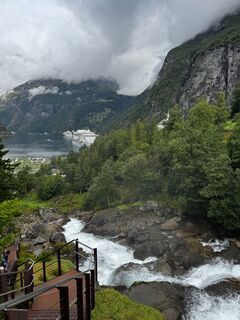
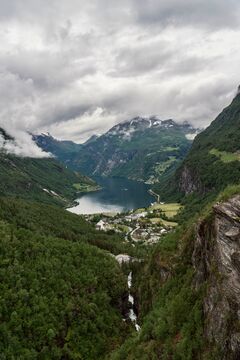
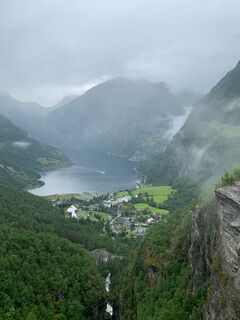
Geirangerfjord
Worth a visitUNESCOGo for A UNESCO fjord cruise beneath the Seven Sisters waterfall
Top sights
- Time neededhalf a day for a fjord cruise, more with a drive up to the Dalsnibba viewpoint
- Book aheadrecommended for the cruise in summer
Book ahead: the cruise, in summer
Read the full sectionShowing Geirangerfjord
A week covers Bergen, the Flåm Railway and Nærøyfjord, and Geirangerfjord in one loop. Ten days stretches that into Bergen and Ålesund, or adds a flight north to Tromsø. Each entry below carries the time it takes, whether to book ahead, and its UNESCO status where it has one.
- Book two things first: the Flåm Railway and, if the northern lights are the point, a bed in Tromsø or Lofoten between October and March.
- Go in summer for the fjords and the big hikes. Winter is for the Arctic north and the northern lights.
- Set aside a full day for Trolltunga or Kjeragbolten. Both take most of a day on foot, and summer is the only safe season for either.
The fjords and scenic drives
Geirangerfjord
Must-do
- UNESCO: inscribed 2005 together with Nærøyfjord, as the West Norwegian Fjords listing
- Time needed: half a day for a fjord cruise, more with a drive up to the Dalsnibba viewpoint
- Book ahead: recommended for the cruise in summer
- Best months: summer, for the cruise
- Plan it: 7-day Norway Fjords itinerary
A fjord cruise down Geirangerfjord takes half a day, longer with a drive up to the Dalsnibba viewpoint above it. Boats pass beneath the Seven Sisters waterfall and below Skageflå, an abandoned mountain farm on a ledge above the water. UNESCO World Heritage Centre writes, "The starkly dramatic landscapes of Geirangerfjord and Nærøyfjord are exceptional in scale and grandeur in a country of spectacular fjords."
Viewing the fjord from the shore costs nothing; the cruise is the paid way to get beneath the waterfalls. The toll road up to Dalsnibba climbs even higher, for a panorama over the fjord that the boat cruise never shows.
Start on the water in the morning, then drive up to Dalsnibba afterward for the high panorama over the fjord.
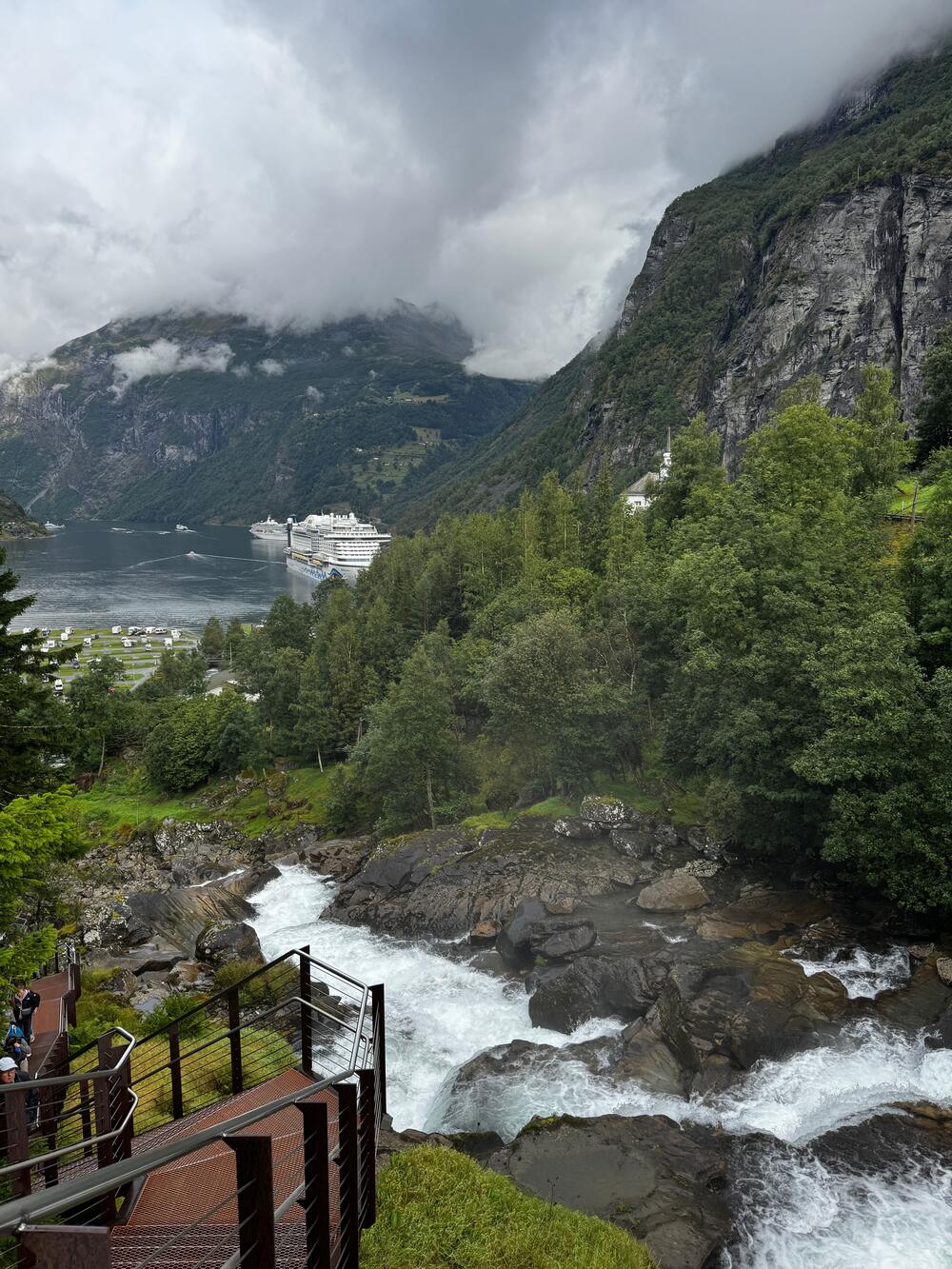 Photo by Bernhard Egger on Pexels
A fjord cruise boat on Geirangerfjord beneath lush green mountains with a waterfall
Nærøyfjord and the fjord villages of Flåm and Aurland
- UNESCO: same 2005 inscription as Geirangerfjord, as part of the West Norwegian Fjords listing
- Time needed: 2-3 hours by boat from Flåm or Gudvangen
- Book ahead: recommended in summer
- Best months: summer
- Stegastein Viewpoint: a platform 650 m above Aurlandsfjord, free and road-accessible
- Plan it: 7-day Norway Fjords itinerary
Nærøyfjord shares the same 2005 UNESCO inscription as Geirangerfjord, reached by boat from the fjord villages of Flåm or Gudvangen instead of a drive. Sognefjord, Norway's longest and deepest fjord, is the trunk that Nærøyfjord and Aurlandsfjord both branch from. Pair the cruise with a run on Aurlandsfjord next door, a quieter branch of the same system covered by rented motorboat or kayak.
Skip the Lærdal Tunnel, the longest road tunnel in Europe, for the old mountain road over to Lærdal: Gamle Aurlandsvegen is the slower, scenic alternative. From Aurland, Stegastein Viewpoint climbs to a platform cantilevered 650 m above Aurlandsfjord, free to visit. Time it for evening, when the light softens over the fjord below.
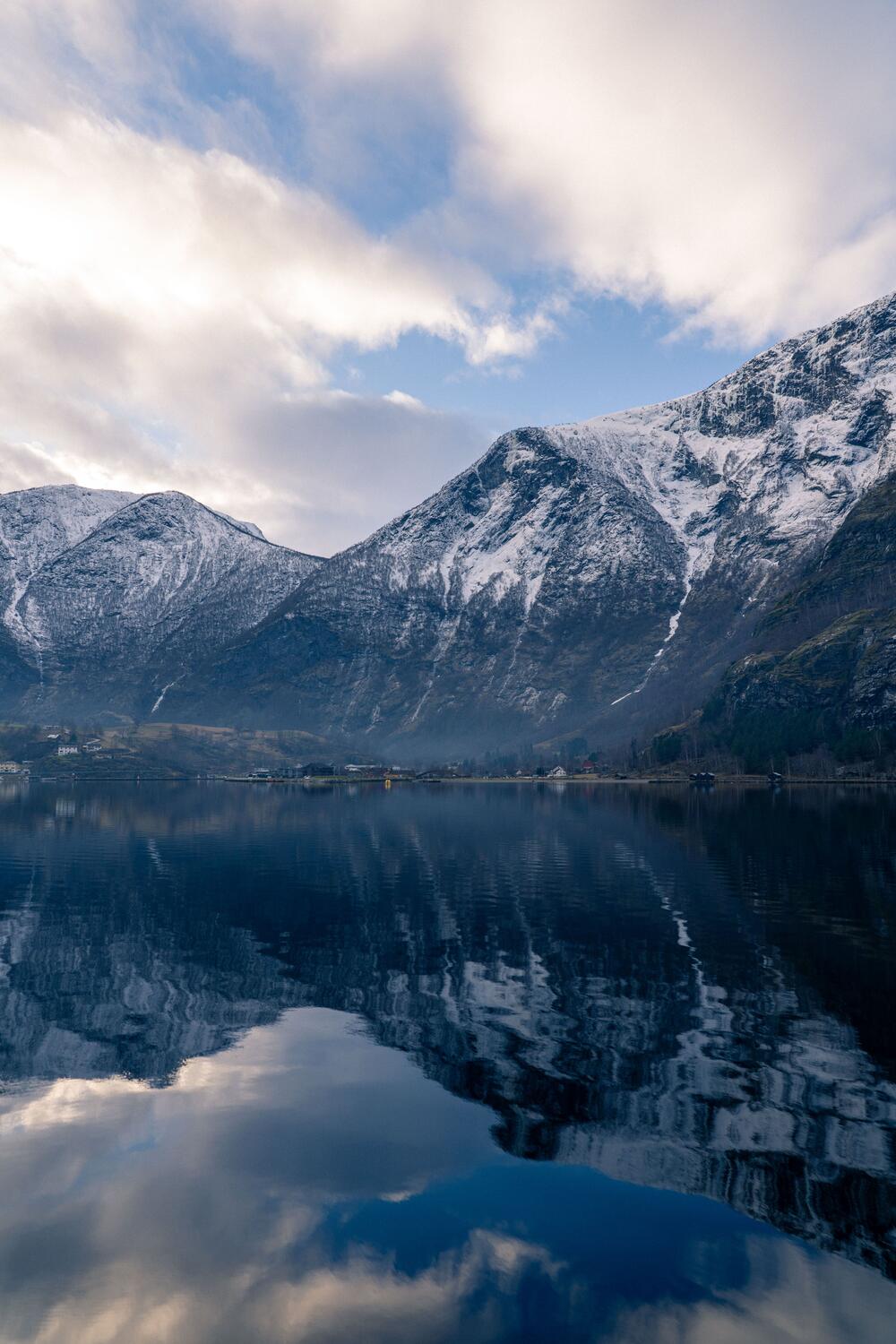 Photo by Audrey Bory on Pexels
Snow-capped mountains reflected in the still water of Nærøyfjord
The Flåm Railway
Must-do
- Route: about 20 km (12.4 mi) from Flåm, at sea level, to Myrdal, at 866 m (2,841 ft)
- Time needed: about 1 hour one-way
- Book ahead: yes, tickets have sold out before
- Best months: year-round; summer for the fullest scenery
- Plan it: 7-day Norway Fjords itinerary
The Flåm Railway climbs about 20 km (12.4 mi) from sea level at Flåm to 866 m (2,841 ft) at Myrdal, in about an hour. The line ranks among the steepest standard-gauge railways in the world, with scheduled stops at waterfalls along the climb.
Book the ride ahead, especially in summer; tickets on this line have sold out before. Trains run year-round, but summer shows off the full run of waterfalls along the track.
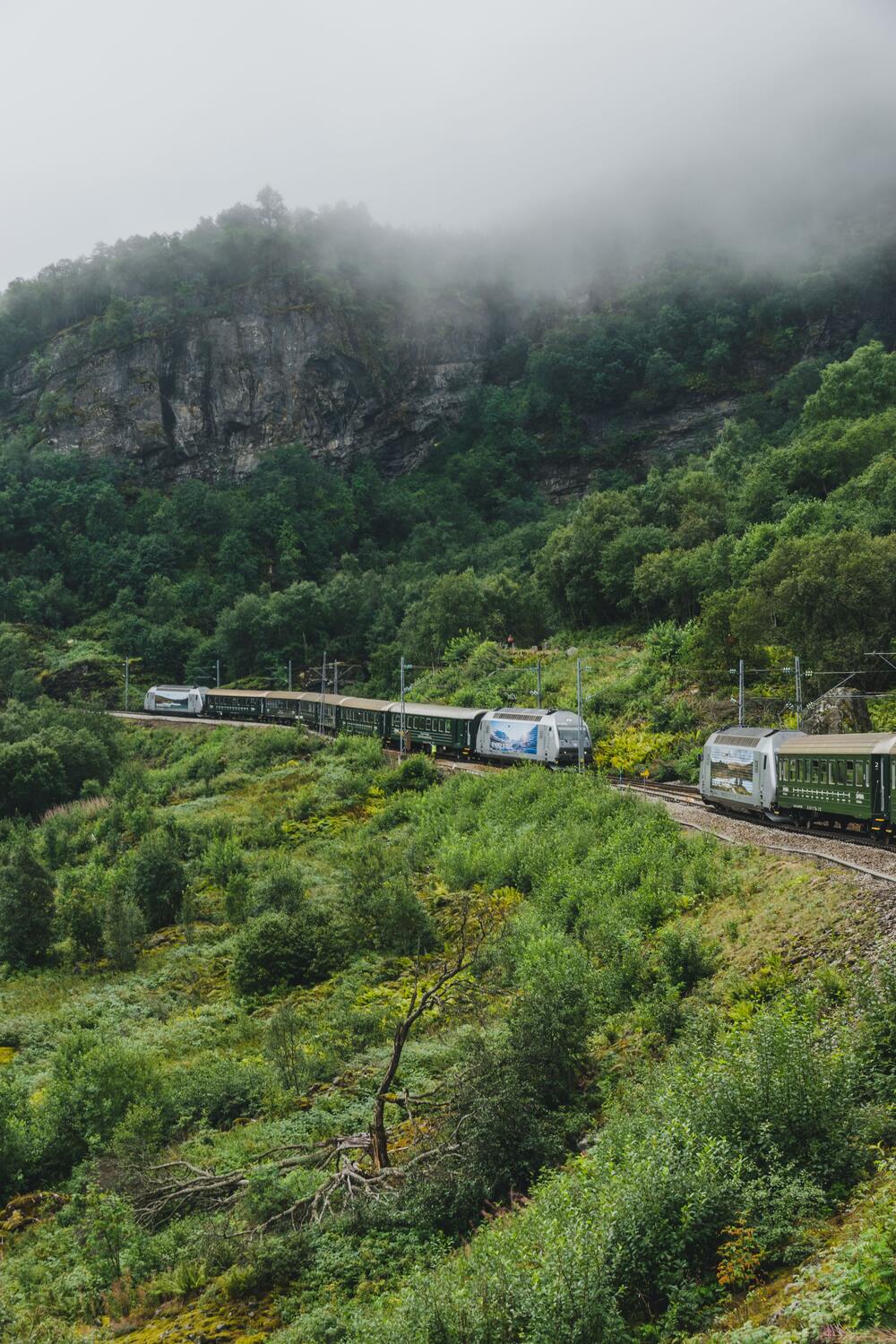 Photo by Enric Cruz López on Pexels
A train on the Flåm Railway line running through the valley
Trollstigen and the Atlantic Ocean Road
- Trollstigen: 11 hairpin bends and a waterfall viewpoint, 1-2 hours including stops; closes for winter
- Atlantic Ocean Road: 8.3 km of highway bridging skerries in the open sea, free to drive
- Best months: summer for Trollstigen (seasonal road); a storm day on the Atlantic Ocean Road for dramatic waves, or a calm summer day for easier driving
- Plan it: Norway guide
Waves break over the low bridges of the Atlantic Ocean Road in a storm, a well-known photo spot on Norway's west coast. Trollstigen's eleven hairpin bends climb through the mountains nearby, up to a waterfall viewpoint at the top of the pass.
Trollstigen takes one to two hours with stops at the viewpoint, and the road closes for winter. The Atlantic Ocean Road's 8.3 km costs nothing to drive.
For a quieter fjord than Geirangerfjord, detour to Hjørundfjord near Ålesund, ringed by the Sunnmøre Alps. Gamle Strynefjellsvegen, a 27 km historic mountain road near Stryn, is a similarly low-traffic alternative to the modern highway.
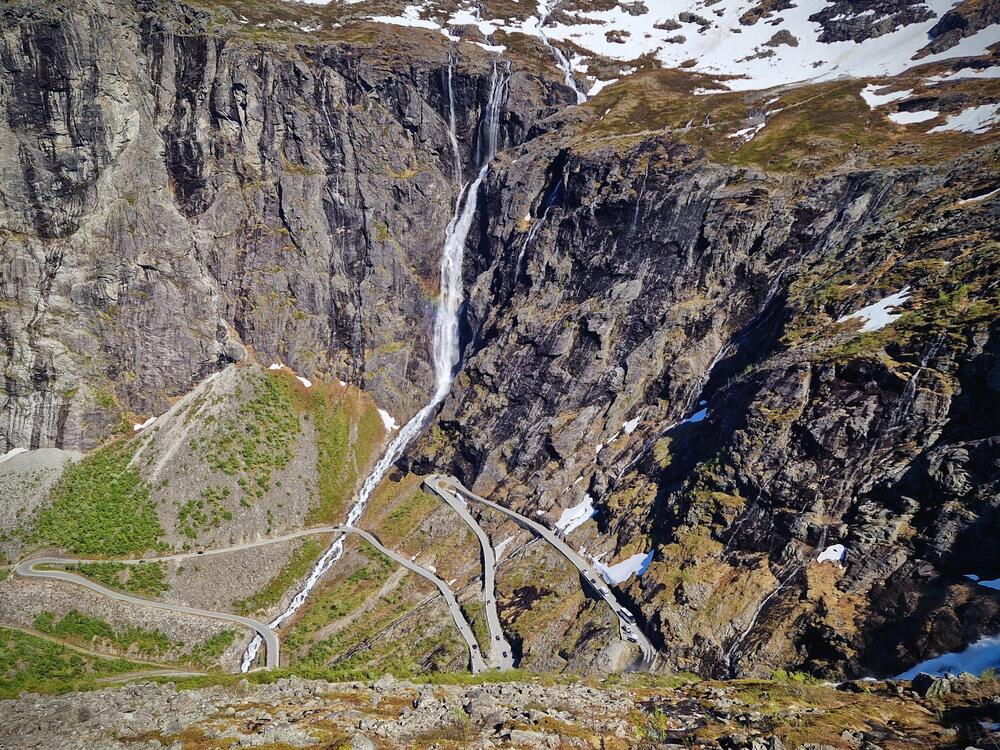 Photo by Peter Holmboe on Pexels
Aerial view of Trollstigen's hairpin road switchbacks and a waterfall
The big hikes
Preikestolen
- Time needed: 4-5 hours round trip (8 km / 5 mi, out-and-back)
- Book ahead: not for the trail; shuttle buses recommended in peak season
- Best months: summer
- Plan it: Norway guide
Preikestolen is worth the climb for a flat cliff plateau 604 m above Lysefjord, one of Norway's best-known hikes and photo spots. The plateau juts out from the cliff at an angle, open air on three sides and Lysefjord far below.
The round trip covers 8 km (5 mi) and takes 4 to 5 hours. Shuttle buses are recommended in peak season, and a trip built with MonkeyEatingMango lists them on its booking checklist. Go in summer, for the most dependable trail conditions underfoot.
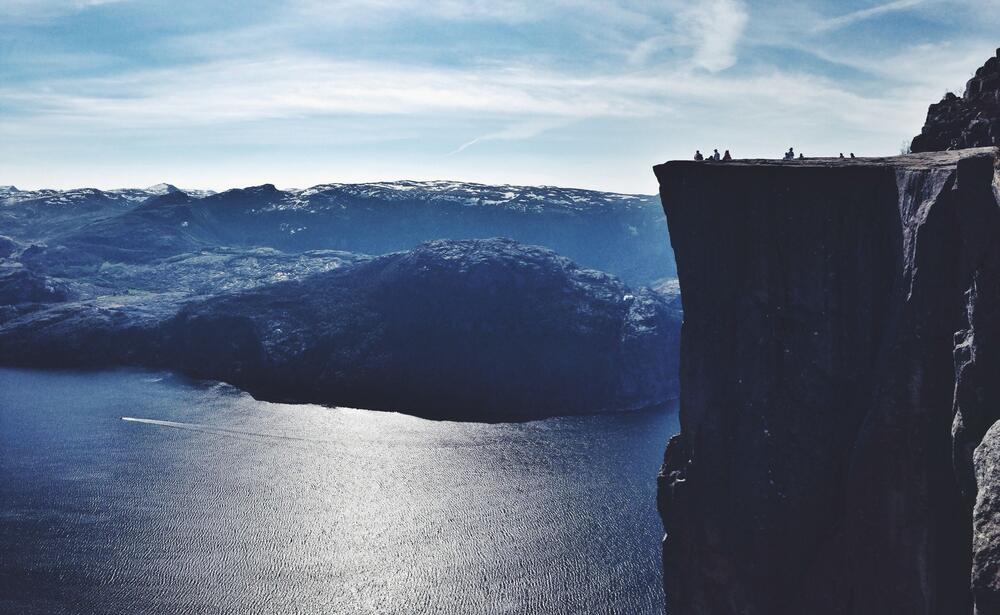 Photo by Snapwire on Pexels
Aerial view of the flat Preikestolen plateau jutting out above Lysefjord
Trolltunga
- Time needed: full day, 10-12 hours round trip
- Book ahead: no trail booking, but a full day of daylight is required
- Best months: summer (snow can block the trail outside it)
- Plan it: Norway guide
The round trip to Trolltunga runs 10 to 12 hours, to a slab jutting 700 m above Ringedalsvatnet lake, so start before dawn no matter the season. Trolltunga sits in Ullensvang, the municipality Odda merged into during Norway's 2020 local government reform. Odda, the valley town below the trail, is still the name to search for directions and lodging.
No permit is required, but the hike demands a full day of daylight.
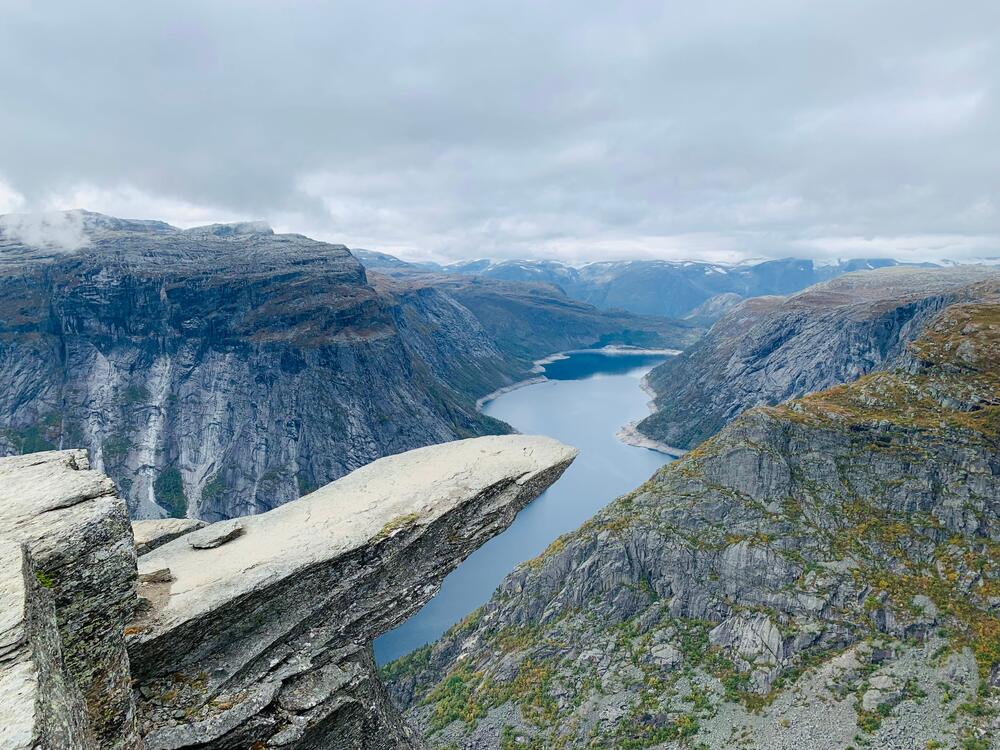 Photo by Sanjay Prakash on Pexels
Aerial view of the Trolltunga rock ledge jutting out above a lake
Kjeragbolten
- Time needed: 6-8 hours round trip
- Best months: summer
- Plan it: Norway guide
Kjeragbolten asks for more commitment than Preikestolen: 6 to 8 hours round trip to a boulder wedged in a mountain crevasse 1,000 m above Lysefjord. Stavanger is within reach of both hikes, though Kjeragbolten's trail reaches further into the cliffs above the same fjord.
No official fee applies to the hike, and summer is the season to attempt it. Lysebotn is the hamlet the climb starts from.
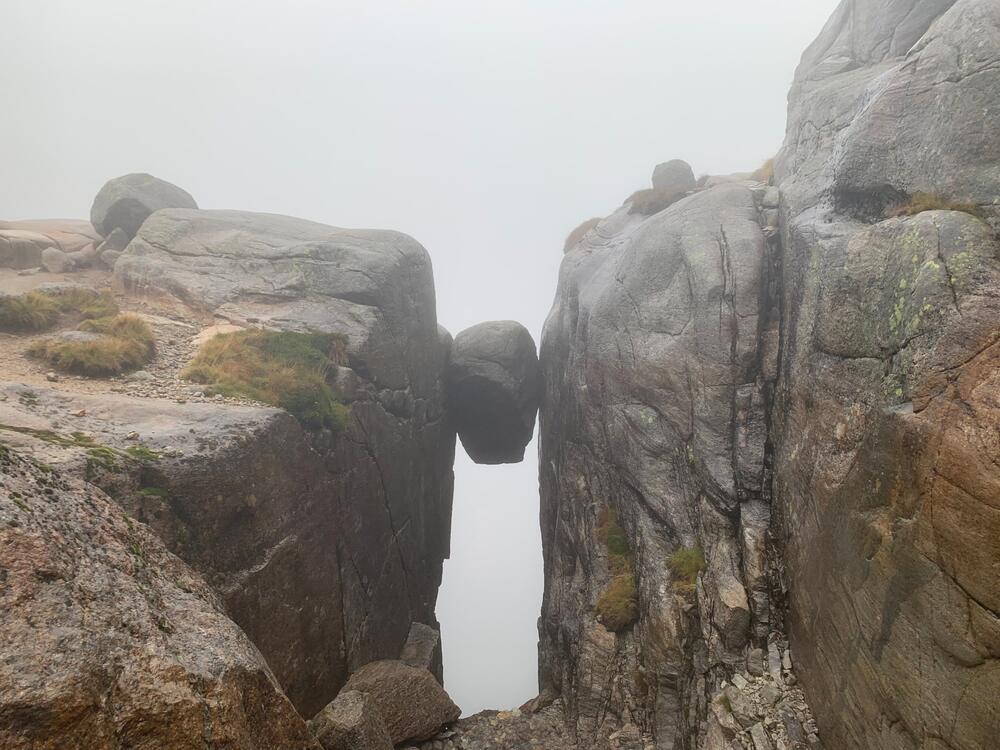 Photo by Sanjay Prakash on Pexels
Kjeragbolten, the boulder wedged in a mountain crevasse above Lysefjord
Jotunheimen National Park and the Besseggen Ridge
- Time needed: day hikes to multi-day treks; Besseggen runs 6-8 hours one-way with a boat transfer
- Book ahead: yes, for the Gjendesheim-Memurubu ferry
- Best months: late June to September for Besseggen, trail-condition dependent; summer generally for the park
- Plan it: Norway guide
Jotunheimen holds Norway's two tallest peaks, Galdhøpiggen and Glittertind, among more than 250 mountains reaching nearly 2,000 m. Besseggen Ridge crosses 14 km (9 mi) of ridge between two lakes of different colors.
The ridge runs one-way between Gjendesheim and Memurubu, 6 to 8 hours, with a boat transfer that needs booking ahead. Go between late June and September, when the trail is clear of snow.
Longer treks into the park need lodge bookings ahead in peak season, though wild camping needs no permit or fee, covered nationwide under Norway's right to roam.
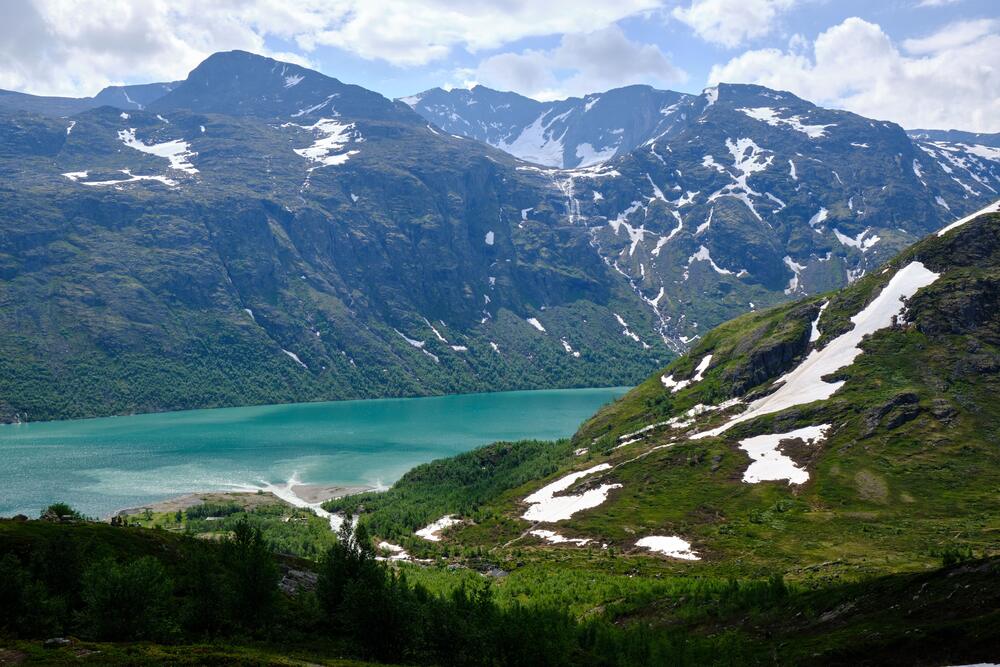 Photo by Barnabas Davoti on Pexels
The Besseggen Ridge landscape with snow-capped peaks above a turquoise lake
The glaciers: Folgefonna and Jostedalsbreen
- Folgefonna: guided ice hikes, half a day; mainland Norway's third-largest glacier
- Jostedalsbreen / Briksdal: the largest glacier in continental Europe; the Briksdal arm takes 2-4 hours to reach
- Best months: summer
- Plan it: Norway guide
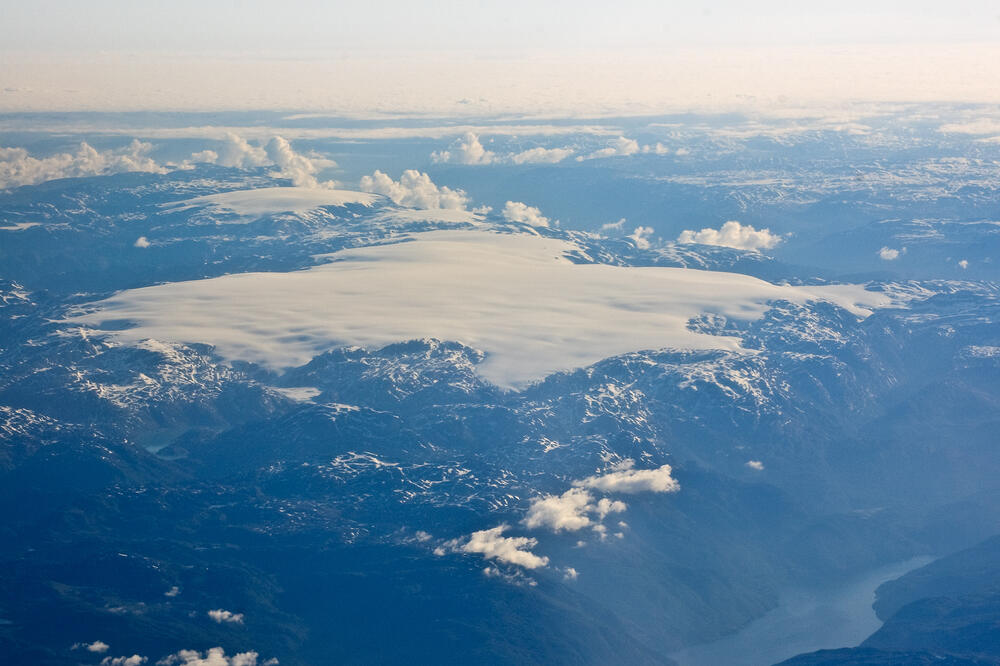
Hike Folgefonna first if glacier time is short: guided half-day tours cover mainland Norway's third-largest glacier. Jostedalsbreen spreads out as the largest glacier in continental Europe, with Briksdalsbreen as its easiest-access arm.
Reaching the Briksdal arm takes 2 to 4 hours, shorter than the half-day trip to Folgefonna. Book a guided tour for ice access at both; summer works best for either.
 Aqwis (CC BY-SA 3.0)
Aerial view of the Folgefonna glacier
Hardangervidda and the right to roam
- Time needed: day hikes to multi-day treks, or a few hours by train across the plateau
- Best months: summer
- Plan it: Norway guide
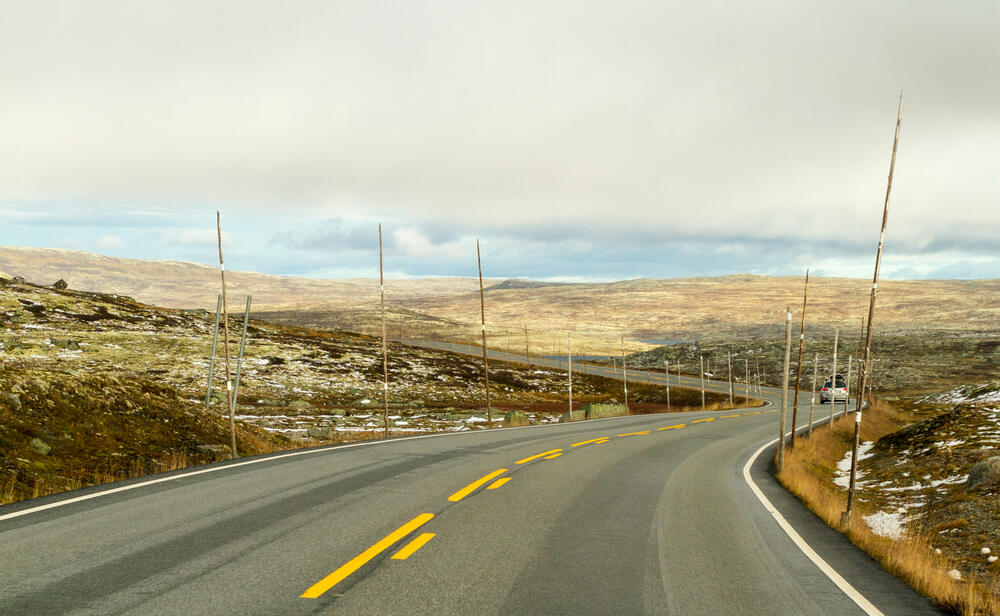
Wild reindeer herds roam Hardangervidda, Europe's largest mountain plateau, crossed by the Oslo-Bergen railway. The train ride over the plateau takes a few hours, the easiest way to see it without a multi-day trek.
Allemannsretten, Norway's right to roam, opens wild camping on the plateau to anyone, free and without a permit. The same law covers beaches, mountains and national parks nationwide, beyond Hardangervidda alone.
A day hike suits a short stop.
 TimOve (CC BY 2.0)
The open mountain plateau of Hardangervidda
The cities
Oslo
- Vigeland Park: 1-2 hours; free, more than 200 granite and bronze figures by Gustav Vigeland
- Oslo Opera House: free to walk the roof and exterior; backstage tours ticketed
- Akershus Fortress: 1-2 hours; free to walk the grounds
- Norsk Folkemuseum: 2-3 hours; more than 150 historic buildings, including a stave church
- Fram Museum: 1-2 hours; NOK 180 adult
- Munch museum: 1-2 hours; ticketed
- Plan it: Norway guide
Vigeland Park holds more than 200 granite and bronze figures by Gustav Vigeland, free to walk any day of the year. The open-air collection fills Frogner Park, worth a visit on your first day in Oslo.
Down by the water, the Oslo Opera House's sloped roof doubles as a free public walkway over the waterfront; backstage tours run on their own ticket. Akershus Fortress, the medieval castle on Oslo's harbor, keeps its grounds open at no charge.
Norsk Folkemuseum gathers more than 150 historic buildings, including a stave church, on the Bygdøy peninsula. Walk aboard the actual polar ship at the Fram Museum nearby for NOK 180, or spend an afternoon with the Munch museum's collection across town.
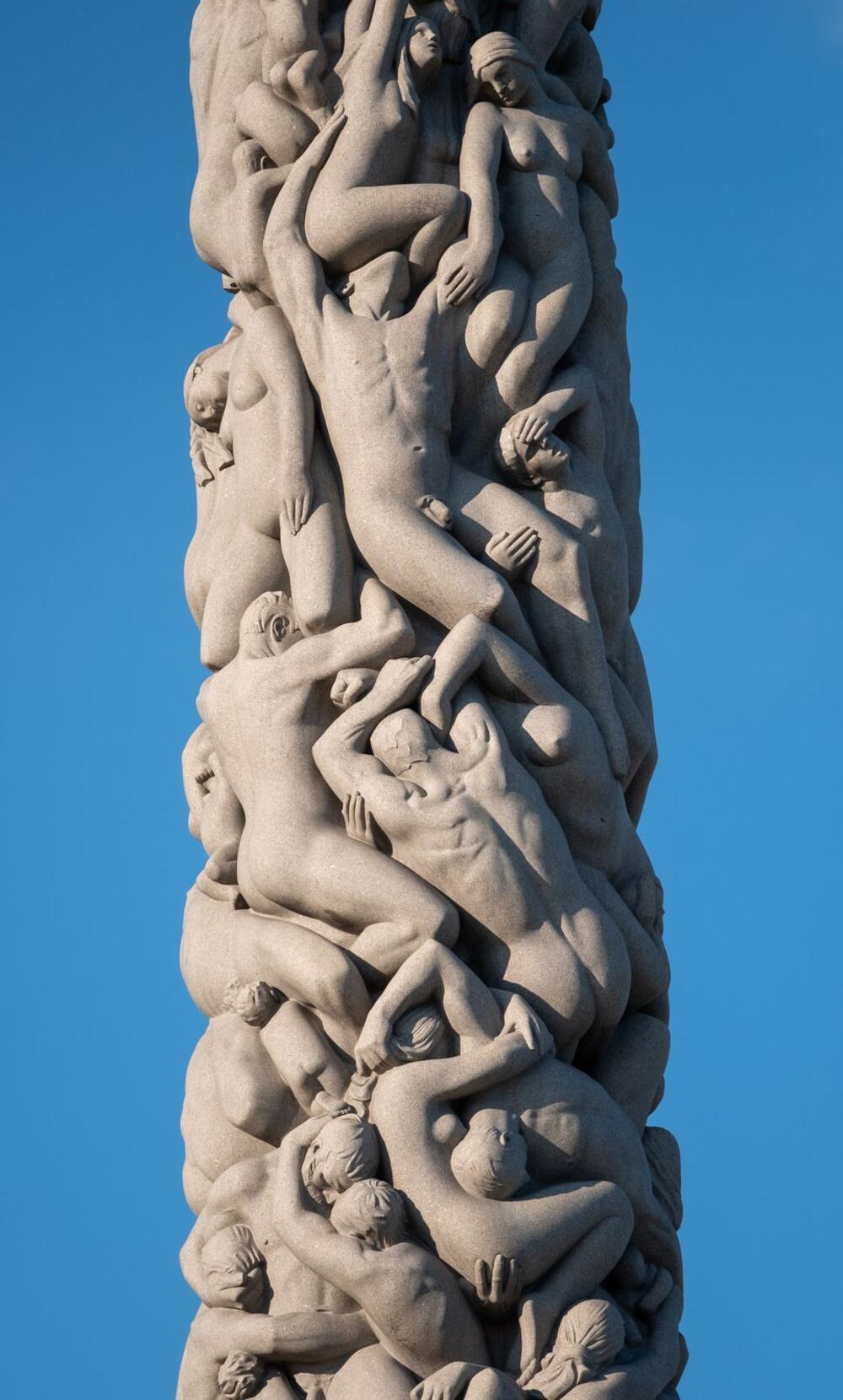 Photo by Ludvig Hedenborg on Pexels
The granite Monolith sculpture at Vigeland Park in Oslo against a clear sky
Bergen
- Bryggen: 1-2 hours; free to walk; UNESCO (1979)
- Mount Fløyen: 1-2 hours by the Fløibanen funicular or on foot
- Plan it: 10-day Norway itinerary, 7-day Norway Fjords itinerary
Bryggen's wooden wharf buildings have lined Bergen's harbor since the 12th century, a UNESCO World Heritage Site since 1979.
Ride the Fløibanen funicular up Mount Fløyen for the classic panorama, with Bergen ringed by seven mountains below, or make the climb on foot. Bergen is also the base for most fjord tours into the surrounding region.
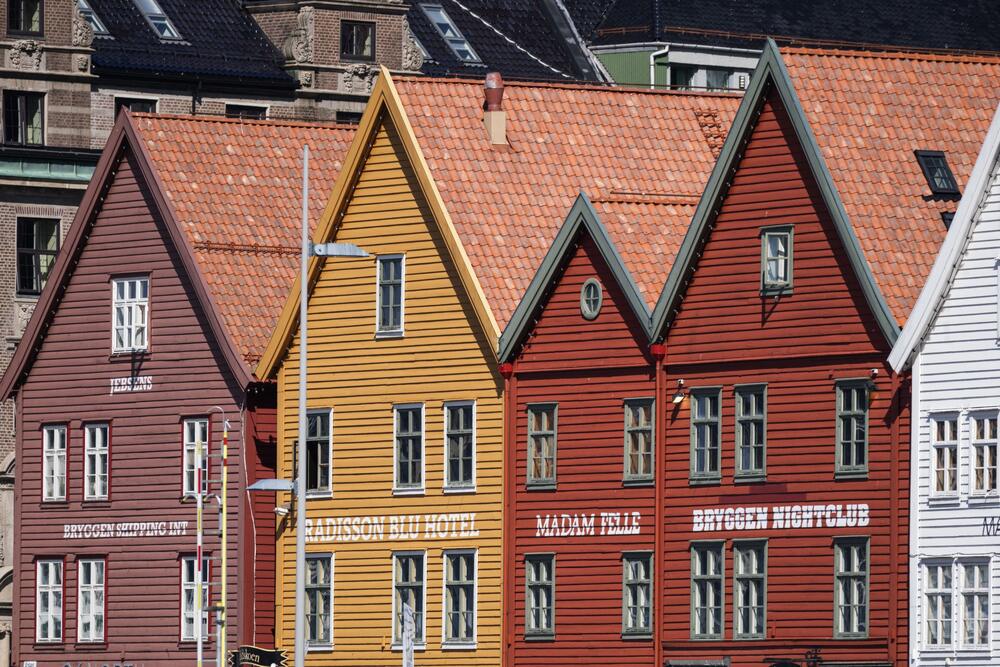 Photo by Rino Adamo on Pexels
Colorful wooden houses lining Bryggen, Bergen's historic wharf
Stavanger
- Gamle Stavanger: 1-2 hours; free; 18th-century wooden old town
- Norwegian Petroleum Museum: 1-2 hours; ticketed
- Plan it: Norway guide
Stay in Stavanger if Preikestolen or Kjeragbolten is on your list. Gamle Stavanger, the preserved 18th-century old town, fills an hour or two on its own, free to wander.
The Norwegian Petroleum Museum covers Norway's North Sea oil industry, a good stop between hikes.
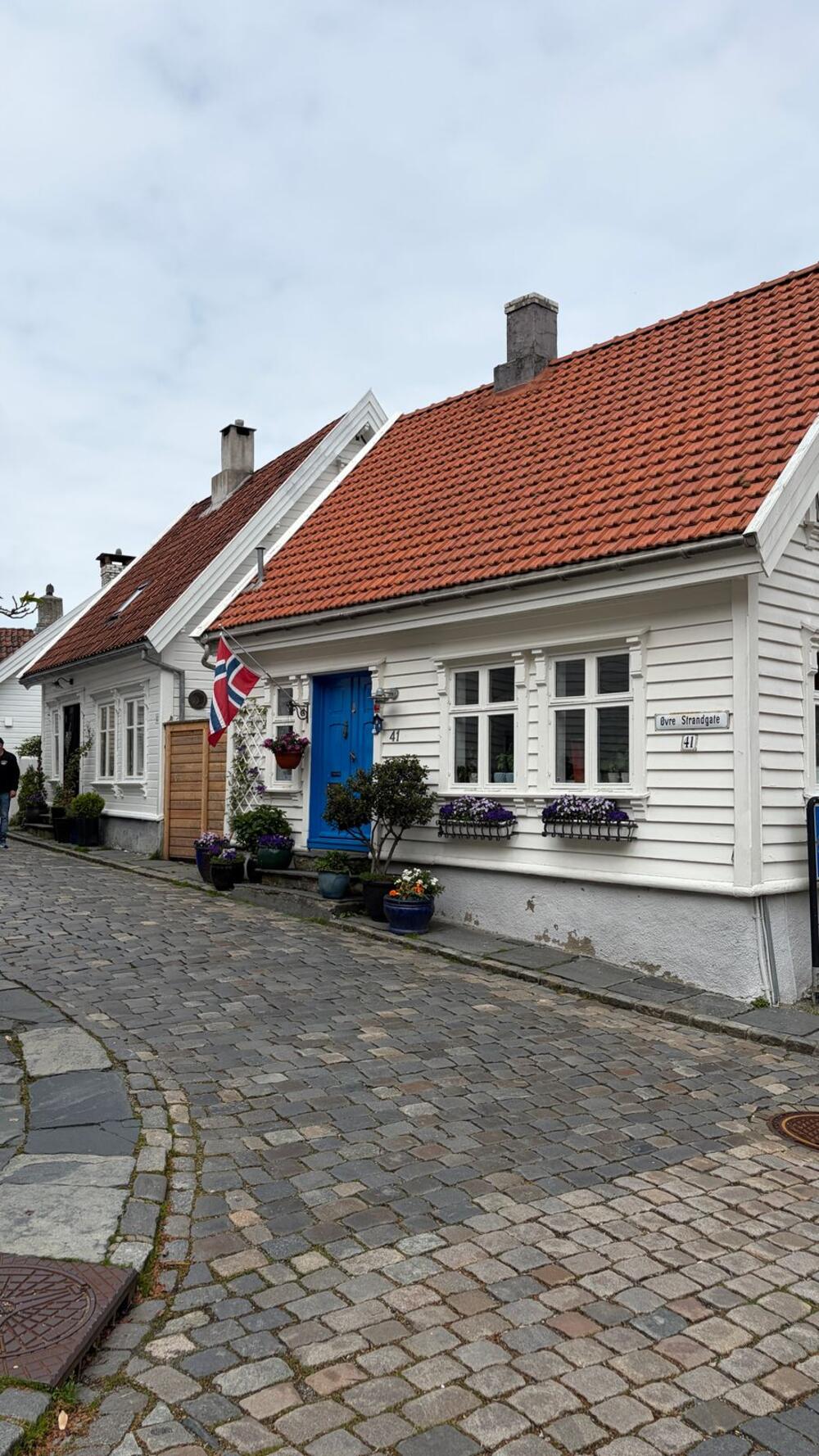 Photo by Fatih Genc on Pexels
A cobblestone street lined with traditional white wooden houses in Gamle Stavanger
Ålesund
- Art Nouveau (Jugendstil) architecture: free to walk; rebuilt after an 1904 fire
- Mount Aksla: viewpoint above the harbor, best at sunset
- Plan it: 10-day Norway itinerary
Mount Aksla rewards a climb before anything else in Ålesund: a view over the harbor and the Art Nouveau rooftops below.
The town was rebuilt almost entirely in Jugendstil style after a fire destroyed it in 1904. The result is one unified streetscape of turrets, spires, and ornament.
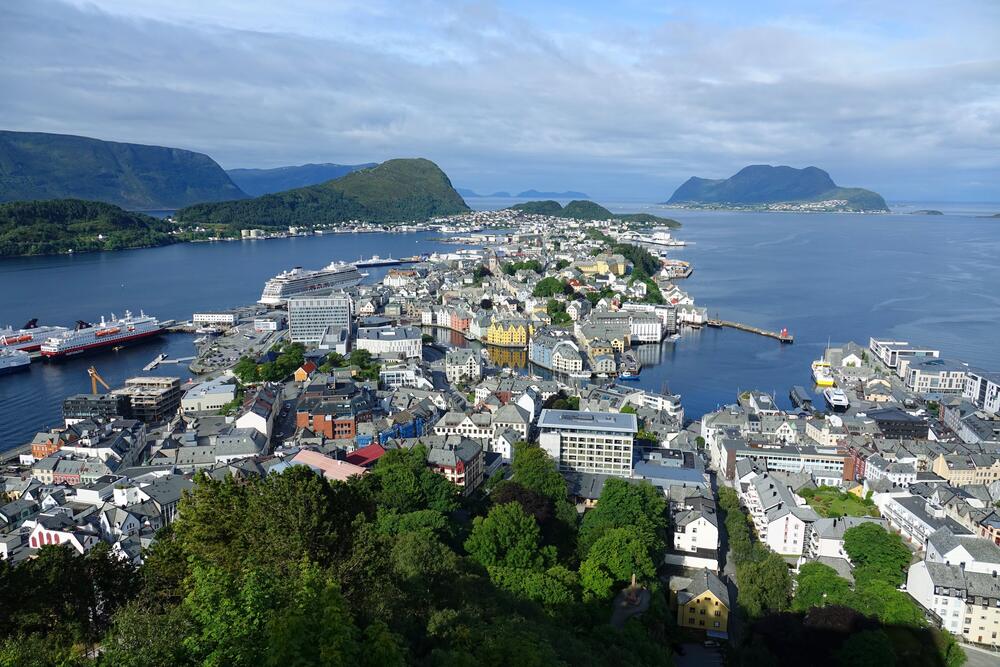 Bjørn Christian Tørrissen (CC BY-SA 4.0)
Ålesund's Art Nouveau rooftops seen from the Mount Aksla viewpoint
Trondheim
- Nidaros Cathedral: 1-2 hours; begun in 1070 on the Viking king Olav's grave; ticketed
- Bakklandet: historic wooden old-town district
- Plan it: Norway guide
Trondheim, Norway's third-largest city, is built around Nidaros Cathedral. The cathedral has stood over the Viking king Olav's grave since construction began in 1070, its facade carved with 76 sculptures.
Climb the tower for the view, then walk from the cathedral to Bakklandet, the wooden old-town district nearby.
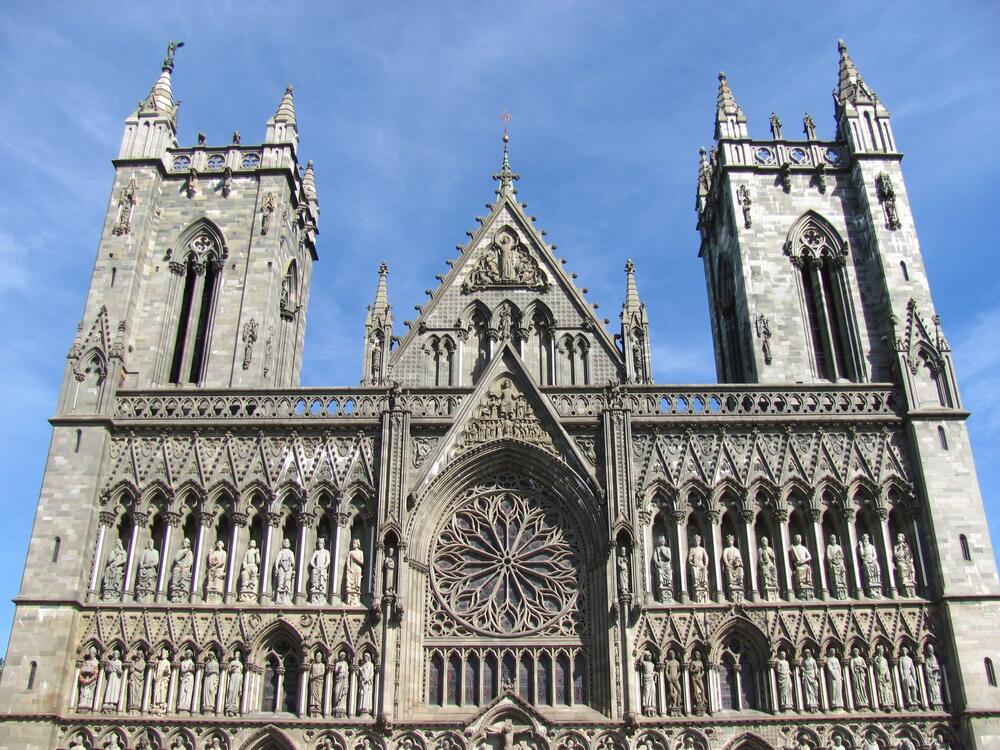 Photo by Marian Florinel Condruz on Pexels
The twin towers and facade of Nidaros Cathedral in Trondheim
Røros and Rjukan
- Røros: a former copper-mining town, free to walk; UNESCO (1980)
- Rjukan: industrial hydropower heritage in Telemark, free to walk; UNESCO (2015)
- Plan it: Norway guide
Røros earned UNESCO status in 1980 for its wooden copper-mining architecture, and Rjukan followed in 2015 for its hydropower and industrial history.
Røros is at its best in winter, when snow settles over its wooden rooftops, and the town stays free to walk year-round.
Rjukan sits apart in Telemark, a different kind of industrial heritage. A hydropower town, it's known for the sun mirror that reflects daylight onto the valley in winter and for a WWII history tied to the heavy-water sabotage raids.
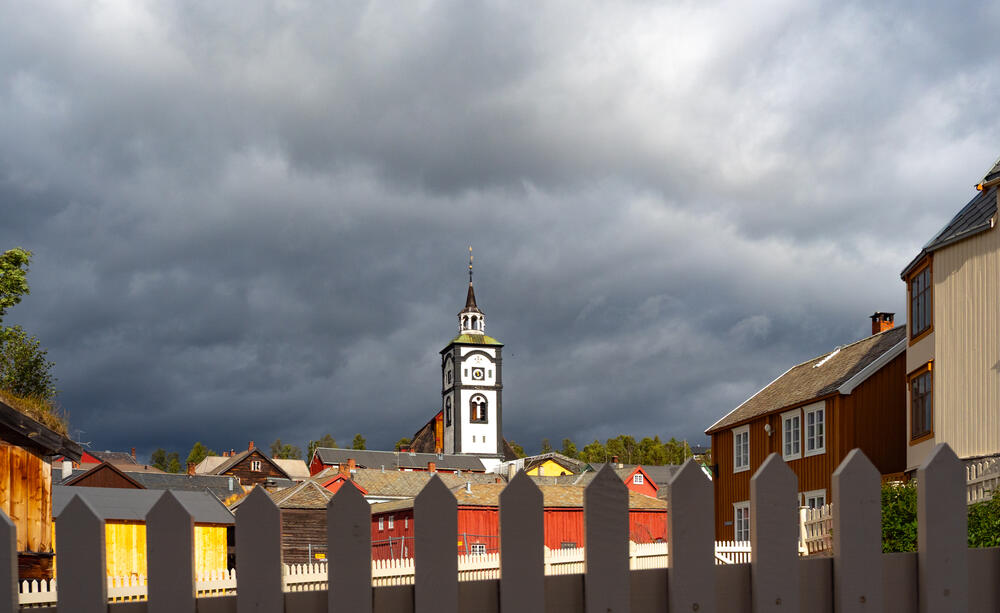 Sivbenteu (CC0)
Røros's old wooden houses and the Røros Church tower
The Arctic north
Tromsø
- Best months: October to March for the northern lights, lodging books up fast; summer for the midnight sun and lower prices
- Plan it: Norway guide, Tromsø in July, Tromsø in March, Tromsø in June, Tromsø in December
Tromsø, well above the Arctic Circle, is the most accessible base for northern lights viewing and day trips into the Arctic terrain. Lodging books up fast in northern-lights season, from October to March.
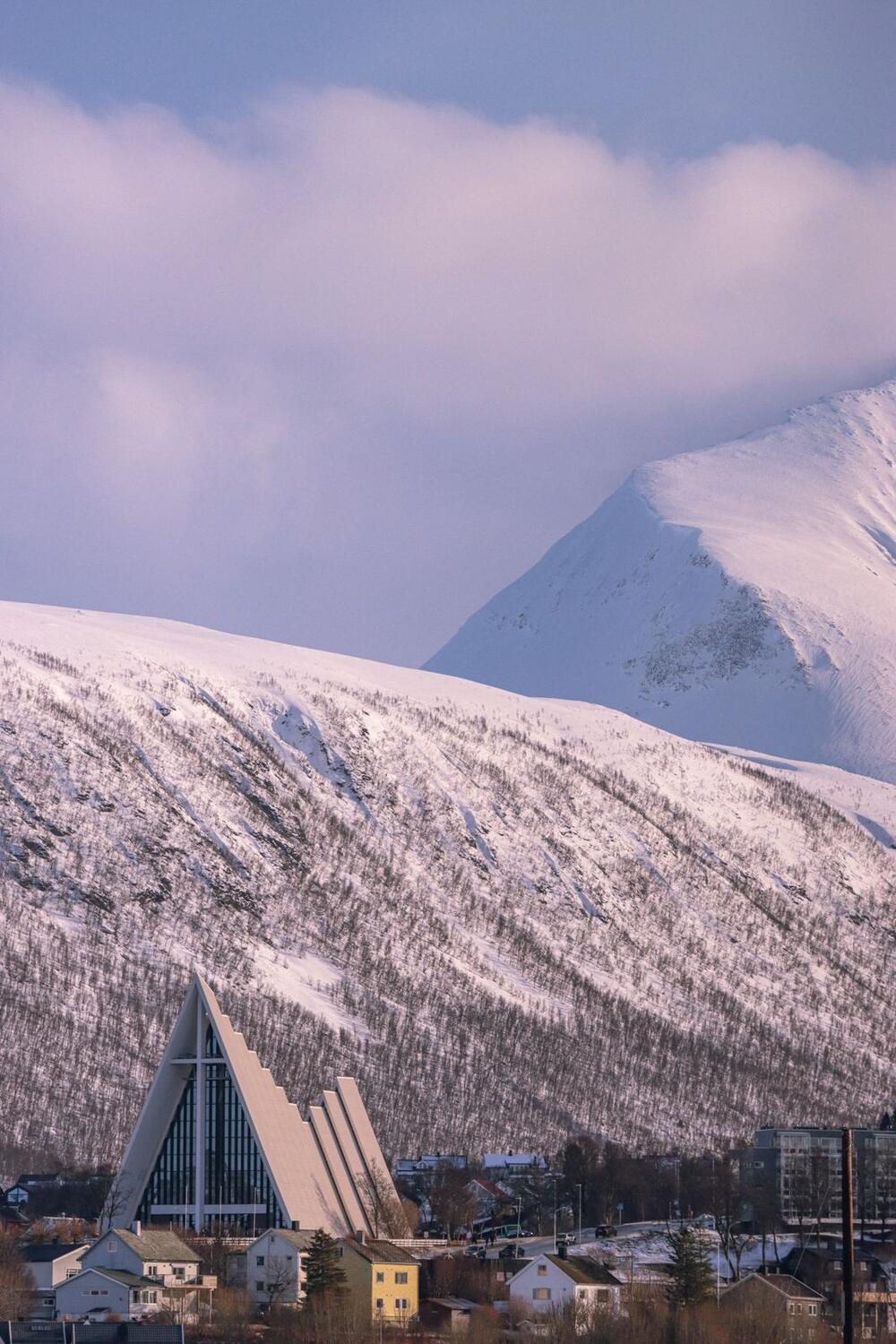 Photo by Efrem Efre on Pexels
The Arctic Cathedral in Tromsø against snow-capped mountains
Lofoten Islands
- Best months: summer for the midnight sun and hiking; winter for the northern lights
- Book ahead: lodging well ahead for summer
- Plan it: Norway guide
At midnight in June, the sun still sits above Lofoten's jagged peaks, lighting the archipelago's red rorbu cabins on the water. Fishing villages dot the coast, among them Reine, Svolvær, and Henningsvær.
Plan on 3 to 5 days to do the archipelago justice, and book lodging well ahead for summer, when rooms fill fast. Winter instead gives you a shot at the northern lights.
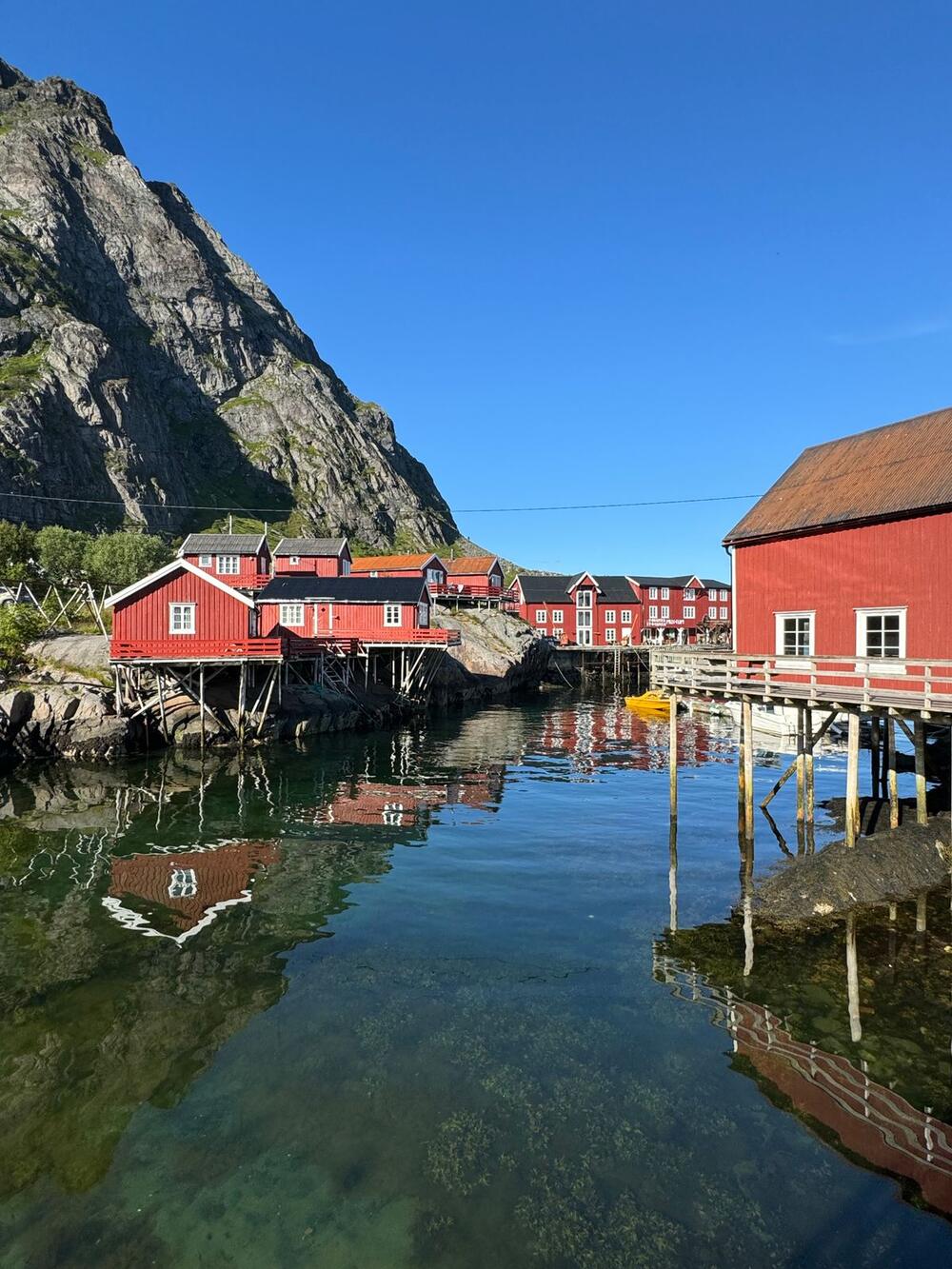 Photo by Petra Nesti on Pexels
Red rorbu cabins reflected on calm water in Lofoten
Svalbard and the polar night
- Best months: summer for daylight and wildlife; winter for the polar night and northern lights
- Guides: a professional guide with polar bear protection is required outside the settlements
- Plan it: Norway guide
A professional guide with polar bear protection is required the moment you step outside Longyearbyen's settlements, even for a short walk. Svalbard sits roughly halfway between mainland Norway and the North Pole.
Plan on 3 to 5 days, split between summer's round-the-clock daylight and wildlife or winter's polar night and northern lights.
The northern lights window runs from late August to late March. The midnight sun, when the sun doesn't set at all, lasts from a couple of weeks at Bodø's latitude to a couple of months at Longyearbyen's.
Try free
Plan your Norway trip in about 2 minutes
Tap through 8 quick cards for a complete itinerary with budget, maps, and packing lists. No account required.
Plan your Norway trip →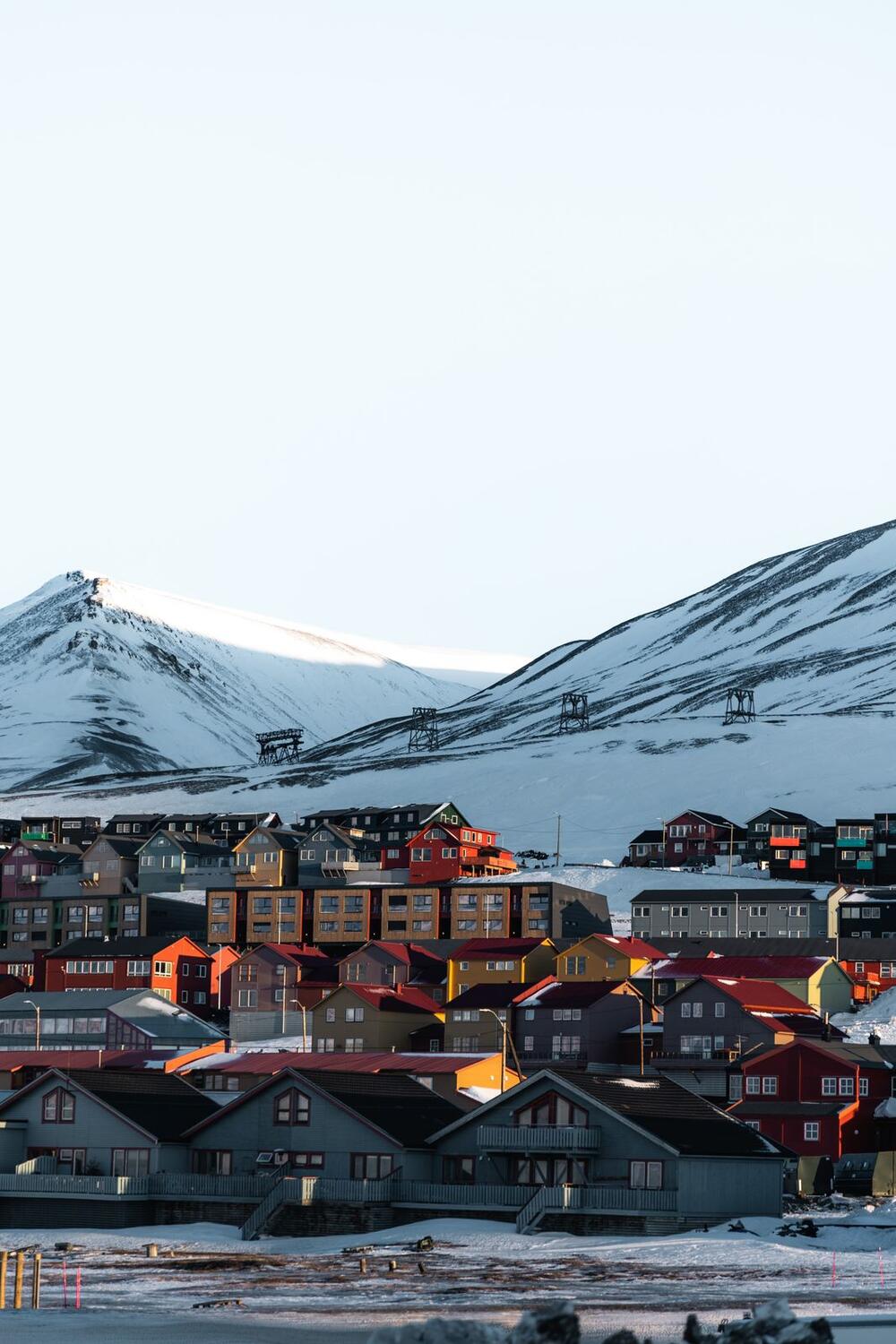 Photo by Tomáš Malík on Pexels
Colorful houses in Longyearbyen framed by snow-covered mountains
One trip by sea
The Hurtigruten Coastal Express
- Route: Bergen to Kirkenes and back, calling at 34 ports
- Length: 12 days round trip; one-way segments also sold
- Book ahead: yes, especially for cabins
- Best months: winter for the northern lights above the Arctic Circle; summer for the midnight sun
- Fares: promotional and date-dependent; see hurtigruten.com's Coastal Express page for current pricing
- Plan it: Norway guide
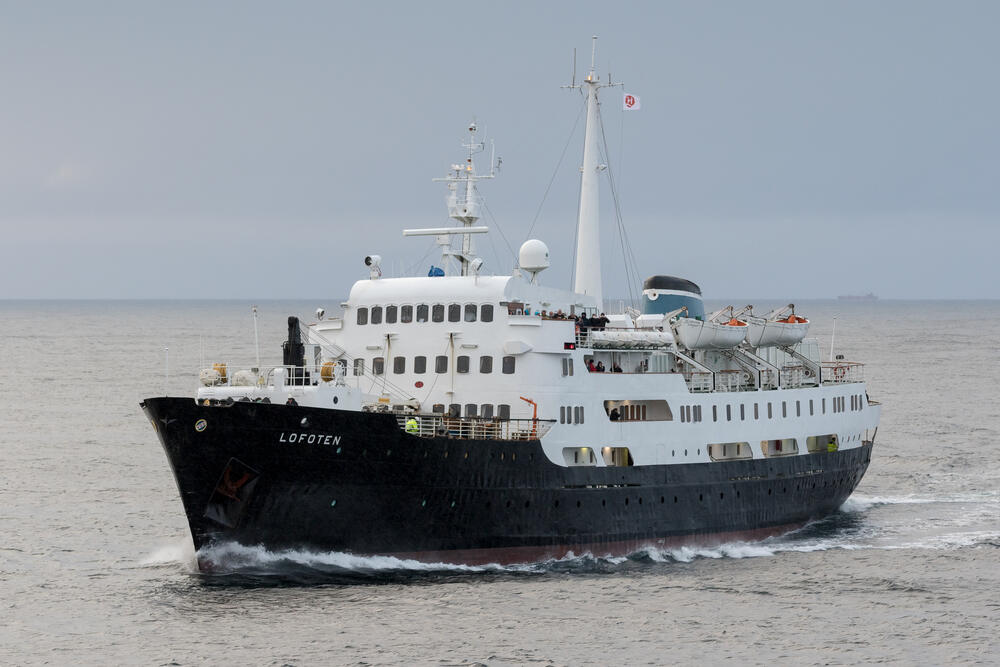
Flying between Norway's coastal cities covers the same ground in hours; the Hurtigruten Coastal Express takes 12 days and calls at 34 ports along the way. The ferry runs year-round between Bergen and Kirkenes and back.
Book ahead, especially for a cabin. Winter sailings reach north of the Arctic Circle, when the northern lights are the draw; summer sailings run under the midnight sun instead.
Fares are promotional and shift with the season, so check hurtigruten.com's Coastal Express page for current pricing rather than a fixed number.
 JoachimKohlerBremen (CC BY-SA 4.0)
The Hurtigruten ship MS Lofoten along the Norwegian coast
More things to see
| Place | Go for | Region |
|---|---|---|
| Marmorslottet | A visually unusual marble-rock formation near the Arctic Circle | Northern Norway (Nordland) |
| Uredd Rest Area | A genuinely unusual, widely photographed piece of public design | Northern Norway (Nordland) |
| Under | Dining with an underwater window view, at Norway's southern tip | Southern Norway (Agder) |
| Viking Valley Njardarheimr | An immersive, staffed Viking-era village re-creation | Fjord Norway (Vestland) |
| Ægir Brewery | A distinctive architectural pub stop in Flåm, named for a Norse sea giant | Fjord Norway (Vestland) |
| Saltstraumen | A narrow strait with an extremely fast tidal current, near Bodø | Northern Norway (Nordland) |
| Urnes Stave Church | The architectural ancestor of Norway's stave-church tradition, UNESCO-listed since 1979 | Fjord Norway (Vestland) |
| Alta (Rock Art of Alta) | Norway's most significant prehistoric rock-art site, UNESCO-listed since 1985 | Northern Norway (Finnmark) |
| Karasjok / Sami culture | The Sami Parliament and Sami National Museum, a window into Norway's indigenous culture | Northern Norway (Finnmark) |
| Nordkapp | A 307 m cliff promoted as mainland Europe's northernmost point reachable by road | Northern Norway (Finnmark) |
The best things to do in Norway at a glance
| Place | Go for | Book ahead |
|---|---|---|
| Geirangerfjord | A UNESCO fjord cruise beneath the Seven Sisters waterfall | the cruise, in summer |
| Nærøyfjord and the fjord villages of Flåm and Aurland | The other half of the Geirangerfjord UNESCO inscription, plus Stegastein Viewpoint | the boat, in summer |
| The Flåm Railway | One of the steepest standard-gauge railways in the world | yes, tickets sell out |
| Trollstigen and the Atlantic Ocean Road | Hairpin bends and a bridge-hopping drive over the open sea | no |
| Preikestolen | A flat cliff plateau 604 m above Lysefjord | shuttle buses in peak season |
| Trolltunga | A rock ledge 700 m above Ringedalsvatnet lake, a full-day hike | no, but start at dawn |
| Kjeragbolten | A boulder wedged over a 1,000 m drop | no |
| Jotunheimen National Park and the Besseggen Ridge | Norway's two tallest peaks and the Besseggen ridge trek | the Gjendesheim-Memurubu ferry |
| The glaciers: Folgefonna and Jostedalsbreen | Guided ice hikes on mainland Norway's biggest glaciers | guided tours |
| Hardangervidda and the right to roam | Europe's largest mountain plateau and free wild camping | lodges for a multi-day crossing |
| Oslo | Vigeland Park, the Opera House and the Fram Museum | no |
| Bergen | Bryggen's UNESCO wharf and the Fløibanen funicular | no |
| Stavanger | Gamle Stavanger, within reach of Preikestolen and Kjeragbolten | no |
| Ålesund | Art Nouveau architecture and the Mount Aksla viewpoint | no |
| Trondheim | Nidaros Cathedral and the Bakklandet old town | no |
| Røros and Rjukan | Two inland UNESCO towns: copper mining and hydropower heritage | no |
| Tromsø | The main base for the northern lights | lodging, October to March |
| Lofoten Islands | Red rorbu cabins beneath a jagged mountain archipelago | lodging, for summer |
| Svalbard and the polar night | Polar bears, the polar night and the midnight sun | a guided tour outside settlements |
| The Hurtigruten Coastal Express | A 12-day coastal voyage from Bergen to Kirkenes | yes, especially cabins |
Plan your Norway trip
For trip length, getting around and costs, start with the Norway travel guide. When you build a trip with MonkeyEatingMango, the booking checklist lists what to book and how many weeks ahead. Every sight on a day's plan is marked Must-do, Maybe or Skip if tired.
Common questions
How many days do you need in Norway?
A week covers Bergen, the Flåm Railway and Nærøyfjord, and Geirangerfjord in one loop. Ten days stretches that into Bergen and Ålesund, or adds a flight north to Tromsø.
What is the best month to visit Norway?
Searches for Norway's best travel month split two ways. One points to June through August, the peak window for the fjords and the high hikes. The other favors the shoulder months, May and June or September and October, for fewer crowds at the same sights.
Is 3 days in Norway enough?
Three days covers one city and a single day trip, such as Oslo with Vigeland Park and the Opera House, or Bergen with Bryggen and a short fjord cruise. Three days isn't enough to add one of the big hikes: Preikestolen alone takes 4 to 5 hours round trip, and Trolltunga takes a full day.
Is Norway expensive to visit?
Norway is one of the pricier countries to visit in Europe for hotels, food and transport. The Norway travel guide breaks down a daily budget by travel style, from backpacker to luxury.
What is Norway's best-known attraction?
Geirangerfjord is Norway's best-known fjord, part of the West Norwegian Fjords UNESCO World Heritage Site inscribed in 2005 together with Nærøyfjord. Geirangerfjord's two named viewpoints are the Seven Sisters waterfall and the abandoned Skageflå farm.
When can you see the northern lights in Norway?
The viewing window for the northern lights runs from late August to late March. Tromsø, Lofoten and Alta are the three bases travelers use for chasing them, and lodging in Tromsø books up fastest from October through March.
How long does the midnight sun last in Norway?
The midnight sun, when the sun never fully sets, lasts from a couple of weeks at Bodø's latitude to a couple of months at Longyearbyen's, the longest stretch in Norway.
Do you need a guide to visit Svalbard?
Yes. Svalbard requires a professional guide with polar bear protection outside its settlements, including Longyearbyen.
Is English widely spoken in Norway?
Yes. English is widely spoken across Norway, especially in cities, shops and anywhere tourists go.
What does allemannsretten mean for travelers?
Allemannsretten, the Norwegian right to roam, opens beaches, mountains and national parks nationwide to free wild camping. Hikers heading into Jotunheimen or along the fjords rely on it to camp for free along the trail.

Written by Shobhit Shrivastava · Founder
Related reading
Things to Do in New Zealand and the Best Places to Visit
Where to go in New Zealand and what to do there: 16 places across the North and South Islands, each with the time it takes, what to book and the official price.
Things to Do in California: Best Places to Visit
Where to go in California and what to see: iconic cities, national parks, theme parks, and the coast and wine country, with time needed, what to book and the official price.
Things to Do in Puerto Rico and the Best Places to Visit
Where to go in Puerto Rico by region: Old San Juan's forts, El Yunque and the bioluminescent bays to the east, Vieques and Culebra by ferry, and the surf towns and caves of the west and south. Every stop carries its top sights, the official price where one exists, and what to book ahead.