The best time to visit Japan is late March to early April or the month of November: the cherry blossom reaches full bloom on March 31 in Tokyo and April 4 in Kyoto on average, and November brings the autumn leaves and mild, dry days of 17.6 °C (64 °F) in both cities. January and February are the quietest months. June is the rainy season, and August stacks the heat, the year's busiest hotels and the typhoon peak.
Try free
Plan a trip in about 2 minutes
Tap through 8 quick cards for a complete itinerary with budget, maps, and packing lists. No account required.
Plan a trip →- Cherry blossom: full bloom on March 31 in Tokyo, April 4 in Kyoto and Osaka, and May 6 in Sapporo, on Japan Meteorological Agency averages.
- Autumn leaves: maples turn from October 28 in Sapporo to November 22 in Hiroshima, November 28 in Tokyo and December 5 in Kyoto.
- Crowds: August is the only peak month nationwide (1.22 times the average month's hotel stays in 2025); January and February are the low months.
- Holidays to avoid: Golden Week (April 29 and May 1 to 5, 2027), Obon (mainly August 13 to 16) and New Year (December 29 to January 4).
- Weather risks: the rainy season from early June to mid-July and typhoons in August and September.
Japan month by month at a glance
| Month | Tokyo high | Kyoto high | Sapporo high | Naha (Okinawa) high | Hotel stays vs average | What's on |
|---|---|---|---|---|---|---|
| January | 10.4 °C (51 °F) | 8.8 °C (48 °F) | −0.1 °C (32 °F) | 19.9 °C (68 °F) | Low (0.88) | New Year, skiing |
| February | 11.2 °C (52 °F) | 9.8 °C (50 °F) | 0.9 °C (34 °F) | 20.1 °C (68 °F) | Low (0.87) | Sapporo Snow Festival |
| March | 15.3 °C (60 °F) | 14.7 °C (58 °F) | 5.6 °C (42 °F) | 21.9 °C (71 °F) | Average (1.01) | Cherry blossom opens |
| April | 19.7 °C (67 °F) | 19.8 °C (68 °F) | 11.7 °C (53 °F) | 24.2 °C (76 °F) | Average (0.96) | Full bloom, Golden Week starts |
| May | 24.8 °C (77 °F) | 25.4 °C (78 °F) | 18.6 °C (65 °F) | 27.2 °C (81 °F) | Average (1.02) | Golden Week, Sapporo blossom |
| June | 26.7 °C (80 °F) | 27.9 °C (82 °F) | 21.7 °C (71 °F) | 30.1 °C (86 °F) | Average (0.91) | Rainy season |
| July | 30.3 °C (87 °F) | 31.6 °C (89 °F) | 26.2 °C (79 °F) | 31.8 °C (89 °F) | Average (1.03) | Gion Matsuri |
| August | 31.8 °C (89 °F) | 33.2 °C (92 °F) | 26.5 °C (80 °F) | 31.8 °C (89 °F) | Peak (1.22) | Obon, summer festivals |
| September | 27.5 °C (82 °F) | 28.5 °C (83 °F) | 23.2 °C (74 °F) | 31.0 °C (88 °F) | Average (0.98) | Typhoon peak |
| October | 22.2 °C (72 °F) | 22.9 °C (73 °F) | 16.5 °C (62 °F) | 28.5 °C (83 °F) | Average (1.08) | Hokkaido leaves |
| November | 17.6 °C (64 °F) | 17.6 °C (64 °F) | 9.3 °C (49 °F) | 25.3 °C (78 °F) | Average (1.04) | Autumn leaves |
| December | 12.7 °C (55 °F) | 11.3 °C (52 °F) | 2.4 °C (36 °F) | 21.7 °C (71 °F) | Average (1.00) | Kyoto leaves, ski season |
Highs are monthly averages for 2013 to 2022. Hotel stays are each month's guest-nights in Japan, Japanese and foreign travelers together, divided by the average month of 2025, from the Japan Tourism Agency: above 1.10 is peak, below 0.90 is low.
When is cherry blossom season in Japan?
Cherry blossom season in Japan moves north from late March to early May: on the Japan Meteorological Agency's 1991-2020 averages, the trees reach full bloom on March 31 in Tokyo and May 6 in Sapporo. Full bloom follows the first flowers by about a week.
| City | First bloom, average | Full bloom, average | 2026 first and full bloom |
|---|---|---|---|
| Tokyo | March 24 | March 31 | March 19, March 28 |
| Hiroshima | March 25 | April 3 | March 19, March 30 |
| Kyoto | March 26 | April 4 | March 23, March 30 |
| Osaka | March 27 | April 4 | March 26, April 3 |
| Kanazawa | April 3 | April 8 | March 29, April 3 |
| Sapporo | May 1 | May 6 | April 18, April 24 |
The dates move a lot. Tokyo's first bloom fell anywhere from March 14 to March 29 between 2021 and 2026, and 2026 ran early in every city. From 2021 to 2026, full bloom fell between March 22 and April 4 in Tokyo and March 24 and April 5 in Kyoto, so a trip spanning late March and the first days of April catches it in most years. Okinawa runs on a different tree, the early hikanzakura, with first bloom in mid-January and full bloom on February 4 on average.
When do the autumn leaves change in Japan?
The autumn leaves change color in Japan from late October in Hokkaido to early December in Kyoto: the Japan Meteorological Agency's 1991-2020 averages put maple coloring on October 28 in Sapporo, November 28 in Tokyo and December 5 in Kyoto, from its records.
| City | Maples turn, average | Ginkgos turn yellow, average |
|---|---|---|
| Sapporo | October 28 | November 4 |
| Hiroshima | November 22 | November 15 |
| Kanazawa | November 24 | November 10 |
| Tokyo | November 28 | November 23 |
| Osaka | December 1 | November 22 |
| Kyoto | December 5 | November 24 |
JMA times each city on a single sample tree in town. Higher ground colors first, per japan-guide.com, so the mountains turn in October while the city trees wait until late November and early December.
Spring: March to May
Spring is Japan's busiest season with foreign visitors: April had the most arrivals of 2025, 3.9 million, per the Japan National Tourism Organization. Blossom, mild days and dry Hokkaido make it the first pick for a first trip.
March
March warms Tokyo to a high of 15.3 °C (60 °F) and opens the cherry blossom in its last week, from March 24 in Tokyo to March 27 in Osaka on average. Hokkaido still has snow for skiing. Japanese school holidays start in the second half of the month, so trains fill toward the end. On March 3, Hinamatsuri, families eat chirashizushi, rice scattered with toppings, and pink sakuramochi.
April
April is the cherry blossom month in most of Japan, with full bloom on April 4 in Kyoto and Osaka and April 8 in Kanazawa, and Tokyo averages highs of 19.7 °C (67 °F). Foreign guest-nights peak at 1.15, and Kyoto prefecture's at 1.14, so book Kyoto hotels early. The Spring Takayama Festival fills the old town with floats on April 14 and 15, by the 2026 schedule on the Hida tourism site. Golden Week begins on Thursday, April 29, 2027. Under the trees, people eat hanami dango, three-color rice dumplings on a stick.
May
May is green and warm, Tokyo at 24.8 °C (77 °F), and Sapporo's cherry trees bloom, May 1 to 6 on average. Sapporo is also the driest of the seven cities this month, 92 mm (3.6 in). Golden Week runs from Saturday, May 1 to Wednesday, May 5, 2027, with travel peaking on May 1 out of the cities and May 4 and 5 back, per japan-guide.com; come after it. Okinawa's rainy season starts around May 10. For Children's Day on May 5, shops sell kashiwa mochi, rice cakes wrapped in an oak leaf.
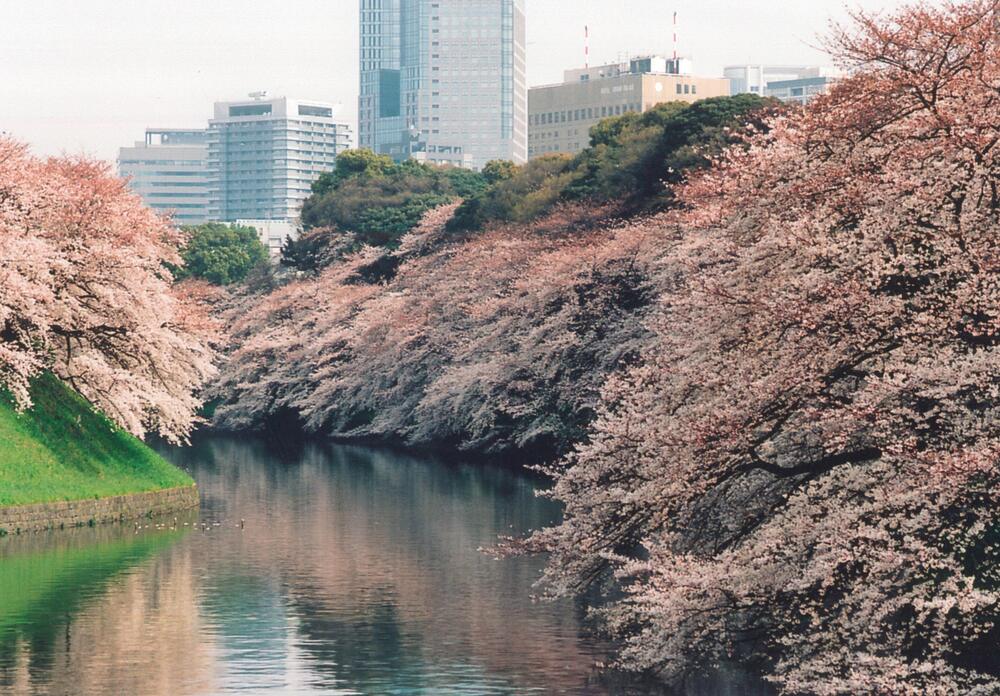 Kirin7739 (CC BY 4.0)
Cherry blossoms over the Chidorigafuchi moat, Tokyo
Summer: June to August
Summer in Japan means rain, then heat. The rainy season covers June and most of July on the main islands, and August is the hottest and busiest month of the year.
June
June is the rainy season (tsuyu) across most of Japan, from around June 6 in Kyoto and Osaka and June 7 in Tokyo to July 19 on JMA averages. It does not rain every day: Tokyo averages 12.3 wet days and highs of 26.7 °C (80 °F). Hokkaido has no declared rainy season, which makes it June's best pick, and Okinawa's ends around June 21. Restaurants put out hiyashi chuka, chilled ramen with cold toppings.
July
July turns hot once the rains end around July 19: Osaka averages 32.2 °C (90 °F) and Kyoto 31.6 °C (89 °F), and Hiroshima's July is the wettest month of any city here, 290 mm (11.4 in). Kyoto's Gion Matsuri runs all month, with its float processions on the mornings of July 17 and 24, both Saturdays in 2027, per Yasaka Shrine. Hokkaido's hotels peak, at 1.21 times the average month. On Midsummer Ox Day, eel shops sell unadon, grilled eel over rice.
August
August is the hottest month in six of the seven cities, Osaka at 34.1 °C (93 °F), and the busiest month of the year for hotels, 1.22 times average, because Japanese families travel through the school holidays. Obon falls mainly on August 13 to 16, with the 2027 travel peak forecast for August 7 to 16, per japan-guide.com. Typhoons approach most often in August and September, 3.3 a month on average. The festivals are the reason to go: Tokushima's Awa Odori runs August 11 to 15 every year, per its organizer. Cool off with nagashi somen, cold noodles sent down a bamboo flume.
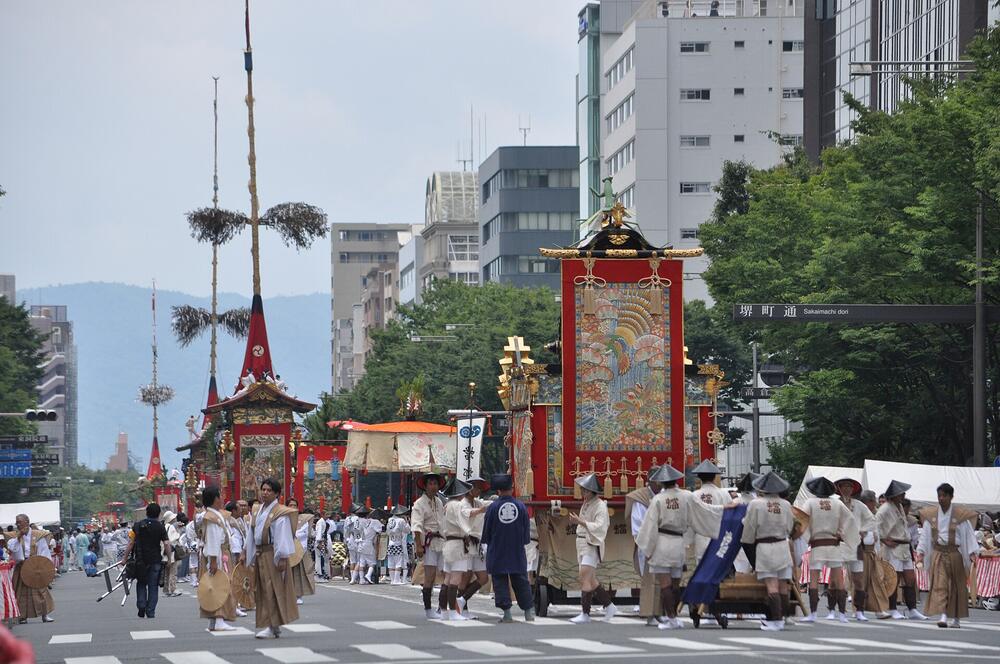 江戸村のとくぞう (CC BY-SA 4.0)
A float in the Gion Matsuri procession, Kyoto, July 17
Autumn: September to November
Autumn starts with the typhoon peak and ends with the leaves. By November, the cities are dry, mild and at their most colorful.
September
September is still warm, Osaka at 29.6 °C (85 °F), and it is the main typhoon month, with 3.3 approaches and the year's most landfalls, 1.0, on JMA normals. Foreign guest-nights hit their low (0.86), so the cities feel less crowded. Keep a buffer day before flights; the typhoon season guide covers what trains and airlines do. Grilled sanma, Pacific saury, marks the start of autumn on the table, and tsukimi dango, white rice dumplings, are eaten for autumn moon viewing.
October
October brings comfortable highs, Tokyo at 22.2 °C (72 °F), and the first color in Hokkaido and the mountains, with Sapporo's maples turning on October 28 on average. Tokyo's October is its wettest month, 221 mm (8.7 in), the tail of the typhoon season. The Autumn Takayama Festival runs October 9 and 10 every year, per Hida tourism. Kyoto prefecture's hotels peak (1.14 times average).
November
November is the strongest month for autumn leaves and dry, mild weather: Tokyo and Kyoto average 17.6 °C (64 °F), and Hiroshima is the driest of the seven cities, 69 mm (2.7 in). Maples turn on November 22 in Hiroshima, November 24 in Kanazawa and November 28 in Tokyo on average. Ishikawa prefecture's hotels, around Kanazawa, peak (1.24 times average), and it is also turning wet, 166 mm (6.5 in).
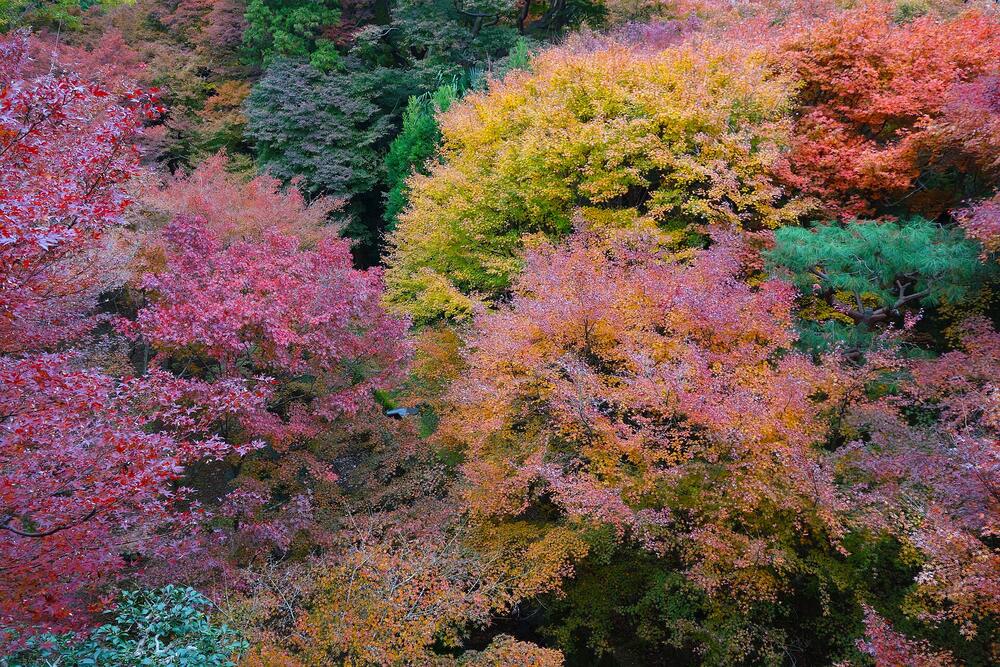 Luka Peternel (CC BY-SA 4.0)
Maple leaves at Tofuku-ji, Kyoto, in late November
Winter: December to February
Winter is the dry, quiet season on Japan's Pacific side and the wet one on the Sea of Japan coast. Tokyo averages 4.6 wet days in January, while Kanazawa on the Sea of Japan coast gets 21.8.
December
December keeps the color going in Kyoto and Osaka for the first week, with maples turning on December 5 and December 1 on average. Tokyo is at its driest, 59 mm (2.3 in), with highs of 12.7 °C (55 °F). The ski season gets fully underway this month, per japan-guide.com. Between December 29 and January 4, many shops, restaurants and banks close on one or more days, especially January 1, per japan-guide.com; temples and shrines stay open. On New Year's Eve, people eat toshikoshi soba.
January
January is the coldest month, Tokyo at 10.4 °C (51 °F) by day and 1.2 °C (34 °F) at night, and one of the quietest, 0.88 times the average month's hotel stays. Pacific-side cities are dry and sunny: Tokyo averages 4.6 wet days. The New Year closures run to January 4. Okinawa's early cherry trees open in mid-January, and Naha stays near 19.9 °C (68 °F). New Year's Day means zoni, a soup with grilled mochi.
February
February is the low month for hotels nationwide, 0.87 times average, and the peak of the snow season: the Sapporo Snow Festival runs Thursday, February 4 to Thursday, February 11, 2027, per the festival site. Sapporo's average high is 0.9 °C (34 °F), and Hokkaido's hotels run above average (1.05). Shirakawa-go's thatched farmhouses sit under snow. For Setsubun in early February, people eat ehomaki, a whole uncut sushi roll.
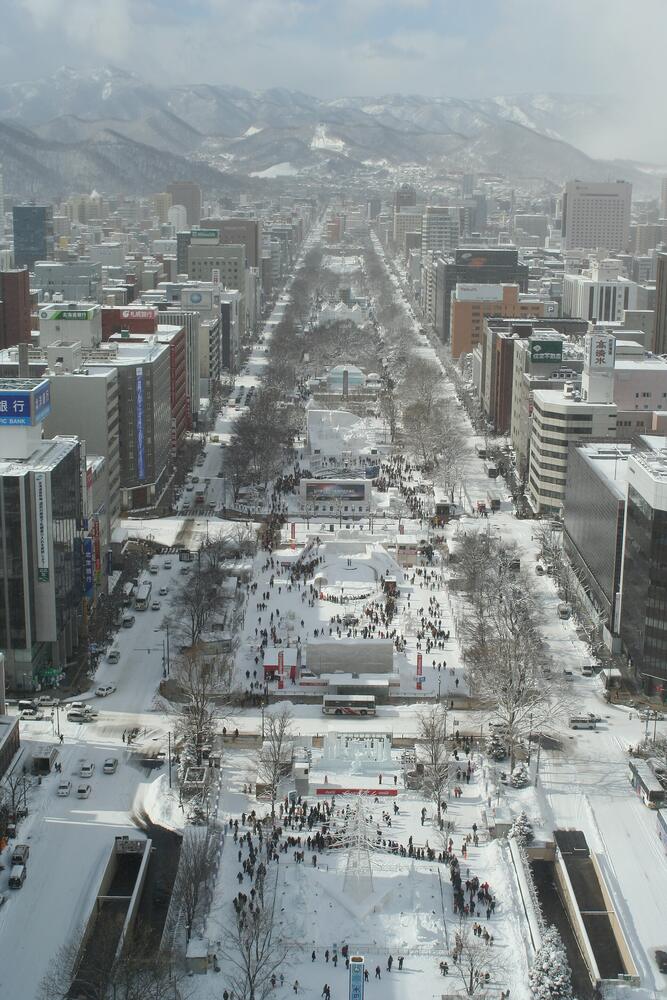 Eckhard Pecher (CC BY 2.5)
Odori Park during the Sapporo Snow Festival, seen from the TV Tower in February
What does a day in Japan cost?
A mid-range day in Japan costs about $142 a person, by Budget Your Trip's traveler-reported averages, updated September 2026: about $178 in Tokyo and $106 in Osaka. The figures cover a share of a double room, food, local transport and entertainment, not flights.
Plan the trip
The 7-day Japan itinerary covers Tokyo, Kyoto and Osaka, and the 3-day Tokyo and 3-day Osaka plans fit a shorter stay; the Japan guide covers the rest of the country.
A MonkeyEatingMango trip plan shows each city's measured weather for the travel month, from the same city records as the tables above. The free Japan packing list lists what to bring.
Plan a trip to Japan →How the figures were gathered
Cherry blossom, autumn-leaf, rainy-season and typhoon dates are the Japan Meteorological Agency's 1991-2020 averages, with 2026 dates where noted. Highs, lows, rain and wet days are 2013 to 2022 monthly averages from TerraClimate and ERA5 reanalysis, grid values that can differ from JMA's station figures. Crowds are 2025 hotel guest-nights from the Japan Tourism Agency (final figures, published July 2026) and 2025 arrivals from the Japan National Tourism Organization; monthly totals blur one-week peaks such as blossom week. Holiday and festival dates were read from the Cabinet Office, the organizers' sites and japan-guide.com in October 2026; where an organizer has not published 2027 dates, the page gives the fixed annual dates or says so. Budgets are Budget Your Trip's mid-range averages. Photos come from Wikimedia Commons, credited on each.
Pick the season and the cities, and the planner builds the days, with a time and a cost on every stop: plan a Japan trip.
Last updated October 2026.

Written by Shobhit Shrivastava · Founder
Related reading
Japan travel guide
A Week in Japan: Tokyo and Kyoto, from teamLab to Kinkaku-ji
7 days across Kyoto and Tokyo. Begin with 3 nights in Kyoto (Fushimi Inari, Kiyomizu-dera, Arashiyama Bamboo Grove, based in Higashiyama), then ride the Shinkansen to Tokyo for 4 nights (Shibuya Crossing, Tsukiji Outer Market, teamLab Planets, Asakusa). Packed pace with 4-5 activities daily,...
Osaka in 3 Days: Dotonbori and Osaka Castle
3 days in Osaka: focus on the food and nightlife districts of Namba and Dotonbori, with a dedicated day for the modern installations at teamLab Botanical Garden. This trip uses a central Namba base to keep transport simple. Expect a packed pace with 4-5 activities daily, balancing neon-lit...
Tokyo in 3 Days: Sensō-ji, Shibuya Crossing and More
This packed 3-day Tokyo journey for a couple delves into contrasting districts, blending traditional spiritual sites like Sensō-ji Temple in Asakusa with the cutting-edge digital art of teamLab Planets TOKYO. Explore the iconic Shibuya Crossing, enjoy a performance at Kabuki-za Theatre, and...
5 Days in Tokyo: Senso-ji, Tsukiji Market and the Tokyo Skytree
5 days exploring Tokyo's diverse character through food, spiritual sites, and local culture. Experience the historic Senso-ji Temple and Meiji Jingu, browse the vintage shops of Shimokitazawa, and dine at Tsukiji Outer Market. Maintain a comfortable pace with one neighborhood focus per day and...
Typhoon Season in Japan: Months, Regions, Plans
Typhoon season in Japan, month by month from the Japan Meteorological Agency's own records: when storms come, which regions they hit, how the rainy season differs, and what trains and airlines do when one arrives.
Where to Go in March 2027: 18 Best Places to Travel
Eighteen March trips, from cherry blossom in Tokyo, Kyoto and Washington to Las Fallas, Holi, Holy Week in Seville and the last of the Alpine snow, each with its March weather, a daily budget, its season and its 2027 dates.
Where to Go in January 2027: 18 Best Places to Travel
Eighteen January trips, from dry-season beaches and southern summer to Lapland snow and Shetland's fire festival, each with its January weather, a daily budget, whether January is its peak season, and its 2027 dates.