Finns are most likely to be eating dinner at 17:10, Argentines at 21:30, each on local time. Lunch sits between 12:00 and 13:30 almost everywhere, so dinner is the meal you will have to move.
Plan your days on local time, or you may eat dinner hours before or after the locals. In Spain, Greece and Argentina, dinner is a 21:00 meal, so make lunch the big one and book dinner late. In most of northern Europe, the United States and Canada, sit down between 18:00 and 18:30 to eat with the locals.
- Spain eats lunch at 14:30, two and a half hours after the American noon.
- Mexico's main meal, the comida, comes around 15:00.
- Japan's lunch peaks at 12:15, and the share eating halves between 12:45 and 13:00.
- Mizoram and Nagaland eat dinner at 18:00, while the rest of India eats at 20:30.
What time do people eat dinner around the world?
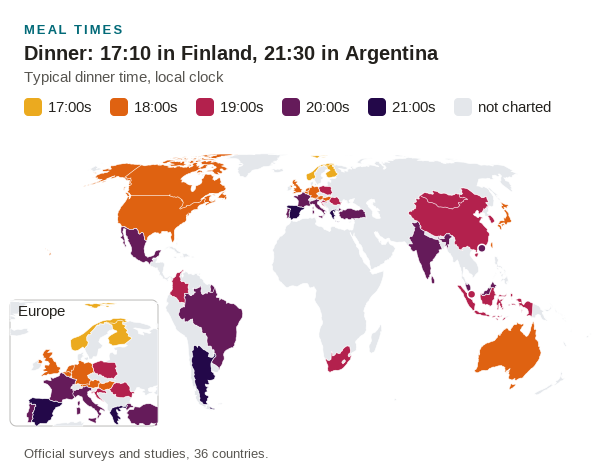
The data · 36 countries by dinner hour
| Dinner | Countries |
|---|---|
| 17:00s | Finland 17:10, Norway 17:30 |
| 18:00s | Australia 18:00, Taiwan 18:00, United States 18:00, Canada 18:10, Netherlands 18:10, Belgium 18:20, United Kingdom 18:20, Austria 18:30, Germany 18:30, Hungary 18:40, Japan 18:58 |
| 19:00s | China 19:00, Colombia 19:00, Indonesia 19:00, Singapore 19:00, South Africa 19:00, South Korea 19:01, Croatia 19:10, Mongolia 19:10, Poland 19:20, Romania 19:20 |
| 20:00s | Brazil 20:00, France 20:00, Hong Kong 20:00, Malaysia 20:00, Mexico 20:00, Portugal 20:00, Sri Lanka 20:18, Italy 20:20, Turkey 20:20, India 20:30 |
| 21:00s | Greece 21:10, Spain 21:20, Argentina 21:30 |
Dinner comes earliest in the Nordic countries, the US, Canada, the UK, Australia and central Europe, and latest in southern Europe, Mexico, Brazil, Argentina and India.
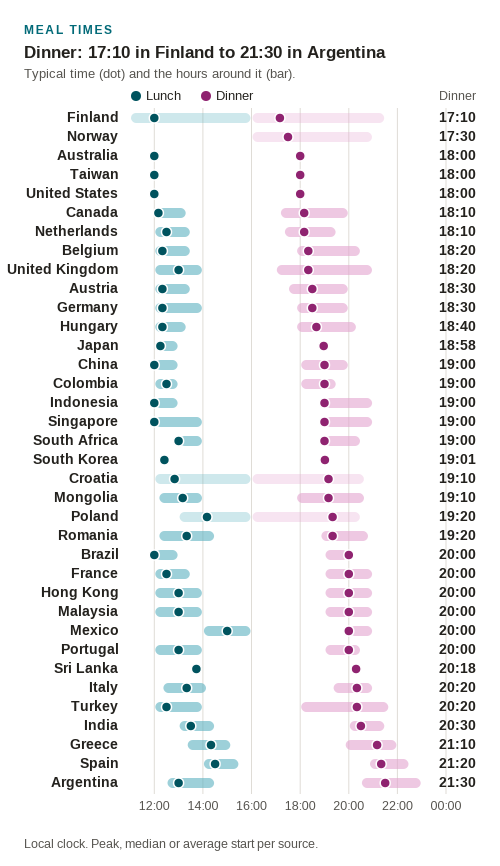
The data · 36 countries
| Country | Lunch | Dinner | Source (survey year) |
|---|---|---|---|
| Finland | 12:00, busiest before 11:00 to after 16:00 | 17:10, busiest before 16:00 to 21:30 | Eurostat (2020-21) |
| Norway | no clear peak | 17:30, busiest before 16:00 to 21:00 | Eurostat (2022-23) |
| Australia | 12:00 most common | 18:00 most common | Leech et al. (2011-12) |
| Taiwan | 12:00, busiest hour | 18:00, busiest hour | DGBAS (2004) |
| United States | 12:00, busiest hour | 18:00, busiest hour | BLS (2024) |
| Canada | 12:10, busiest 12:00 to 13:20 | 18:10, busiest 17:10 to 20:00 | Statistics Canada (2022-23) |
| Netherlands | 12:30, busiest 12:00 to 13:30 | 18:10, busiest 17:20 to 19:30 | Eurostat (2021-23) |
| Belgium | 12:20, busiest 12:00 to 13:30 | 18:20, busiest 17:50 to 20:30 | Eurostat (2012-13) |
| United Kingdom | 13:00, busiest 12:00 to 14:00 | 18:20, busiest 17:00 to 21:00 | Eurostat (2014-15) |
| Austria | 12:20, busiest 12:00 to 13:30 | 18:30, busiest 17:30 to 20:00 | Eurostat (2021-22) |
| Germany | 12:20, busiest 12:00 to 14:00 | 18:30, busiest 17:50 to 20:00 | Eurostat (2022) |
| Hungary | 12:20, busiest 12:00 to 13:20 | 18:40, busiest 17:50 to 20:20 | Eurostat (2024-25) |
| Japan | 12:15, busiest 12:00 to 13:00 | 18:58 average start | dinner: Statistics Bureau of Japan (2021); lunch: NHK Broadcasting Culture Research Institute (2025) |
| China | 12:00, busiest 12:00 to 13:00 | 19:00, busiest 18:00 to 20:00 | Mognard et al. (2019-20) |
| Colombia | 12:30 median, middle half 12:00 to 13:00 | 19:00 median, middle half 18:00 to 19:30 | Zea & Herran (2015-16) |
| Indonesia | 12:00, busiest 12:00 to 13:00 | 19:00, busiest 19:00 to 21:00 | Mognard et al. (2019-20) |
| Singapore | 12:00, busiest 12:00 to 14:00 | 19:00, busiest 19:00 to 21:00 | Mognard et al. (2019-20) |
| South Africa | 13:00, busiest 13:00 to 14:00 | 19:00, busiest 19:00 to 20:30 | Stats SA (2010) |
| South Korea | 12:25 average start | 19:01 average start | Statistics Korea (2024) |
| Croatia | 12:50, busiest 12:00 to after 16:00 | 19:10, busiest before 16:00 to 20:40 | Eurostat (2022-23) |
| Mongolia | 13:10, busiest 12:10 to 14:00 | 19:10, busiest 17:50 to 20:40 | NSO Mongolia (2019) |
| Poland | 14:10, busiest 13:00 to after 16:00 | 19:20, busiest before 16:00 to 20:30 | Eurostat (2023) |
| Romania | 13:20, busiest 12:10 to 14:30 | 19:20, busiest 18:50 to 20:50 | Eurostat (2010-11) |
| Brazil | 12:00 median, middle half 12:00 to 13:00 | 20:00 median, middle half 19:00 to 20:00 | IBGE (2017-18) |
| France | 12:30, busiest 12:00 to 13:30 | 20:00, busiest 19:00 to 21:00 | Eurostat (2009-10) |
| Hong Kong | 13:00, busiest 12:00 to 14:00 | 20:00, busiest 19:00 to 21:00 | Mognard et al. (2019-20) |
| Malaysia | 13:00, busiest 12:00 to 14:00 | 20:00, busiest 19:00 to 21:00 | Mognard et al. (2019-20) |
| Mexico | 15:00 median, middle half 14:00 to 16:00 | 20:00 median, middle half 20:00 to 21:00 | INSP (2024) |
| Portugal | 13:00 most common, most eat 12:00 to 14:00 | 20:00 most common, most eat 19:00 to 20:30 | INE Portugal (1999; 2015-16) |
| Sri Lanka | 13:44 average start | 20:18 average start | Swarnamali & Jayawardena (c. 2010) |
| Italy | 13:20, busiest 12:20 to 14:10 | 20:20, busiest 19:20 to 21:00 | Eurostat (2008-09) |
| Turkey | 12:30, busiest 12:00 to 14:00 | 20:20, busiest 18:00 to 21:40 | Eurostat (2014-15) |
| India | 13:30, busiest 13:00 to 14:30 | 20:30, busiest 20:00 to 21:30 | NSO (2024) |
| Greece | 14:20, busiest 13:20 to 15:10 | 21:10, busiest 19:50 to 22:00 | Eurostat (2013-14) |
| Spain | 14:30, busiest 14:00 to 15:30 | 21:20, busiest 20:50 to 22:30 | Eurostat (2009-10) |
| Argentina | 13:00, busiest 12:30 to 14:30 | 21:30, busiest 20:30 to 23:00 | INDEC (2021) |
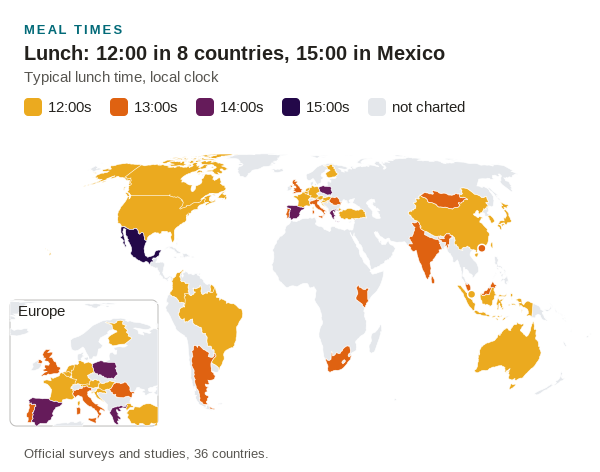
The data · 36 countries by lunch hour
| Lunch | Countries |
|---|---|
| 12:00s | Australia 12:00, Brazil 12:00, China 12:00, Finland 12:00, Indonesia 12:00, Singapore 12:00, Taiwan 12:00, United States 12:00, Canada 12:10, Japan 12:15, Austria 12:20, Belgium 12:20, Germany 12:20, Hungary 12:20, South Korea 12:25, Colombia 12:30, France 12:30, Netherlands 12:30, Turkey 12:30, Croatia 12:50 |
| 13:00s | Argentina 13:00, Hong Kong 13:00, Kenya 13:00, Malaysia 13:00, Portugal 13:00, South Africa 13:00, United Kingdom 13:00, Mongolia 13:10, Italy 13:20, Romania 13:20, India 13:30, Sri Lanka 13:44 |
| 14:00s | Poland 14:10, Greece 14:20, Spain 14:30 |
| 15:00s | Mexico 15:00 |
Lunch falls between 12:00 and 13:30 in 31 of the 36 countries on the lunch map. Poland, Greece, Spain and Mexico eat lunch latest, from 14:10 to 15:00.
What time do people eat dinner in Spain?
Spain's dinner peaks at 21:20 in the official time-use survey, and most people are eating between 20:50 and 22:30. At 19:00 most Spaniards have not started. Lunch is the bigger meal, peaking at 14:30 with 40% of adults eating, against 32% at the dinner peak. Greece is close behind, with lunch at 14:20 and dinner at 21:10.
Book dinner for 21:00 or later and plan the afternoon around a 14:00 lunch. With small kids or no taste for late nights, make lunch the big meal, as Spaniards do.
What time is dinner in Argentina?
Argentina eats dinner later than any other country with survey data, with a peak at 21:30 in the diaries of its 2021 national time-use survey. People are still eating at 23:00. Lunch is at 13:00, and between 17:00 and 18:00, 14% of Argentines are eating again: the merienda, an afternoon snack.
A merienda of your own around 17:30 makes a 21:30 table easy to wait for. Families with small kids can make the 13:00 lunch the big meal instead.
When is lunch in Mexico?
Mexicans eat the comida, their main meal, around 15:00, in our count from the 2024 national health and nutrition survey. Half of adults eat it between 14:00 and 16:00 and only 12% at noon or 13:00, so a noon lunch puts you about two hours ahead of Mexico.
Breakfast comes around 09:00 and the lighter cena around 20:00. If you eat breakfast at 07:00, the wait for the comida is long. Do what 46% of Mexicans do and eat a mid-morning almuerzo around 11:00. Spend the morning sightseeing, then sit down to the comida around 14:30.
Do northern Europe and the US really eat at 6?
By 20:30 in Amsterdam or Hamburg, most locals have eaten dinner. The evening meal peaks at 18:00 in the United States, where 16.3% of people are eating between 18:00 and 19:00, and Swedes start eating around the same hour. Canada, the Netherlands, Germany and Austria are eating by 18:30. To eat when they do, sit down between 18:00 and 18:30.
Finland eats earliest of all, at 17:10, followed by Norway at 17:30. Many Finns then eat a second, lighter evening meal around 20:10.
When do people eat lunch in Japan, Korea and China?
Lunch in Japan, South Korea and China is a short noon meal. Japan's lunch peaks at 12:15 on weekdays, South Koreans start lunch at 12:25 on average, and in China the busiest hour is 12:00 to 13:00. On weekdays, dinner starts at 18:58 on average in Japan and at 19:01 in Korea, so book for 19:00.
Eat lunch after 13:00 and you miss the rush. In Japan, the share of people eating falls from 26.9% at 12:45 to 12.3% at 13:00.
Try free
Plan a trip in about 2 minutes
Tap through 8 quick cards for a complete itinerary with budget, maps, and packing lists. No account required.
Plan a trip →Do meal times change within a country?
Meal times rarely change by more than an hour within a country. All 47 Japanese prefectures sit within 27 minutes of Japan's national average for breakfast and dinner. Quebec matches the rest of Canada, Bali matches Indonesia, and South Africa's nine provinces and Mongolia's five regions sit within an hour of their national times. The one exception we found is India's Northeast.
When do people eat dinner in India?
India's dinner peaks at 20:30 and lunch at 13:30, in our computation from the diaries of 365,281 adults in the Time Use Survey 2024. Plan dinner for 20:30 or later in most of the country.
Three Northeastern states eat dinner more than an hour earlier, so in Aizawl in Mizoram or Kohima in Nagaland, plan it before 19:00:
| State | Dinner peak | Difference from India |
|---|---|---|
| Mizoram | 18:00 | 2 h 30 min earlier |
| Nagaland | 18:00 | 2 h 30 min earlier |
| Manipur | 19:00 | 1 h 30 min earlier |
| Rest of India | 20:30 |
Assam, the biggest Northeastern state, eats at 21:00 like the rest of India.
Breakfast, lunch and dinner in 65 countries
A single time is the peak, median or average a survey or study measured. A time marked "about" and a range are hours a source states rather than measures. Where a row mixes sources, D, L and B mark dinner, lunch and breakfast. "Survey (ours)" means we computed the time from an official survey's own diaries or answers, and "work hours" means official work and school hours.
| Country | Dinner | Lunch | Breakfast | Evidence (year) |
|---|---|---|---|---|
| Argentina | 21:30 | 13:00 | 08:20 | survey (ours) (2021) |
| Australia | 18:00 | 12:00 | – | study (2011-12) |
| Austria | 18:30 | 12:20 | 08:00 | survey (2021-22) |
| Belgium | 18:20 | 12:20 | 08:20 | survey (2012-13) |
| Brazil | 20:00 | 12:00 | 07:00 | survey (ours) (2017-18) |
| Canada | 18:10 | 12:10 | 08:10 | survey (ours) (2022-23) |
| Chile | 18:00–20:00 | 11:30–15:00 | – | encyclopedia |
| China | 19:00 | 12:00 | 07:00 | study (2019-20) |
| Colombia | 19:00 | 12:30 | 08:00 | study (2015-16) |
| Costa Rica | – | 12:00–14:00 | – | encyclopedia |
| Croatia | 19:10 | 12:50 | 07:40 | survey (2022-23) |
| Cuba | from 16:00 | 10:00–16:00 | by 10:00 | encyclopedia |
| Czech Republic | – | – | 07:00–08:00 | work hours (in force) |
| Denmark | about 18:30 | about 12:20 | about 07:30 | study (2008-09) |
| Egypt | about 22:00 | 14:00–16:00 | – | encyclopedia |
| Fiji | from 16:30 | – | by 08:00 | work hours (2011 policy) |
| Finland | 17:10 | 12:00 | 08:20 | survey (2020-21) |
| France | 20:00 | 12:30 | 08:10 | survey (2009-10) |
| Germany | 18:30 | 12:20 | 08:40 | survey (2022) |
| Greece | 21:10 | 14:20 | 07:40 | survey (2013-14) |
| Hong Kong | 20:00 | 13:00 | 08:00 | study (2019-20) |
| Hungary | 18:40 | 12:20 | 08:10 | survey (2024-25) |
| Iceland | – | about 12:00 | 08:10–08:25 | L: encyclopedia · B: work hours (2025-26) |
| India | 20:30 | 13:30 | 08:30 | survey (ours) (2024) |
| Indonesia | 19:00 | 12:00 | 07:00 | study (2019-20) |
| Iran | from 20:00 | 12:00–15:00 | 08:02 | DL: encyclopedia · B: study (2019) |
| Ireland | 18:00–19:00 | about 13:00 | 08:00–10:00 | D: study (2019) · L: work hours (1980s scheme) · B: study (c. 2016) |
| Israel | 18:00–20:00 | – | – | study (c. 2021) |
| Italy | 20:20 | 13:20 | 07:30 | survey (2008-09) |
| Japan | 18:58 | 12:15 | 07:11 | DB: survey (2021) · L: survey (2025) |
| Jordan | 18:00–21:00 | 13:00–16:00 | – | D: study (not stated) · L: encyclopedia |
| Kenya | 20:00 | 13:00 | 08:00 | study (2017) |
| Laos | – | 12:00–13:00 | – | encyclopedia |
| Malaysia | 20:00 | 13:00 | 08:00 | study (2019-20) |
| Mexico | 20:00 | 15:00 | 09:00 | survey (ours) (2024) |
| Mongolia | 19:10 | 13:10 | 07:50 | survey (ours) (2019) |
| Morocco | 20:00–22:00 | 12:30–14:30 | 07:00–09:00 | survey (2011-12) |
| Nepal | 19:00–20:00 | no clear peak | about 10:00 | encyclopedia |
| Netherlands | 18:10 | 12:30 | 08:40 | survey (2021-23) |
| New Zealand | 18:00–20:00 | 12:00–14:00 | 07:00–08:00 | study (2022-23) |
| Norway | 17:30 | no clear peak | 09:00 | survey (2022-23) |
| Oman | – | 13:00–16:00 | – | encyclopedia |
| Pakistan | – | 13:00–13:30 | – | work hours (2023) |
| Peru | from 19:30 | 13:00–15:00 | 06:00–09:00 | encyclopedia |
| Philippines | 18:00–20:00 | 12:00–13:00 | 07:00–11:00 | DB: encyclopedia · L: work hours (1991, in force) |
| Poland | 19:20 | 14:10 | 08:40 | survey (2023) |
| Portugal | 20:00 | 13:00 | 08:00 | DL: survey (1999; 2015-16) · B: survey (2015-16) |
| Qatar | 20:36 | 13:00–15:30 | – | D: study (2020) · L: encyclopedia |
| Romania | 19:20 | 13:20 | 07:30 | survey (2010-11) |
| Saudi Arabia | from 19:30 | 13:00–16:00 | by 07:15 | DB: study (c. 2025) · L: encyclopedia |
| Singapore | 19:00 | 12:00 | 08:00 | study (2019-20) |
| South Africa | 19:00 | 13:00 | 08:00 | survey (ours) (2010) |
| South Korea | 19:01 | 12:25 | 07:50 | survey (2024) |
| Spain | 21:20 | 14:30 | 09:20 | survey (2009-10) |
| Sri Lanka | 20:18 | 13:44 | 08:17 | study (c. 2010) |
| Sweden | about 18:00 | about 12:00 | 07:00 | DL: survey (2010-11) · B: study (1995-2000) |
| Switzerland | – | 12:00–14:00 | – | work hours (current) |
| Taiwan | 18:00 | 12:00 | 07:00 | survey (2004) |
| Tanzania | 20:00–21:00 | 13:00–14:00 | about 09:00 | study (2019) |
| Thailand | 17:00–20:00 | 12:00–13:00 | 06:00–09:00 | DB: study (2024) · L: work hours (1959 rule, current) |
| Turkey | 20:20 | 12:30 | 10:20 | survey (2014-15) |
| United Arab Emirates | – | 13:00–16:00 | 08:00–11:00 | L: encyclopedia · B: study (2024-25) |
| United Kingdom | 18:20 | 13:00 | 08:20 | survey (2014-15) |
| United States | 18:00 | 12:00 | 08:00 | survey (2024) |
| Vietnam | 17:00–20:00 | 11:30–13:00 | by 07:30 | D: work hours (2025) · LB: work hours (2026) |
To see what a 14:00 lunch and a 21:00 dinner do to a day of sightseeing, look at a 7-day Spain itinerary or the Spain guide, or plan your own trip.
How the meal times were measured
Most values come from national time-use surveys. In a time-use survey, thousands of people write down what they are doing in every 10, 15 or 30 minutes of one day. The statistics office then publishes the share of people eating in each slot. The Bureau of Labor Statistics describes its table: "These data are a snapshot of the main activities people were doing at the time indicated."
The typical time is the busiest slot. The window around it takes in every neighboring slot where at least half as many people are eating. Where that window runs into the edge of the hours searched (16:00 for dinner), the table says "before" or "after". Nutrition surveys give a median instead, with the middle half of answers as the window. Where a survey publishes its diaries rather than a table (Argentina, Canada, India, Mongolia, South Africa) or its 24-hour food recall (Mexico, Brazil), we computed the same figures from the records. Our India computation exactly reproduces the survey's own published figure of 91 minutes a day spent eating and drinking.
Where a country has no official time-of-day table, we used published studies, then government work and school hours or an encyclopedia. The table labels each one. A survey records when residents eat at home and at work, not when restaurants open.
Notes on the evidence
- Survey years run from the late 1990s (Portugal's time-use survey and a 1995 to 2000 study behind Sweden's breakfast) to 2025, and the table gives each one. Spain, France, Italy and Greece come from the 2010 wave of the European surveys, the latest wave Eurostat publishes for them.
- Japan's breakfast and dinner are average start times on weekdays, not peaks; South Korea's are averages too. Australia, Denmark and Sri Lanka come from studies, not official tables.
- China, Hong Kong, Singapore, Malaysia and Indonesia come from a peer-reviewed online panel of adults in large cities, the Eating Out database, from which we computed the times.
- Five countries in the study have no usable source for any meal: Bangladesh, Cambodia, Ecuador, the Maldives and Uruguay. We left them empty rather than borrow a neighbor's times.
- The European figures are published by Eurostat, which is not responsible for our computations from them.
Download the data
The dataset is free to reuse under CC BY 4.0, with credit to MonkeyEatingMango and a link to this page. Each row also names its source's own terms, which still apply to that row.
- Meal times by country, CSV: every country and meal, with the time, window, statistic, source, survey year and terms, including the cells with no source
- Column guide
Common questions
What time do people eat dinner?
Dinner times differ between countries by more than four hours. Official time-use surveys put the busiest dinner time at 17:10 in Finland, 18:00 in the United States, 20:00 in France and 21:30 in Argentina, local clock.
What time do people eat dinner in Spain?
In Spain's official time-use survey, dinner peaks at 21:20, with most people eating between 20:50 and 22:30. Lunch peaks at 14:30 and is the main meal of the day.
What is the average dinner time in America?
The busiest hour for eating in the evening in the United States is 18:00 to 19:00, when 16.3% of Americans aged 15 and over are eating, in the 2024 American Time Use Survey. At 19:00 the share is still 14.1%.
What time do Europeans eat dinner?
Europeans eat dinner between about 17:10 and 21:20, depending on the country. Finland and Norway eat earliest. Dinner peaks between 18:10 and 18:30 in the Netherlands, Belgium, Germany and Austria, at 20:00 in France and at 20:20 in Italy. Greece and Spain eat after 21:00.
What time do people eat dinner in Italy?
In Italy's official time-use survey, dinner peaks at 20:20, with most people eating between 19:20 and 21:00. Lunch peaks at 13:20.
What time is dinner in France?
France's dinner peaks at 20:00, with most people eating between 19:00 and 21:00. Lunch peaks at 12:30, when half the population is eating at once, in France's official time-use survey.
What time do people eat lunch in Mexico?
In Mexico's 2024 national health and nutrition survey, the main meal, the comida, is eaten around 15:00, and half of adults eat it between 14:00 and 16:00. Only 12% eat it at noon or 13:00.
Which country eats dinner the latest?
Of the countries with official survey data, Argentina eats dinner latest, with a peak at 21:30 and eating continuing to 23:00. Spain (21:20) and Greece (21:10) come next.
Which country eats dinner the earliest?
Finland eats dinner earliest, with a peak at 17:10, followed by Norway at 17:30, in the 2020 wave of the European time-use surveys.
Do meal times change within a country?
Meal times rarely vary by more than an hour within a country. All 47 Japanese prefectures sit within 27 minutes of Japan's national average. The exception found here is India's Northeast, where Mizoram and Nagaland eat dinner at 18:00, two and a half hours before the rest of India.
Where does this meal time data come from?
The times come from national time-use surveys, in which thousands of people record what they do in every 10 to 30 minutes of a day, and from national nutrition surveys and peer-reviewed studies. Each value carries its source and survey year in the downloadable dataset.
Related reading
- Museum ticket prices in 84 countries: what a museum charges a foreign visitor, read from 1,086 museums' own websites
- 43% of AI-planned days carry a fault: what goes wrong in generated plans, and how often
- Japan travel guide: planning a trip around a noon lunch and a 19:00 dinner
Last updated November 2026.
How to cite
“Across 36 countries with official survey or peer-reviewed data, the typical time for the evening meal runs from 17:10 in Finland to 21:30 in Argentina, local time.” with a link to monkeyeatingmango.com/research/meal-times-by-country/. Data and charts are licensed CC BY 4.0: free to republish with attribution.

Written by Shobhit Shrivastava · Founder