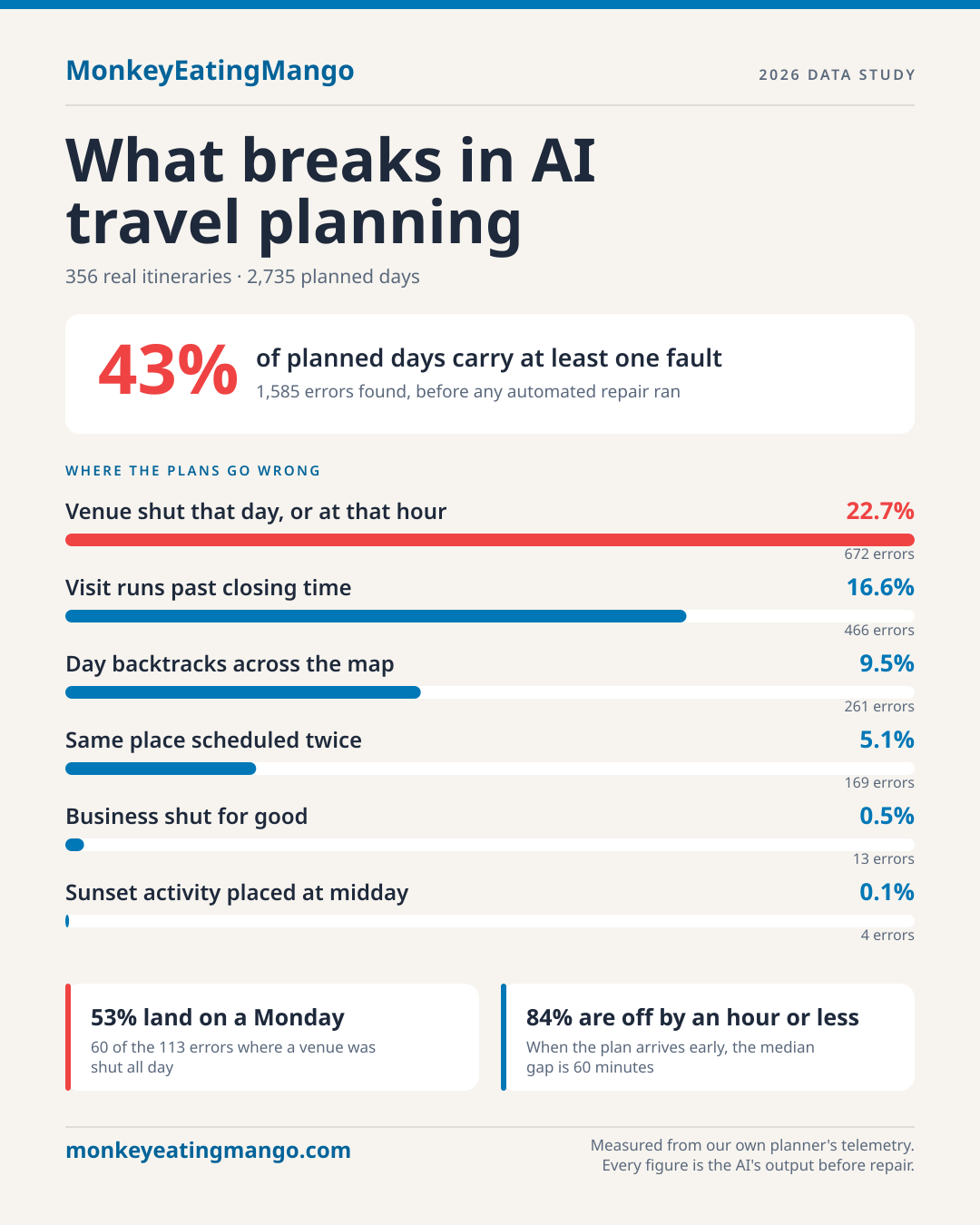
Across 356 AI-generated itineraries covering 2,735 planned days, 43% of days carried at least one verifiable fault: a venue shut at the scheduled hour, a visit running past closing time, a day that backtracks across the map, or the same place booked twice.
An AI hallucination or simple oversight is all it takes for four people to find themselves standing in front of a closed landmark on a Monday afternoon. You know how that looks, and you definitely don’t want to be the person who brought this reluctant group here. It’s the kind of mistake that will be remembered till eternity, and the AI driven travel planning will become a family joke.
We are building MonkeyEatingMango to fix such errors. But first, we needed to measure them. Here is our analysis of 356 real itineraries generated by AI for our customers, covering 2,735 days, 268 destinations, and 284 cities across 61 countries. Of these, 104 itineraries visit more than one city, and there are 551 destination lines. The itineraries are mostly from the US, Europe, and Asia.
These results are purely directional. AI is indeterminate, continuously evolving, and changing by the hour.
How this was measured
- Sample: 356 AI-generated itineraries built for real MonkeyEatingMango customers, covering 2,735 planned days, 268 destinations, 284 cities and 61 countries.
- Source: production telemetry from itineraries customers actually generated, not a synthetic test set.
- Detection: each fault type is checked against an outside source rather than read off the model's own text. Opening hours and permanent closures come from a live venue listing check, repeated bookings from a same-itinerary place match, and backtracking from whether a day's stops run in a sensible geographic order.
The six things that break in AI travel planning
We classified the errors into six categories. Some are obvious factual errors, while others are planning mistakes that make an itinerary less practical.
| # | What went wrong | Errors found | Days affected |
|---|---|---|---|
| 1 | Venue closed at that hour | 672 | 22.7% |
| 2 | Visit runs past closing time | 466 | 16.6% |
| 3 | Place permanently or temporarily shut | 13 | 0.5% |
| 4 | Same place scheduled twice or more | 169 | 5.1% |
| 5 | Day backtracks across the map | 261 | 9.5% |
| 6 | Sunset or sunrise activity scheduled at midday | 4 | 0.1% |
| Total | 1,585 | 43.2% |
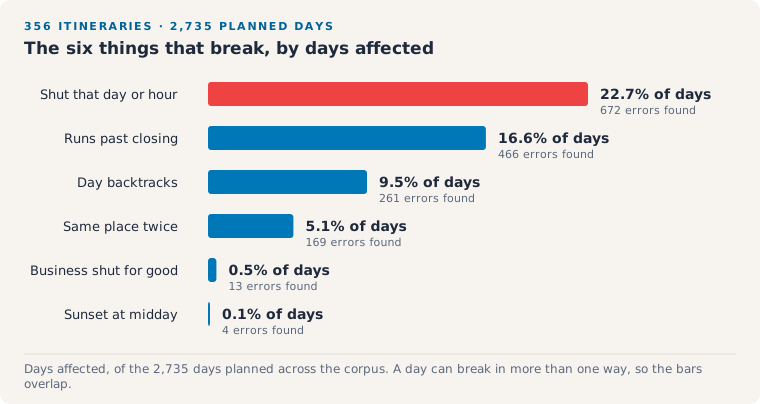
The last column counts days, and it does not add up because a day can have more than one issue. Read the total instead. Nearly two days in five have something wrong with them. Each percentage in that table is the share of the 2,735 planned days that had at least one occurrence of the listed fault, not a share of the 1,585 total error events, since a single day can carry more than one occurrence of the same fault type.
For the issues we couldn't fix due to feasibility constraints, we highlight them in our plan. It may not be the best solution, but we prefer to be transparent rather than leave people with last-minute surprises. Our target is a 100% fix rate, and work is underway.
Why do AI itineraries book places on days they are closed?
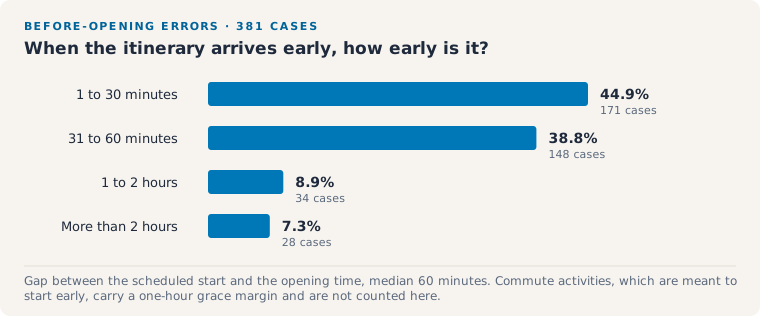
Of the 672 timing errors measured here, the most common was scheduling a visit before the venue opened: 381 cases, or 56.7%. Another 149 (22.2%) were scheduled after closing time, while 113 (16.8%) fell on a day when the venue did not open at all.
| Sub-type | Count | Share |
|---|---|---|
| Scheduled to start before opening time | 381 | 56.7% |
| Scheduled to start after closing time | 149 | 22.2% |
| Venue does not open that weekday at all | 113 | 16.8% |
| Scheduled inside a midday closure gap | 28 | 4.2% |
| Heuristic flag on an unverified venue | 1 | 0.1% |
| Total | 672 | 100% |
More than half of these errors are simple timing mistakes: the venue is open that day, but the itinerary gets there too early.
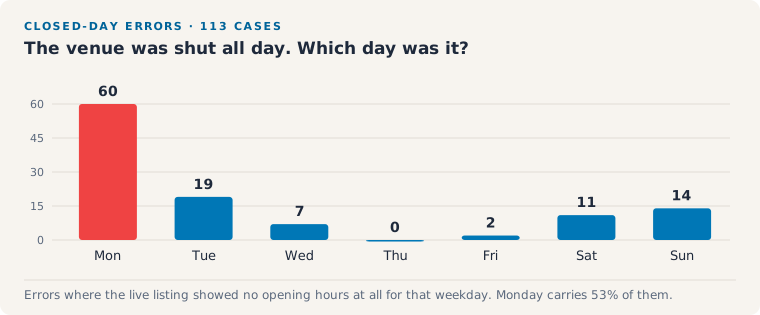
The more serious failures are the 104 days when the venue does not open at all. These are not scheduling slips of an hour; the visit simply cannot happen. Carnavalet Museum in Paris and Imperial Palace East Garden in Tokyo are two examples: both were scheduled on days the live listing showed as closed.
The near-misses are less interesting than the far ones. Where an activity was scheduled before opening, the median gap was 60 minutes, but some were more than two hours out.
The country pattern is thinner. The United States and Japan lead in raw counts simply because they account for more trips. Normalized per trip, the standouts are small samples: Austria at 3.14 findings per trip across seven trips, and Taiwan at 3.00 across five. Interesting, but not yet conclusive.
Can an AI travel planner tell if a place has closed down?
Thirteen venues were flagged as permanently or temporarily closed by a live listing check. Two of them show the failure mode with unusual clarity.
Tjapukai Aboriginal Cultural Park near Cairns ran for 33 years before closing permanently in January 2021, after the pandemic brought international arrivals to Queensland to a halt, as reported by ABC News. It still appears in enormous amounts of travel writing, which is exactly why a model reaches for it.
Wajima Morning Market on the Noto Peninsula was one of Japan's three great morning markets. A fire that broke out immediately after the 1 January 2024 Noto earthquake destroyed roughly 240 buildings across the market district. The market as it existed is gone.
Neither closure is obscure. Both are simply after the fact, from the AI's point of view. Memory of Agadir Museum and Miradouro da Vitoria in Porto were listed as permanently closed, while Cairo Tower, Dublin Castle and the Tour Montparnasse observation deck were temporarily closed when they were checked.
This category is small, at 13 findings, but needs the most attention per finding. A slightly mistimed museum costs an hour. A venue that no longer exists can cost a whole afternoon.
The same place, twice, and the longer the trip, the worse it gets
The duplicate-detection rule fires when a specific place appears twice on the same itinerary. The trip-length pattern is striking:
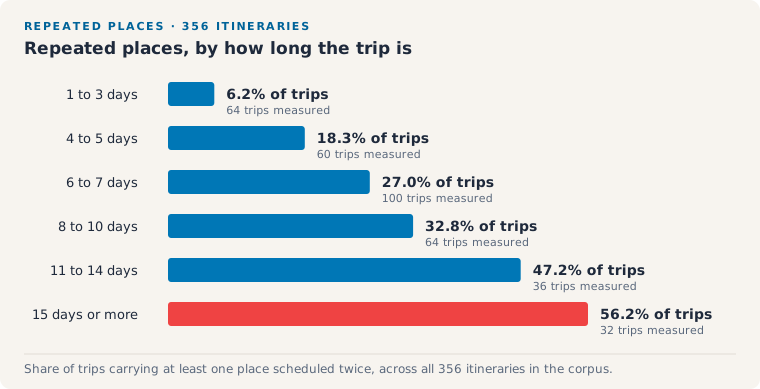
The obvious objection is that longer trips have more days, and therefore more chances to repeat a place. That is true, but it is not enough to explain the pattern. The rate per planned day rises from 4.76 findings per 100 days on 4-to-5-day trips to 7.42 on trips of 15 days or more. Longer trips are not just rolling the dice more often. They are rolling worse dice.
The same effect shows up within a single trip. Sorted by the day on which the repeat occurs, the rate climbs from 0% on day 1 to 21.1% on day 9. A model composing day 9 has more prior days to avoid colliding with and, apparently, a weaker grip on what it has already used.
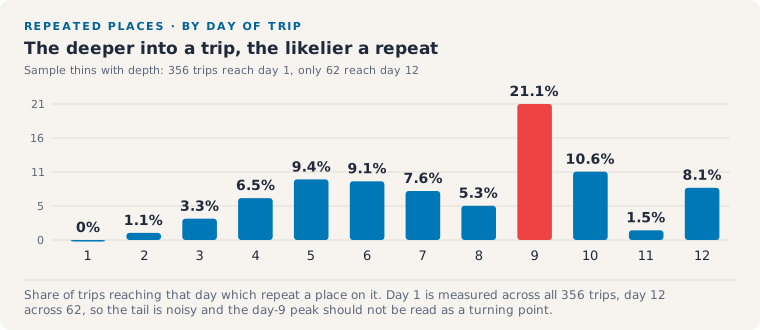
The repeats are not scattered evenly across the trip. Of all repeats, 26.6% occur on adjacent days, 30.2% are two days apart, and 0.6% put the same place twice within a single day. Nearly three in five repeats sit within two days of each other, which suggests something closer to local drift than genuine forgetting.
Trip shape matters more than trip length here. Single-city trips repeated a place in 20.3% of cases; trips covering more than one city did so in 45.2%. A repeat may be easier to produce when an itinerary spans several cities, where the model has more moving parts to keep track of.
Why do AI itineraries zigzag across a city?
The last rule measures whether a day's stops are visited in a sensible order. It compares the distance travelled in the scheduled sequence against the shortest route through the same places, and flags a day when the ratio gets high enough to matter.
The worst example in this corpus on the site is drawn below to scale from the coordinates on a published page.
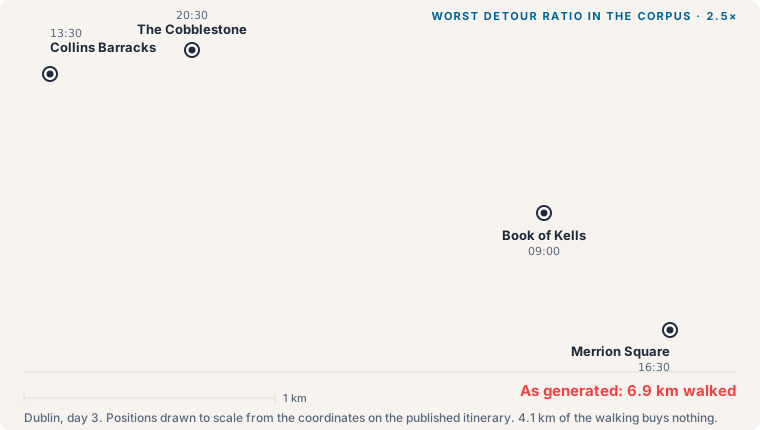
Nothing is wrong with any individual choice. All four are real places, all four are open at the times given, and the day reads perfectly well as a list. It is only when the list becomes a route that the problem appears: the day crosses Dublin from east to west and back again twice, covering 6.9 km when 2.8 km would be enough to reach the same four places.
Across the corpus, 261 days were flagged. The median added 3.4 km of avoidable walking or driving, and the worst added 40 km. In total, roughly 1,480 km of travel exists purely because of visit order.
The broken days are strikingly simple ones. Of the 261 flagged days, 142 had only three stops and 237 had three or four. A dense twelve-stop day would at least be a hard ordering problem. Three points on a map in the wrong order is the smallest version of this mistake that can exist.
And unlike duplicates, this one is indifferent to everything. Short trips, long trips, single-city, five-city, it holds at 8 to 10 flagged days per 100 planned days. Ordering does not degrade with context length because each day is composed more or less on its own.
This error does more than waste distance. It can take away time that could have been spent visiting another place, while the extra walking or driving can leave children and older travelers unnecessarily tired. It is worth checking the route, not just the list of places, before starting the day.
Does a chat assistant have the same blind spot?
The numbers here come from our planner's telemetry, not from a chatbot. The underlying failure modes carry across anyway. A travel itinerary that ChatGPT or Gemini generates without live lookups cannot reliably know that Tjapukai closed in 2021 or that Wajima burned in 2024. Closing days are the same kind of fact: small, frequently revised, and poorly represented in prose.
Two of the six faults need no outside data at all. Putting a day's stops in a sensible order is one. Not scheduling a sunset at noon is the other. Both are reasoning rather than lookup. But the bigger difference is the missing stage. When a chat assistant finishes writing, the text is usually the finished product: nothing automatically re-reads it against live data, sends a bad day back to be rewritten, or flags what it got wrong. Every number in this study exists because our planner runs that second stage. A raw model can produce the same faults with no counter-check, which is why no fix rate can be quoted for one.
Whether other planners run that second stage is not visible from the outside, and this study cannot speak for tools it did not measure. What it can offer is something to look for: a tool that checks its own output should have something to show for it: a corrected plan or a visible flag where it could not fix an error.
The prompt side of the chat route has its own walkthrough: how to use ChatGPT for travel planning. Both assistants share entry 10 in a ranked comparison of ten AI travel planners, scored on what they do and do not produce.
Three checks that catch most AI travel-planning errors
Across 356 itineraries, the study found six repeatable failure modes. Three checks catch most of the problems a traveler is likely to feel.
1. Check the opening day, not just the hour. This is the most common fault by volume, and a maps listing can answer it in seconds. Start with the places you would be genuinely disappointed to miss, especially anything scheduled on a Monday. The study found 113 cases where a venue was scheduled on a day it was closed.
2. Skim long itineraries for repeats, starting around day 8. Repeated places become much more common on longer trips: 6.2% on trips of three days or fewer versus 56.2% on trips of 15 days or more. Repeats also tend to cluster within two days, so scanning consecutive days catches most of them.
3. Read each day as a route, not a list. Put the day's stops on a map. If the route doubles back, reorder the stops before removing anything. This problem is remarkably consistent: backtracking affected 8 to 10 days per 100 planned days regardless of trip length.
The other failures are less common but still worth knowing about. A live listing check caught 13 venues that had permanently or temporarily closed. And when an error cannot be repaired, our planner labels it rather than hiding it.
MonkeyEatingMango provides a Google Maps URL for every recommended place, along with maps for each day and the overall trip. You can open them directly from the planner to quickly validate and visualize your itinerary.
Most writing about AI travel planning is a feature comparison. This is different. It is the quality telemetry behind our planner, based on what actually goes wrong when an AI generates a plausible-looking day without checking from the sources.
What the errors have to do with each other
The faults are not independent. Among trips with a duplicate, 93% also have a timing error, and 81% have a visit running past closing. Among trips with a backtracking day, 37% have a duplicate.
The pattern suggests that timing errors, duplicates and overruns share a cause: the model loses its grip as a trip gets longer and more complex. Ordering errors appear different, tied to the composition of a single day, and seem independent of any other error type.
Is a generated itinerary worth using anyway?
Yes. On the evidence here, provided the three checks are run. A draft that takes two minutes is a better starting point than a blank page and 40 open browser tabs, and better still when it arrives already checked, with anything that failed the check labeled rather than buried.
The itineraries measured here are built from a short set of questions. All 81 checks run on every itinerary before delivery. The errors send a day back to be rewritten, and anything that still cannot be fixed is printed on the activity rather than left for a traveler to discover in front of disapproving fellow travelers. Publishing the itineraries that survived is part of the same commitment: show the work, including where it falls short.
Disclosure: MonkeyEatingMango is our own product, and the telemetry in this study comes from it. ChatGPT and Gemini are mentioned only for the mechanism they share with language models; neither was measured here.
Last updated September 2026.

Written by
Shobhit ShrivastavaPhotos from Wikimedia Commons, used under Creative Commons licenses