When should you visit Australia, and does the answer change once the tropical north is part of the trip? Yes: Australia's seasons run opposite the northern hemisphere's, so December through February is summer in Sydney and Melbourne, and those same three months are the wet season and the stinger season on the Great Barrier Reef. May through October runs the other way: a dry season up north, and down south a cooler stretch that stays dry in Sydney while Melbourne turns wetter. May, September and October suit a Sydney-and-Cairns trip best, even though Melbourne and Darwin each have a rough patch inside that window.
High and sea, °C: lowest 14.1 °C (57 °F), Melbourne in July; highest 33.6 °C (92 °F), Darwin in November. Wet days: lowest 0, Darwin wet days in July; highest 25, Darwin wet days in January. Overseas visitor arrivals: lowest Low (0.82), Overseas visitor arrivals in May; highest Peak (1.39), Overseas visitor arrivals in December. Best months: May, September, October.
The month-by-month table: Australia's twelve months compared
- May, September and October line up Sydney's mildest weather with Cairns' dry season: Sydney ties its driest month in May and warms to 23.4 °C (74 °F) by October, while Cairns stays under 3 wet days all three months.
- Book a reef trip for June through October: that window sits inside the official dry season and clear of Queensland's stinger season, which lasts from November to May.
- Book Vivid Sydney (May 28 to June 19, 2027) or the Australian Open (January 10 to 31, 2027) ahead if either is the reason for your dates: both draw crowds to Sydney and Melbourne.
Summer: December to February
December to February is summer in the south and the wet season up north: Sydney and Melbourne peak for the year while Cairns and Darwin log their heaviest rain.
December
Best for Sydney's New Year's Eve, worst for the Top End's monsoon arriving
- Weather: Sydney highs 26.3 °C (79 °F), 6 wet days, sea 21.0 °C (70 °F); Melbourne highs 25.4 °C (78 °F), 6 wet days; Cairns highs 31.7 °C (89 °F), 9 wet days; Darwin highs 32.7 °C (91 °F), 21 wet days
- Season: Peak, 1.39 times an average month in overseas visitor arrivals nationally, the year's busiest reading
- Plan it: 10-day Australia itinerary, Australia guide
Sydney Harbour's New Year's Eve fireworks light up December, the same month Victoria's summer school holidays begin, December 21, 2026 to January 27, 2027. Book accommodation early: overseas visitor arrivals peak nationally at 1.39 times an average month, the year's busiest.
The monsoon usually reaches Darwin in the last week of December. Cairns stays drier, but both cities are already in the stinger season that began in November, so save the reef for later in the year.
January
Best for the Australian Open, worst for the tropical north's wettest month
- Weather: Sydney highs 27.5 °C (82 °F), 7 wet days, sea 22.3 °C (72 °F); Melbourne highs 27.5 °C (82 °F), 5 wet days; Cairns highs 32.1 °C (90 °F), 16 wet days, sea 28.3 °C (83 °F); Darwin highs 31.7 °C (89 °F), 25 wet days, sea 30.6 °C (87 °F)
- Dates: The Australian Open, January 10 to 31, 2027
- Season: Shoulder, 0.95 times an average month in overseas visitor arrivals nationally
- Plan it: 10-day Australia itinerary, where to go in January
Darwin logs 25 wet days and Cairns 16 in January, each its own peak for the year, so keep a January trip to the south.
The Australian Open fills Melbourne Park from January 10, while Sydney and Melbourne share the same yearly-high temperature, 27.5 °C (82 °F). Swim inside the netted enclosures or in a full-body lycra suit if you do head north: both cities are deep in the marine stinger season.
February
Best for Melbourne's driest month of the year, worst for the tropical north's still-heavy rain
- Weather: Melbourne highs 26.9 °C (80 °F), 3 wet days; Sydney highs 27.1 °C (81 °F), 9 wet days, sea 23.4 °C (74 °F); Cairns highs 32.1 °C (90 °F), 13 wet days, sea 28.7 °C (84 °F); Darwin highs 32.2 °C (90 °F), 21 wet days, sea 30.1 °C (86 °F)
- Season: Peak, 1.06 times an average month in overseas visitor arrivals nationally
- Plan it: 10-day Australia itinerary, Australia guide
Melbourne is the drier pick in February: the city logs just 3 wet days, its driest month of the year. Its high stays close to Sydney's too, 26.9 °C (80 °F) against 27.1 °C (81 °F).
Cairns and Darwin are past January's peak but still deep in their wet season, 13 and 21 wet days, so the south stays the drier pick in February too.
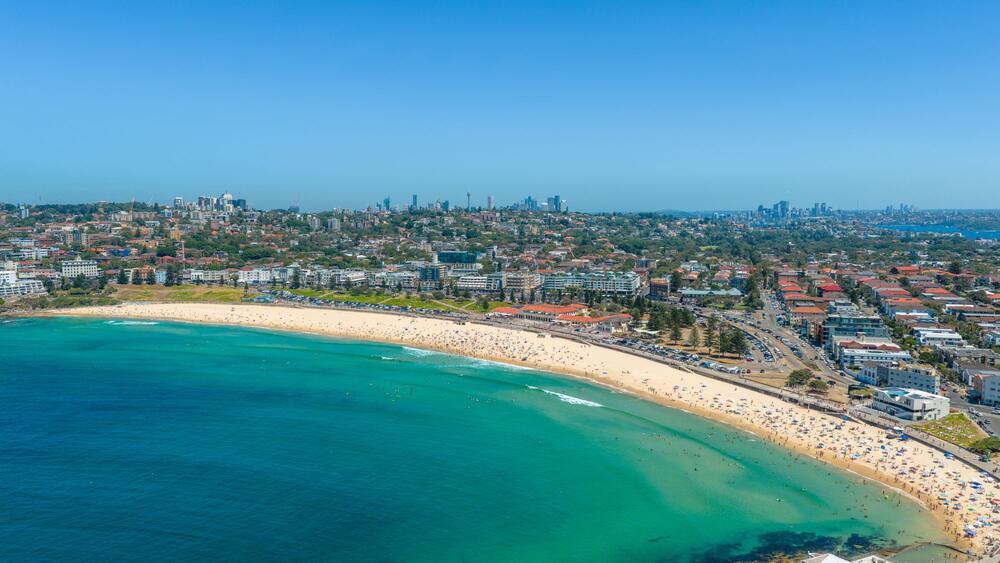 Photo by Macourt Media on Pexels
Bondi Beach, Sydney, crowded with swimmers and sunbathers
Autumn: March to May
In autumn, Sydney and Melbourne cool down from summer while the tropical north's wet season breaks, officially ending in April.
March
Best for Sydney's warmest sea and Mardi Gras, worst for Sydney's own wettest month
- Weather: Sydney highs 26.0 °C (79 °F), 12 wet days, sea 23.5 °C (74 °F); Melbourne highs 25.3 °C (78 °F), 5 wet days; Cairns highs 31.2 °C (88 °F), 13 wet days; Darwin highs 32.6 °C (91 °F), 23 wet days
- Dates: Sydney Gay and Lesbian Mardi Gras Parade, March 6, 2027
- Season: Shoulder, 1.02 times an average month in overseas visitor arrivals nationally
- Plan it: 10-day Australia itinerary, Australia guide
The Mardi Gras Parade runs down Oxford Street, Flinders Street and Anzac Parade on March 6. Pack for rain alongside it: March is Sydney's wettest month of the year, 12 wet days.
Sydney's sea peaks at 23.5 °C (74 °F) in March, a month after the air starts cooling. Darwin stays close to January's peak too, 23 wet days, deep in its own wet season.
April
Best for Cairns' wet season finally breaking, worst for Darwin's slower end to the wet
- Weather: Sydney highs 23.9 °C (75 °F), 7 wet days; Melbourne highs 21.2 °C (70 °F), 6 wet days; Cairns highs 29.8 °C (86 °F), 4 wet days; Darwin highs 33.2 °C (92 °F), 9 wet days
- Season: Low, 0.86 times an average month in overseas visitor arrivals nationally
- Plan it: 10-day Australia itinerary, Australia guide
Pick Cairns over Darwin in April: the wet season breaks faster there, 4 wet days against Darwin's 9. Darwin's own air still runs hottest, 33.2 °C (92 °F), its second-warmest reading of the year.
Sydney and Melbourne settle into a comfortable autumn, 23.9 °C (75 °F) and 21.2 °C (70 °F). Overseas visitor arrivals also sit near the year's lowest nationally, behind only May and June.
May
Best for the dry season's start up north and Sydney's driest stretch, worst for Melbourne's rising rain
- Weather: Sydney highs 21.2 °C (70 °F), 4 wet days, sea 21.3 °C (70 °F); Melbourne highs 17.6 °C (64 °F), 8 wet days; Cairns highs 28.1 °C (83 °F), 2 wet days; Darwin highs 32.1 °C (90 °F), 2 wet days
- Dates: Vivid Sydney, May 28 to June 19, 2027
- Season: Low, 0.82 times an average month in overseas visitor arrivals nationally, the year's quietest reading
- Plan it: 10-day Australia itinerary, Australia guide
May opens the official dry season for Cairns, Darwin and the rest of the tropical north: both cities drop to just 2 wet days, down from March's 13 and 23. Pack a lycra suit for the reef regardless, since marine stinger season runs through May.
Vivid Sydney opens May 28 and lights the Opera House and the Harbour after dark. The festival calls itself "the world's largest festival of light, music, minds and food." Sydney settles into its own driest stretch the same month, tied with July and August at 4 wet days. Melbourne goes the other way, climbing to 8.
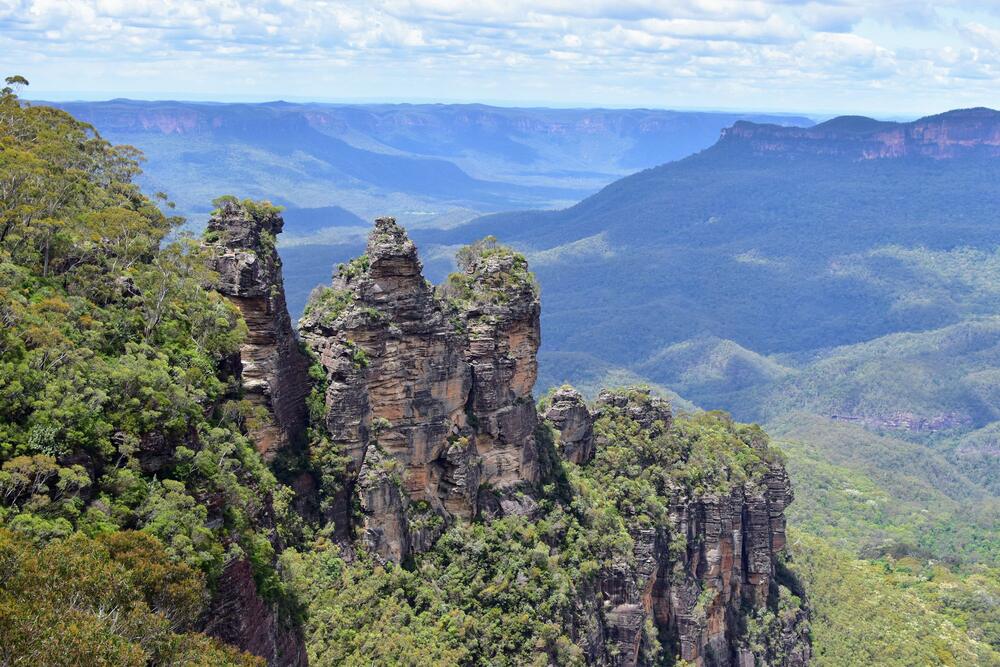 Photo by Onin on Pexels
The Three Sisters above the Jamison Valley, Blue Mountains
Winter: June to August
Darwin and Cairns log their driest months of the year in winter, while Melbourne drops to its coldest, 14.1 °C (57 °F) in July.
June
Best for the Top End's driest run and Vivid Sydney's final weeks
- Weather: Sydney highs 18.2 °C (65 °F), 7 wet days, sea 20.2 °C (68 °F); Melbourne highs 14.4 °C (58 °F), 8 wet days; Cairns highs 26.6 °C (80 °F), 2 wet days; Darwin highs 30.9 °C (88 °F), 1 wet day
- Season: Low, 0.84 times an average month in overseas visitor arrivals nationally
- Plan it: 10-day Australia itinerary, Australia guide
Vivid Sydney runs through its final weeks in June, closing June 19. Book before then if the light festival is the reason for your trip.
Darwin drops to a single wet day in June and Cairns holds at 2, both still warm, 30.9 °C (88 °F) and 26.6 °C (80 °F). Melbourne and Sydney run cooler and wetter instead, 14.4 °C (58 °F) and 18.2 °C (65 °F), with Melbourne at 8 wet days to Sydney's 7.
July
Best for a dry reef trip up north, worst for Melbourne's coldest month
- Weather: Darwin highs 30.7 °C (87 °F), 0 wet days, sea 26.1 °C (79 °F); Cairns highs 26.1 °C (79 °F), 1 wet day, sea 22.6 °C (73 °F); Sydney highs 18.0 °C (64 °F), 4 wet days; Melbourne highs 14.1 °C (57 °F), 9 wet days
- Season: Shoulder, 1.00 times an average month in overseas visitor arrivals nationally
- Plan it: 10-day Australia itinerary, Australia guide
Take the Kuranda Scenic Railway into the rainforest above Cairns in July, A$58 one-way for an adult until March 31, 2027, rising around 3.4% from April. Darwin and Cairns hold their driest run of the year, zero and 1 wet day. Cairns' sea is also at its coolest though, 22.6 °C (73 °F).
Melbourne has its coldest month of the year in July, 14.1 °C (57 °F). Sydney stays milder, 18.0 °C (64 °F), with just 4 wet days.
August
Best for the Top End's last fully dry month, worst for Melbourne's cold
- Weather: Darwin highs 31.2 °C (88 °F), 0 wet days; Cairns highs 27.0 °C (81 °F), 1 wet day; Sydney highs 18.8 °C (66 °F), 4 wet days; Melbourne highs 14.9 °C (59 °F), 9 wet days
- Season: Shoulder, 1.01 times an average month in overseas visitor arrivals nationally
- Plan it: 10-day Australia itinerary, Australia guide
August is the Top End's last fully dry month: Darwin holds at zero wet days and Cairns at 1, before Darwin's rain starts to build again in September.
Melbourne logs its third-coldest reading of the year, 14.9 °C (59 °F), with 9 wet days. Sydney ties July at 4 wet days and a milder high, 18.8 °C (66 °F).
Try free
Plan your Australia trip in about 2 minutes
Tap through 8 quick cards for a complete itinerary with budget, maps, and packing lists. No account required.
Plan your Australia trip →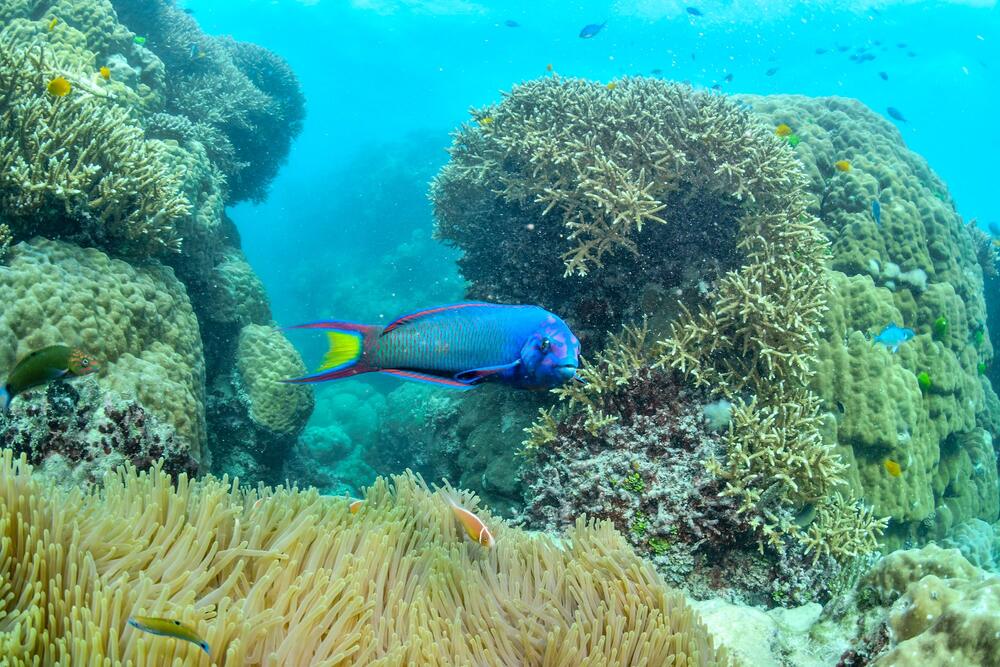 Photo by Martins OPO on Pexels
A parrotfish over coral on the Great Barrier Reef
Spring: September to November
By September the south is warming back up, and the tropical north's dry season still has two months left before the wet season returns in November.
September
Best for Cairns' driest stretch, worst for Melbourne's rain
- Weather: Cairns highs 28.5 °C (83 °F), 1 wet day; Darwin highs 32.3 °C (90 °F), 3 wet days; Sydney highs 21.3 °C (70 °F), 5 wet days; Melbourne highs 17.5 °C (64 °F), 9 wet days
- Season: Low, 0.94 times an average month in overseas visitor arrivals nationally
- Plan it: 10-day Australia itinerary, Australia guide
Pair Cairns with Sydney in September, not Melbourne. Cairns ties its driest reading of the year, 1 wet day, while Sydney stays mild at 21.3 °C (70 °F). Melbourne logs 9 wet days instead, tied with July and August as its wettest stretch.
Darwin stays nearly as dry, 3 wet days, with both northern cities holding their heat, 28.5 °C (83 °F) and 32.3 °C (90 °F).
October
Best for Cairns and Sydney's spring, worst for Darwin's rain returning
- Weather: Sydney highs 23.4 °C (74 °F), 7 wet days, sea 19.0 °C (66 °F); Melbourne highs 20.6 °C (69 °F), 8 wet days; Cairns highs 30.1 °C (86 °F), 2 wet days; Darwin highs 33.0 °C (91 °F), 10 wet days
- Season: Shoulder, 0.99 times an average month in overseas visitor arrivals nationally
- Plan it: 10-day Australia itinerary, where to go in October
Keep Cairns on an October itinerary and drop Darwin: Cairns stays dry at 2 wet days. Darwin's wet days jump to 10 instead, up from September's 3.
Sydney warms to 23.4 °C (74 °F) in October, a comfortable spring month, 7 wet days.
November
Best for Sydney's spring warmth, worst for the wet season returning to the Top End
- Weather: Sydney highs 24.6 °C (76 °F), 6 wet days, sea 19.6 °C (67 °F); Melbourne highs 22.6 °C (73 °F), 8 wet days; Cairns highs 31.1 °C (88 °F), 5 wet days; Darwin highs 33.6 °C (92 °F), 17 wet days
- Season: Peak, 1.12 times an average month in overseas visitor arrivals nationally
- Plan it: 10-day Australia itinerary, Australia guide
Darwin's wet season returns in force in November, 17 wet days against October's 10, and the marine stinger season begins again the same month. Book the reef before then if swimming without a stinger suit matters to you.
Sydney and Melbourne keep warming, 24.6 °C (76 °F) and 22.6 °C (73 °F). Cairns climbs more gently than Darwin, to just 5 wet days.
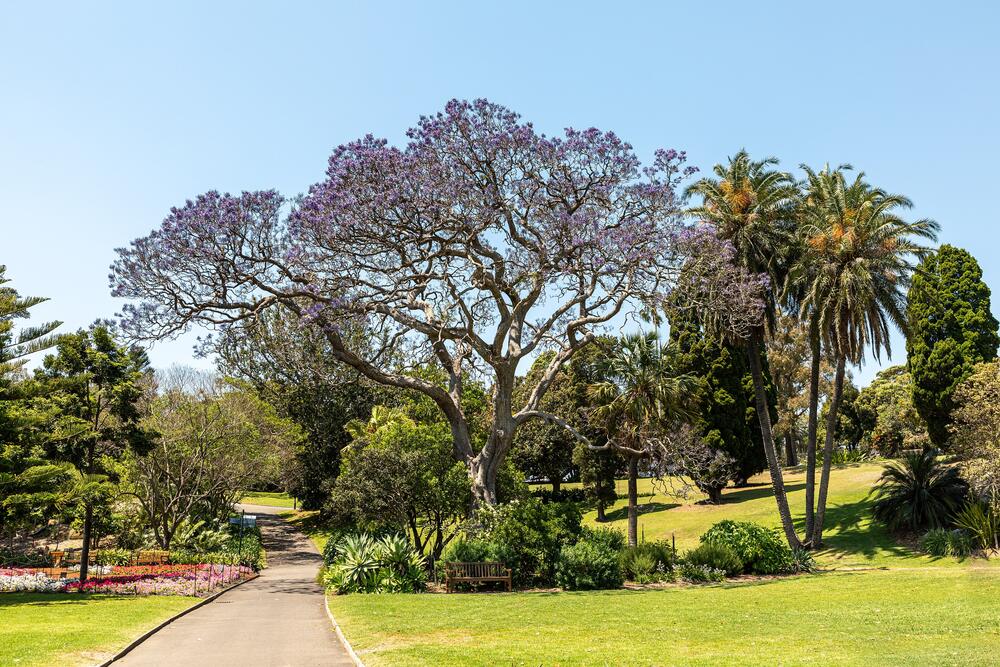 Dietmar Rabich (CC BY-SA 4.0)
A jacaranda in bloom in the Royal Botanic Garden, Sydney
Which month suits your trip?
| If you want | Go in | Because |
|---|---|---|
| A first trip across Sydney and Cairns | May, September or October | Sydney ties its driest month in May and Cairns holds its dry season throughout; Melbourne's own wettest spell falls in September and Darwin's rain returns in October |
| Sydney's beaches and harbor in full summer | December to February | Sydney and Melbourne both reach 27.5 °C (82 °F) in January, and Sydney's sea stays at or above 21 °C (70 °F) |
| The Great Barrier Reef without stingers | June to October | May is still inside Queensland's stinger season (November to May); June through October is clear of it and inside the dry season |
| The Australian Open | January 10 to 31, 2027 | Melbourne Park, in the city's hottest month |
| Sydney's Mardi Gras Parade | March 6, 2027 | down Oxford Street, Flinders Street and Anzac Parade, in Sydney's wettest month of the year |
| Vivid Sydney | May 28 to June 19, 2027 | the Harbour and the Opera House lit after dark |
| Low season nationally | April, May or June | overseas visitor arrivals fall to 0.86, 0.82 and 0.84 times an average month |
| Avoid | the tropical north from December to March | Darwin logs 21 to 25 wet days a month; January is the north's wettest month of the year, inside the stinger season |
Australia's twelve months compared
| Month | Sydney | Melbourne | Cairns | Darwin | Darwin wet days | What's on |
|---|---|---|---|---|---|---|
| January | 27.5 °C (82 °F), sea 22.3 °C (72 °F) | 27.5 °C (82 °F) | 32.1 °C (90 °F), sea 28.3 °C (83 °F) | 31.7 °C (89 °F), sea 30.6 °C (87 °F) | 25 | Australian Open Jan 10 to 31 |
| February | 27.1 °C (81 °F), sea 23.4 °C (74 °F) | 26.9 °C (80 °F) | 32.1 °C (90 °F), sea 28.7 °C (84 °F) | 32.2 °C (90 °F), sea 30.1 °C (86 °F) | 21 | n/a |
| March | 26.0 °C (79 °F), sea 23.5 °C (74 °F) | 25.3 °C (78 °F) | 31.2 °C (88 °F), sea 28.4 °C (83 °F) | 32.6 °C (91 °F), sea 30.3 °C (87 °F) | 23 | Mardi Gras Parade Mar 6 |
| April | 23.9 °C (75 °F), sea 22.7 °C (73 °F) | 21.2 °C (70 °F) | 29.8 °C (86 °F), sea 27.4 °C (81 °F) | 33.2 °C (92 °F), sea 30.5 °C (87 °F) | 9 | n/a |
| May | 21.2 °C (70 °F), sea 21.3 °C (70 °F) | 17.6 °C (64 °F) | 28.1 °C (83 °F), sea 25.6 °C (78 °F) | 32.1 °C (90 °F), sea 29.5 °C (85 °F) | 2 | Vivid Sydney opens May 28 |
| June | 18.2 °C (65 °F), sea 20.2 °C (68 °F) | 14.4 °C (58 °F) | 26.6 °C (80 °F), sea 23.9 °C (75 °F) | 30.9 °C (88 °F), sea 27.7 °C (82 °F) | 1 | Vivid Sydney closes Jun 19 |
| July | 18.0 °C (64 °F), sea 18.6 °C (65 °F) | 14.1 °C (57 °F) | 26.1 °C (79 °F), sea 22.6 °C (73 °F) | 30.7 °C (87 °F), sea 26.1 °C (79 °F) | 0 | n/a |
| August | 18.8 °C (66 °F), sea 18.0 °C (64 °F) | 14.9 °C (59 °F) | 27.0 °C (81 °F), sea 22.9 °C (73 °F) | 31.2 °C (88 °F), sea 26.3 °C (79 °F) | 0 | n/a |
| September | 21.3 °C (70 °F), sea 17.9 °C (64 °F) | 17.5 °C (64 °F) | 28.5 °C (83 °F), sea 23.8 °C (75 °F) | 32.3 °C (90 °F), sea 27.5 °C (82 °F) | 3 | n/a |
| October | 23.4 °C (74 °F), sea 19.0 °C (66 °F) | 20.6 °C (69 °F) | 30.1 °C (86 °F), sea 25.3 °C (78 °F) | 33.0 °C (91 °F), sea 29.3 °C (85 °F) | 10 | n/a |
| November | 24.6 °C (76 °F), sea 19.6 °C (67 °F) | 22.6 °C (73 °F) | 31.1 °C (88 °F), sea 26.9 °C (80 °F) | 33.6 °C (92 °F), sea 30.6 °C (87 °F) | 17 | n/a |
| December | 26.3 °C (79 °F), sea 21.0 °C (70 °F) | 25.4 °C (78 °F) | 31.7 °C (89 °F), sea 27.9 °C (82 °F) | 32.7 °C (91 °F), sea 31.3 °C (88 °F) | 21 | n/a |
Highs and sea temperatures are monthly averages for 2013 to 2022, measured for the city named. Overseas visitor arrivals are the Australian Bureau of Statistics' short-term visitor arrivals series, 2025 monthly figures divided by 2025's average month. Arrivals are a national total of international visitors and leave out domestic travelers.
Plan the trip
The 10-day Australia itinerary spends 4 days in Sydney, including a Blue Mountains day trip, then 3 in Melbourne and 3 in Cairns. The Australia guide covers what to see in each city.
Every MonkeyEatingMango trip plan shows the measured weather for each city in your travel month. A trip spanning Sydney and Cairns shows the south's mild autumn beside the north's dry season in the same plan.
Plan your Australia trip →Choose your month and climate, then plan an Australia trip.
Last updated November 2026.
Common questions
When is summer in Australia?
December through February is summer in Australia, since the country's seasons run opposite the northern hemisphere's. Sydney and Melbourne both reach a January high of 27.5 °C (82 °F), while the same three months are the wet season and the stinger season on the Great Barrier Reef.
What is the best month to visit Australia?
May, September and October line up Sydney's mild, mostly dry weather with Cairns' dry season. Sydney ties its driest month in May and warms to 23.4 °C (74 °F) by October, while Cairns stays under 3 wet days in all three months.
Does the best time to visit Australia depend on where you go?
Yes. Sydney, Melbourne and the rest of the south run a reversed four-season year, summer from December to February and winter from June to August, while the tropical north runs a wet season from November to April and a dry season from May to October instead. A Sydney summer trip lands squarely inside Cairns and Darwin's wet and stinger season.
What is the temperature in Australia by month?
Sydney and Melbourne both reach their yearly high of 27.5 °C (82 °F) in January and cool to 18.0 °C (64 °F) and 14.1 °C (57 °F) in July. Cairns stays far warmer year-round, from 26.1 °C (79 °F) in July to 32.1 °C (90 °F) in January, and Darwin barely cools at all, holding between 30.7 °C (87 °F) and 33.6 °C (92 °F) every month of the year.
When is stinger season on the Great Barrier Reef?
Marine stinger season on Queensland's coast runs from November to May, when the risk from box jellyfish and Irukandji is highest. Swim inside the stinger nets where they're provided or wear a full-body lycra suit, and treat a sting with vinegar.
When is the dry season in northern Australia?
May through October is the official dry season for Cairns, Darwin and the rest of Australia's tropical north. Darwin's wet days fall from 23 in March to 2 in May and stay in single digits through September, while Cairns drops from 13 wet days in March to 2 in May.
What is the cheapest time to visit Australia?
April, May and June see the fewest overseas visitors arriving, which tends to mean less competition for rooms and flights: arrivals fall to 0.86, 0.82 and 0.84 times an average month, by 2025 figures from the Australian Bureau of Statistics. September is close behind at 0.94.
What is the worst time to visit Australia?
January is the hardest month for the tropical north: Darwin logs 25 wet days and Cairns 16, both their wettest of the year, squarely inside the stinger season. Sydney and Melbourne stay far drier in January, so the south is a better bet than the far north that same month.
When is the Australian Open in 2027?
The Australian Open runs from January 10 to 31, 2027, at Melbourne Park. The tournament falls in Melbourne's hottest month, when the city's average high reaches 27.5 °C (82 °F).
When is Sydney's Mardi Gras Parade in 2027?
The Sydney Gay and Lesbian Mardi Gras Parade runs on Saturday, March 6, 2027, down Oxford Street, Flinders Street and Anzac Parade. March is also Sydney's wettest month of the year, 12 wet days on average, so pack for rain as well as the parade.
When is Vivid Sydney in 2027?
Vivid Sydney runs from May 28 to June 19, 2027, lighting the Opera House and the Harbour after dark. The festival opens at the end of May, tied with July and August as Sydney's driest month, 4 wet days.

Written by Shobhit Shrivastava · Founder
Related reading
Australia travel guide
10-Day Sydney, Melbourne, & Cairns, Australia Couples Itinerary
10 days across Australia's east coast: 4 days in Sydney for the Bondi to Coogee walk and Opera House, 3 days in Melbourne for laneway cafes and Queen Victoria Market, and 3 days in Cairns for Great Barrier Reef snorkeling and Daintree rainforest treks. Comfortable pace with domestic flights...
Things to Do in Australia and the Best Places to Visit
Where to go in Australia by region: the big cities, the Reef and the Red Centre, road trips and islands, Tasmania and the West. Every stop carries its top sights, the official price where one exists, and what to book ahead.
Best Time to Visit Thailand: Month by Month (2027)
When to go to Thailand, month by month: weather for Bangkok, Chiang Mai, Phuket and Ko Samui, the 2027 Songkran and Loy Krathong dates, and why the Andaman and Gulf coasts run different rainy seasons.
Traditional Australian Food: What to Eat in Australia
The Australian dishes to eat first, by category: iconic savory mains, spreads and sweets, seafood, coffee and brunch, then a short bush-food section, sourced throughout.