Wanderlog's AI assistant writes a careful, frugal plan, and then leaves it in the chat. One message about a 7-day Tokyo trip returned 27 named stops, none closed on its scheduled day, correct rail pass advice, and a budget table that sums to $1,500. The trip's own itinerary days stayed empty, and the answer left 7 of the 15 must-dos of a first visit unanswered. Pick it if you will build the trip yourself and want a sound draft to copy from.
- What it is: a map-based trip planner at wanderlog.com, with an AI Assistant in a chat beside each trip.
- First plan: about 60 seconds after the brief, after an account and six setup screens.
- The catch: the plan lives only in the chat; every stop has to be added to the trip by hand.
- Free: the planner, plus 10 AI messages on the account tested. Pro starts at $39.99 a year on the website; the pricing post has every plan.
- Oh-No Travel Index: 8 out of 20, lower is better: 7 must-dos unanswered and 1 day fault, 5 stops on day 3.
What does Wanderlog's AI make from a 7-day trip brief?
Wanderlog's AI Assistant answered a 7-day Tokyo brief with a long, sourced plan in about 60 seconds on October 19, 2026. The brief asked for 7 days in Tokyo from November 16 to 22, for a couple, with USD 1,500 excluding flights, at a comfortable pace, on a first visit to Japan.
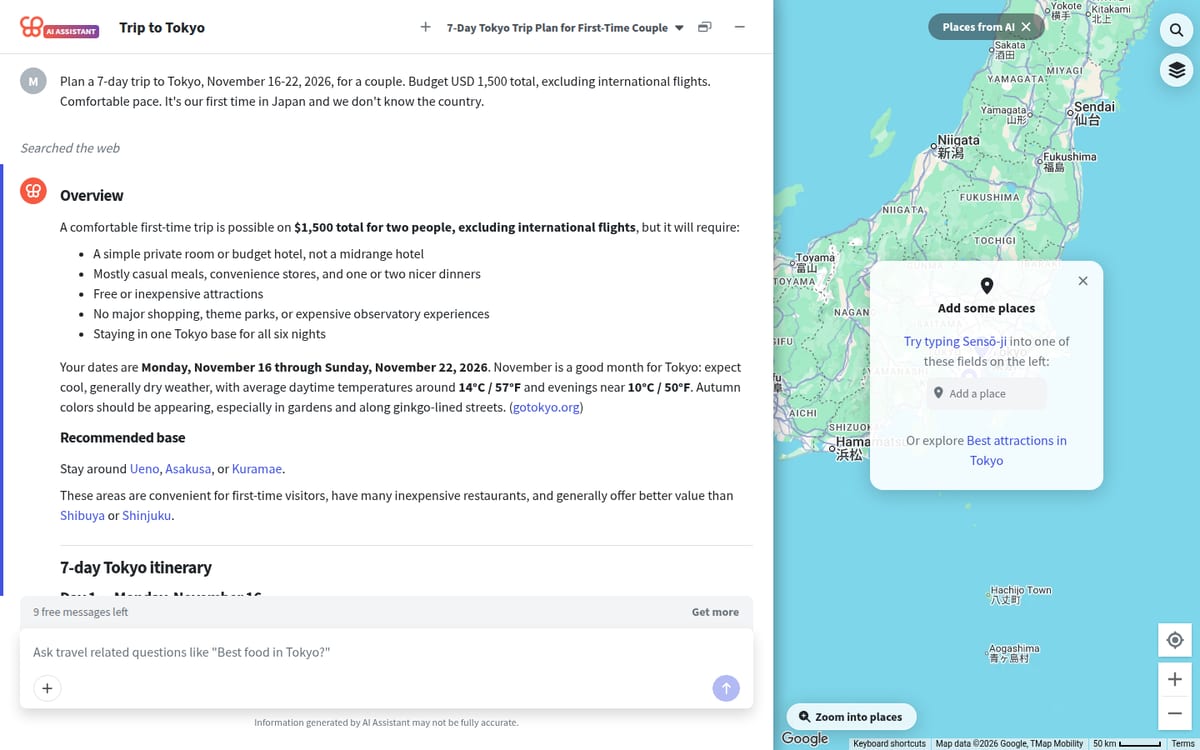
Each day has a theme, a walking order and a spending estimate for two, from $70 to $190. Day 6 is a Kamakura day trip routed station by station, out to Hase for the Great Buddha. The answer cites the official Tokyo tourism site, the Japan Rail Pass site and the Tokyo metropolitan government.
It is also frugal on purpose. It skips the Tokyo Skytree deck and Shibuya Sky to protect the budget, and it tells a first-timer to drop Kyoto, Osaka and Mount Fuji from a 7-day trip. There are no clock times, though: "Start early" is as precise as a day gets. Restaurants are types ("a ramen shop, curry restaurant, izakaya"), not names.
Does Wanderlog's AI plan the trip for you?
Wanderlog's AI plans the trip in the chat, and the trip itself stays empty. After the answer, the itinerary days Mon 11/16 to Sun 11/22 held nothing, and the map still showed "Add some places: Try typing Sensō-ji". Turning the plan into a trip means adding 27 stops by hand, one search at a time.
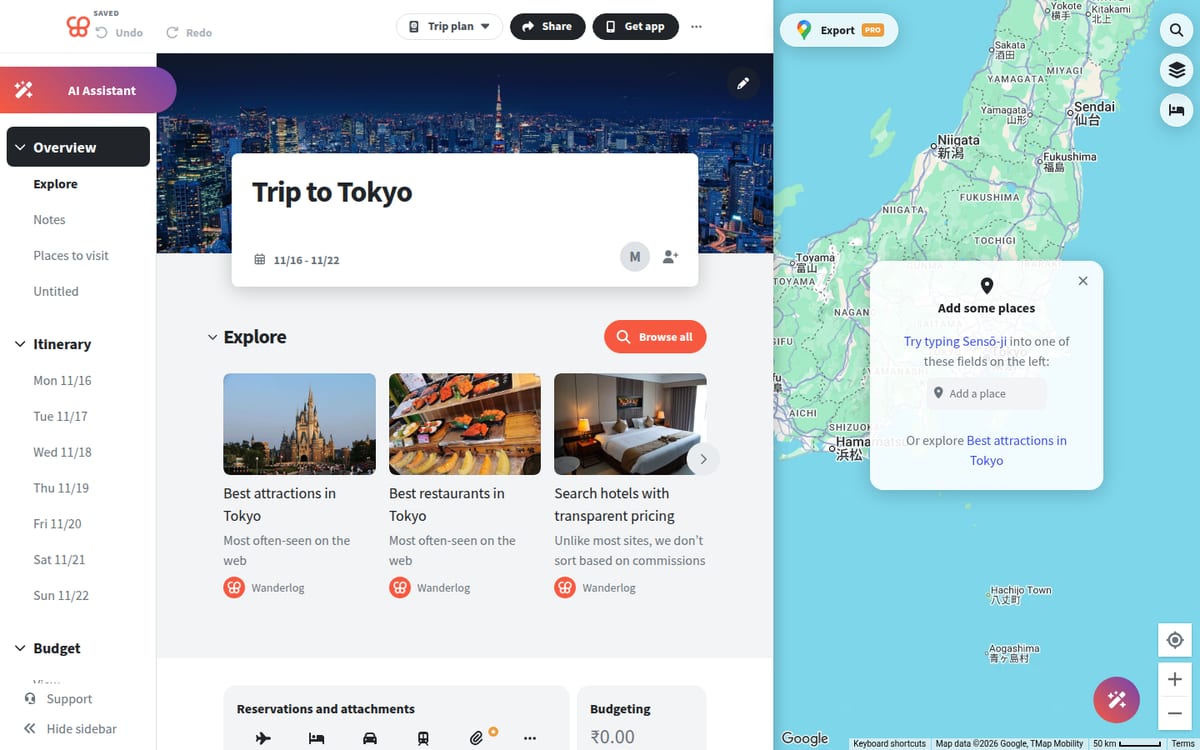
Getting to the assistant takes work too. On a signed-in account, the path ran through Plan new trip, a destination, two calendar dates, Start planning and an Invite tripmates screen before the AI Assistant button was in reach. The message counter read "10 free messages left" before the brief and 9 after it, with a "Get more" link.
The trip page around the chat is where Wanderlog earns its reputation: Share, Invite tripmates, reservations and attachments, and group expense balances. Export and Optimize route carry a Pro label.
Is Wanderlog good for a first trip to Japan?
Wanderlog scores 8 on the Oh-No Travel Index and MonkeyEatingMango scores 4, out of 20, on the October 19, 2026 runs. Lower is better.
| # | Before you go | Wanderlog | MonkeyEatingMango |
|---|---|---|---|
| 1 | Entry papers | ❌ | ✅ passport and visa check |
| 2 | Airport to the city | ❌ no airport route | ✅ Narita Express or limousine bus |
| 3 | Where to stay | ✅ Ueno, Asakusa or Kuramae, $90-110 a night | ✅ Ginza, all six nights |
| 4 | The transit card and how trains work | ✅ Suica, subway day tickets | ✅ Suica, tap in and out |
| 5 | Whether a JR Pass is worth it | ✅ skip it, with the ¥50,000 price | ❌ |
| 6 | Cash or card | ✅ cash for small restaurants, temples | ✅ cash-only spots, 7-Eleven ATMs |
| 7 | SIM, eSIM or pocket Wi-Fi | ❌ | ✅ three options with prices |
| 8 | Etiquette and tipping | ❌ | ✅ no tipping, bowing at shrines |
| 9 | What to book ahead | ❌ lodging only | ✅ teamLab, Kabuki-za, with book-by dates |
| 10 | Closures and holidays on your dates | ❌ Mondays avoided, not explained | ❌ Mondays avoided, not explained |
| 11 | Weather and what to pack | ✅ cool and dry, layers, an umbrella | ✅ forecast and a packing list |
| 12 | Scams and tourist traps | ✅ aggressive touts in Kabukicho | ✅ Roppongi bar touts |
| 13 | A day trip out of Tokyo | ✅ Kamakura, station by station | ✅ Kamakura, as a swap |
| 14 | The must-do sights | ✅ Senso-ji, Meiji Jingu, Shibuya | ✅ Senso-ji, Meiji Jingu, Shibuya |
| 15 | The leaving day | ❌ no airport or set-off time | ✅ checkout time, Narita for the flight |
| # | On the day | Wanderlog | MonkeyEatingMango |
|---|---|---|---|
| 16 | Arrival day planned like a full day | ✅ check-in, a walk and dinner | ✅ 2 stops after landing |
| 17 | Too much in one day | ❌ 5 named stops on day 3 | ✅ at most 4 stops a day |
| 18 | A stop closed when you arrive | ✅ 0 of 27 closed, 2 unconfirmed | ❌ Tsukiji at 4:30 PM, stalls shut |
| 19 | A day that doubles back | ✅ | ❌ day 7 back to Ginza before the airport |
| 20 | The same place twice | ✅ | ✅ |
| Oh-No Travel Index (lower is better) | 8 | 4 |
The schedule is where Wanderlog is strong. Shinjuku Gyoen and the Tokyo National Museum, both closed on Mondays, land on a Friday and a Tuesday; the Imperial Palace East Gardens, closed Mondays and Fridays, land on a Thursday (Imperial Household Agency). Seven of its eight points are must-dos it leaves unanswered.
Wanderlog vs MonkeyEatingMango on the same brief
Wanderlog's answer is the more frugal and cites its sources; MonkeyEatingMango turns the same trip into a dated plan with a time and a cost on every stop, already laid out as a trip.
| Wanderlog | MonkeyEatingMango | |
|---|---|---|
| See the plan yourself | A share button on the trip (not tested) | ✅ Open the plan, no account |
| Input | 1 chat message, after 6 setup screens | 8 tap cards, no account |
| Time to the answer | About 60 seconds | About 95 seconds |
| Day plan | 7 days in the chat; ❌ trip days empty | ✅ 7 timed days, 18 stops |
| Hotels | Three areas and a $90 to $110 nightly target | One area and a price range |
| Cost | A $1,500 table that adds up, and a spend per day | USD 4,539 for 2, USD 2,419 on the ground; ❌ no warning past USD 1,500 |
| Follow-ups | 10 free AI messages | Edit any stop, no limit |
| Oh-No Travel Index (lower is better) | 8 | 4 |
- Where Wanderlog is better: a budget answer that fits the USD 1,500, rail pass advice, no closed stops, and a trip a group can share and split costs on.
- Where MonkeyEatingMango is better: the plan is the trip, with times, costs and a map; it answers 13 of 15 must-dos to Wanderlog's 8.
- Where both slip: neither explains the Monday closures it plans around. MonkeyEatingMango, which asks no budget, also never compared its estimate with the USD 1,500.
Open the full MonkeyEatingMango plan for this brief: all 7 days, the map and the cost estimate, with no sign-in. For other Japan routes, the Japan travel guide and the 7-day Japan itinerary start from the same data.
Try free
Plan a trip in about 2 minutes
Tap through 8 quick cards for a complete itinerary with budget, maps, and packing lists. No account required.
Plan a trip →How do other AI planners compare on the same brief?
Five other planners received the same Tokyo brief on October 19, 2026. They run A to Z below, with MonkeyEatingMango, the product behind this blog, last and scored the same way, and each tool's Oh-No Travel Index (lower is better). For tools that work like Wanderlog without an AI test, see the Wanderlog alternatives roundup.
| Planner | From the brief | Free | Paid, as of October 2026 | Oh-No Travel Index |
|---|---|---|---|---|
| iMean | Prose days in a chat | 1 message a day | From $6.99 a month, billed yearly | 5 |
| Plantrip | ✅ 7 dated days, train fares | 3 plans a month | Plus $3 a month or $30 a year | 11 |
| Stardrift | ✅ 7 dated days, 2 stops each | ✅ Free, with an account | None published | 10 |
| Stippl | ❌ 3 bases, no stops | 20 AI messages | Pro EUR 3.99 a month or EUR 24.99 a year | 11, plus 5 not scored |
| MonkeyEatingMango | ✅ 7 timed days, every stop costed | ✅ The full plan, no account | $0.99 per trip, for downloads | 4 |
1. iMean: one answer with hotels
iMean's first answer added ten priced hotels and a map of every place, which Wanderlog's chat left out. Its free plan allows 1 message a day to Wanderlog's 10. Read the iMean review.
2. Plantrip: a plan with the transit in it
Plantrip writes the whole week from one text box, with the train line, minutes and fare for every leg, and keeps it as a plan rather than a chat. Its days are busier: up to five sights plus meals. Read the Plantrip review.
3. Stardrift: a chat that fills the itinerary
Stardrift's chat fills a dated itinerary beside it, two stops a day with three priced hotels, the step Wanderlog leaves to the traveler. It answered fewer must-dos: 6 of 15 to Wanderlog's 8. Read the Stardrift review.
4. Stippl: another organizer
Stippl is the closest to Wanderlog as an organizer, with a shared route and an expense split. Its free AI drew three bases and no stops. Read the Stippl review.
5. MonkeyEatingMango: the plan is the trip
MonkeyEatingMango puts the plan in the trip: seven timed days with a cost on every stop, no account and no message limit. It has no shared editing, which Wanderlog's free tier offers. Open the Tokyo plan.
What are Wanderlog's limitations?
Wanderlog's main limit is the gap between its AI and its planner: the answer and the trip never meet.
- The plan stays in the chat. Nothing from the answer is pinned on the map or placed in a day.
- Setup before the first answer. An account, a destination, dates and an invite screen come first.
- A metered assistant. 10 free messages on the account tested, then "Get more".
- Thin on practicalities. No entry papers, airport route, SIM, etiquette or book-ahead list, and no clock times, named restaurants or hotels.
- Slowdowns on big trips. In a 2024 r/travel thread, one user wrote "the app gets slower the more you add to it". One report, not a measured fault.
How was this review done?
Wanderlog received the brief word for word in its AI Assistant on October 19, 2026, on a signed-in free account; MonkeyEatingMango, which has no free-text box or budget field, received the same trip through its 8 cards. Each plan was scored on the Oh-No Travel Index with each ticketed venue checked against its official opening days; the screenshots come from those runs.
Who should pick Wanderlog?
Wanderlog suits a traveler, or a group, who wants to build the trip on a shared map and will place each stop by hand, with the AI answer as a careful draft to copy from. Someone who wants the plan to arrive as a dated trip, with times and costs already on it, will want a tool that builds the trip itself.
To see a dated plan with a cost on every stop, start a trip on MonkeyEatingMango.
Disclosure: MonkeyEatingMango, the product behind this blog, also plans trips and appears in the comparison above. Wanderlog facts were read off the live product on October 19, 2026; prices are in the Wanderlog pricing post.
Last updated October 2026.
Common questions
Is Wanderlog good?
Wanderlog's AI assistant gave a careful 7-day Tokyo plan in October 2026: 27 named stops, none closed on its scheduled day, and a $1,500 budget table that adds up. The weak spots were practical: no airport route, SIM, etiquette or list of what to book ahead, and the plan never filled the trip's own itinerary.
Does Wanderlog use AI?
Wanderlog has an AI Assistant that answers in a chat beside a trip. On a free account in October 2026 it showed 10 free messages, and one message returned a full 7-day plan with a budget, sourced from official tourism and rail sites.
Does Wanderlog's AI assistant fill in my itinerary?
Wanderlog's AI answer did not fill the itinerary in the October 2026 test; it stayed in the chat: the trip's itinerary days (Mon 11/16 to Sun 11/22) stayed empty and the map kept showing 'Add some places'. Each stop has to be added to the trip by hand.
Is Wanderlog free?
Wanderlog's planner is free to use, and a free account showed 10 AI messages in October 2026. Pro starts at $39.99 a year on the website and unlocks features such as export and route optimization; the full price breakdown is in the Wanderlog pricing post.
Is Wanderlog good for a trip to Japan?
Wanderlog handles a Japan schedule well: on a 7-day Tokyo brief it kept every Monday-closing venue off Monday and gave correct JR Pass advice. It scored 8 on the Oh-No Travel Index, where lower is better, mostly for practical questions it left open, such as entry papers, the airport route and SIM cards.
Do you need an account to use Wanderlog's AI?
Wanderlog's AI Assistant needs an account: in October 2026 it opened only inside a trip, after signing in, choosing a destination and dates, and dismissing an invite-tripmates screen.
How long does Wanderlog's AI take to plan a trip?
Wanderlog's AI took about 60 seconds to return a 7-day Tokyo plan in October 2026, once the brief was sent. Getting to the AI Assistant took six screens before that.
Does Wanderlog handle a budget?
Wanderlog's AI assistant handled a USD 1,500 budget directly: it said the trip was possible on a budget hotel and casual meals, and gave a table that sums exactly to $1,500 with a per-day estimate. The trip's separate budget widget is manual and was not linked to the AI's numbers.
What are the alternatives to Wanderlog?
Five other planners received the same Tokyo brief: iMean, MonkeyEatingMango, Plantrip, Stardrift and Stippl. Stippl is the closest trip organizer; Plantrip and Stardrift return a full day plan from one message; MonkeyEatingMango gives a dated, timed plan with a cost on every stop.

Written by Shobhit Shrivastava · Founder
Related reading
Stardrift AI Review 2026: Is It Free, and Is It Any Good?
Stardrift turned one message into a dated 7-day Tokyo plan in about 90 seconds, with real hotel prices and an honest budget warning. It left the practical part of the trip to you.
Plantrip AI Review 2026: Is It Free, and Is It Accurate?
Plantrip turned one typed brief into a full 7-day Tokyo plan in 92 seconds, with the clearest train directions of six planners tested. It also packed the days and scheduled a garden on the day it closes.
iMean AI Review 2026: Is It Free, and Is It Accurate?
iMean's first answer to a 7-day Tokyo brief answered 11 of 15 must-dos, the most of the five outside planners tested, with neighborhoods, ten priced hotels, a map and a budget split. The free plan then allowed no follow-up, and several facts were out of date.