Stardrift is a fast way to a clean, dated trip plan, and it leaves the practical part of the trip to you. One message became a 7-day Tokyo plan in about 90 seconds, with two well-grouped stops a day, real hotel prices and an honest budget warning. It said nothing about the airport, cash, SIM cards or the weather. Pick it if you know how to travel and want the days shaped for you.
- What it is: a free AI trip planner at stardrift.ai and on iPhone, rated 4.8 from 12 US App Store ratings (October 21, 2026).
- First plan: one chat message, about 90 seconds, 7 dated days with 2 stops each, start times and a map.
- Hotels: three named options with prices for the dates and a Book button.
- Budget: called USD 1,500 "too tight" and suggested USD 2,000 to 2,300.
- Price: free, with an account; no paid plan is published.
- Oh-No Travel Index: 10 out of 20, lower is better: 9 of 15 must-dos unanswered and a Sunday breakfast at a market where many shops close on Sundays.
What does Stardrift make from a 7-day trip brief?
Stardrift turned one typed brief into a dated 7-day Tokyo plan in about 90 seconds on October 19, 2026, two stops a day with a start time on each. The brief asked for 7 days in Tokyo from November 16 to 22, for a couple, with USD 1,500 excluding flights, at a comfortable pace, on a first visit to Japan.
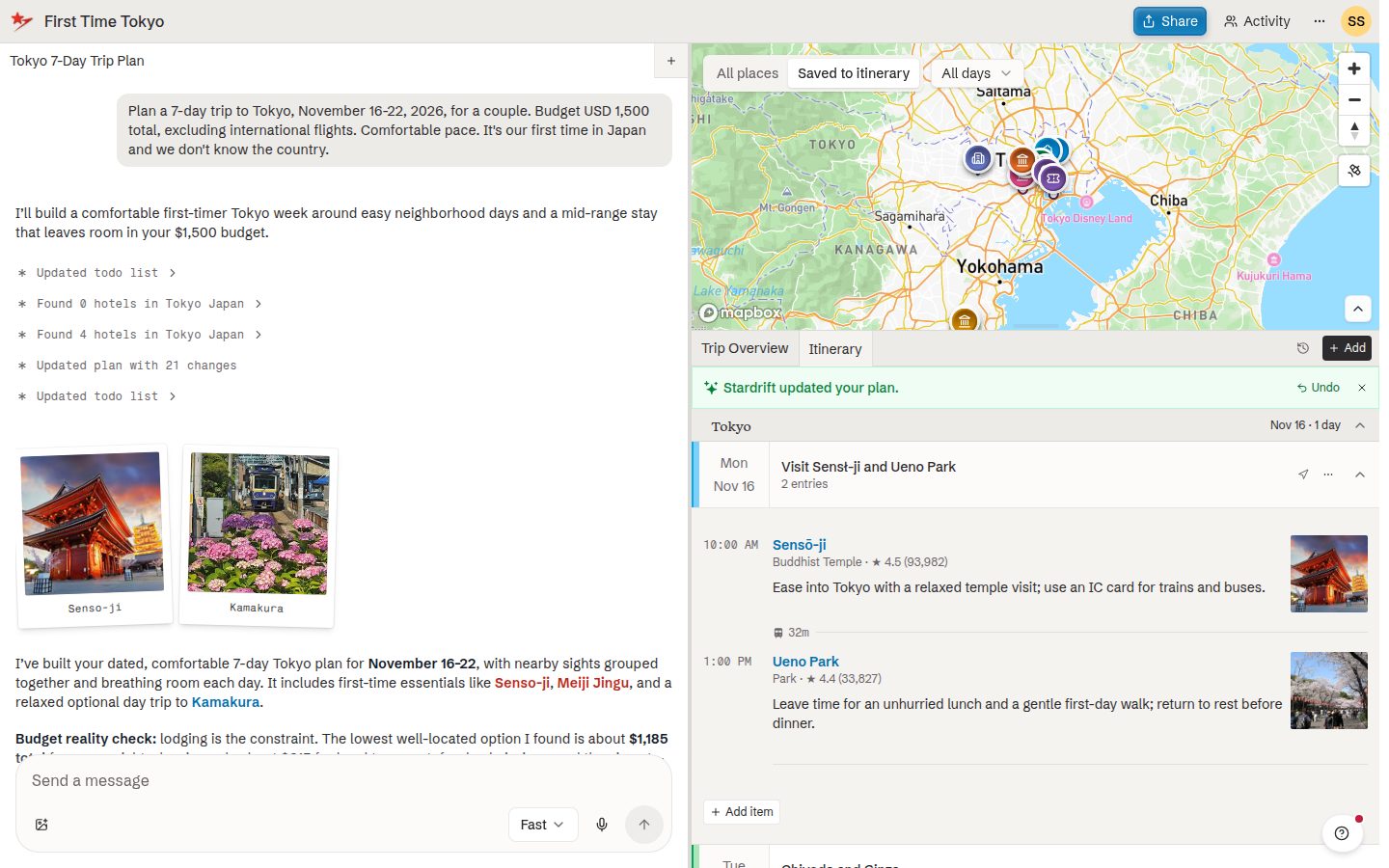
The days are well grouped, and the pace really is comfortable:
| Day | Stops | Area |
|---|---|---|
| Mon 16 | Senso-ji 10:00, Ueno Park 13:00 | Asakusa and Ueno |
| Tue 17 | Imperial Palace 10:00, Ginza 14:30 | Chiyoda |
| Wed 18 | Meiji Jingu 9:30, Shibuya Crossing 12:00 | Harajuku and Shibuya |
| Thu 19 | Shinjuku Gyoen 10:00, Omoide Yokocho 17:30 | Shinjuku |
| Fri 20 | Inokashira Park 10:00, Ghibli Museum 14:00 | Kichijoji and Mitaka |
| Sat 21 | Kotoku-in 9:00, Hase-dera 11:30 | Kamakura |
| Sun 22 | Tsukiji Outer Market 9:00, teamLab Planets 13:00 | Tsukiji and Toyosu |
Each day sits in one area, and the panel shows the travel time between the two stops, from 4 to 32 minutes. No restaurant is named on any day, and no stop carries a price.
Is Stardrift AI free?
Stardrift is free: its App Store listing says "Stardrift is free to use" and lists no in-app purchases, as of October 21, 2026. The website publishes no paid plan. An account is required before the planner opens.
How honest is Stardrift about the budget?
Stardrift was direct about money: it said USD 1,500 was "too tight for a comfortable couple's trip" and suggested USD 2,000 to 2,300. That came after an opening line promising "a mid-range stay that leaves room in your $1,500 budget."
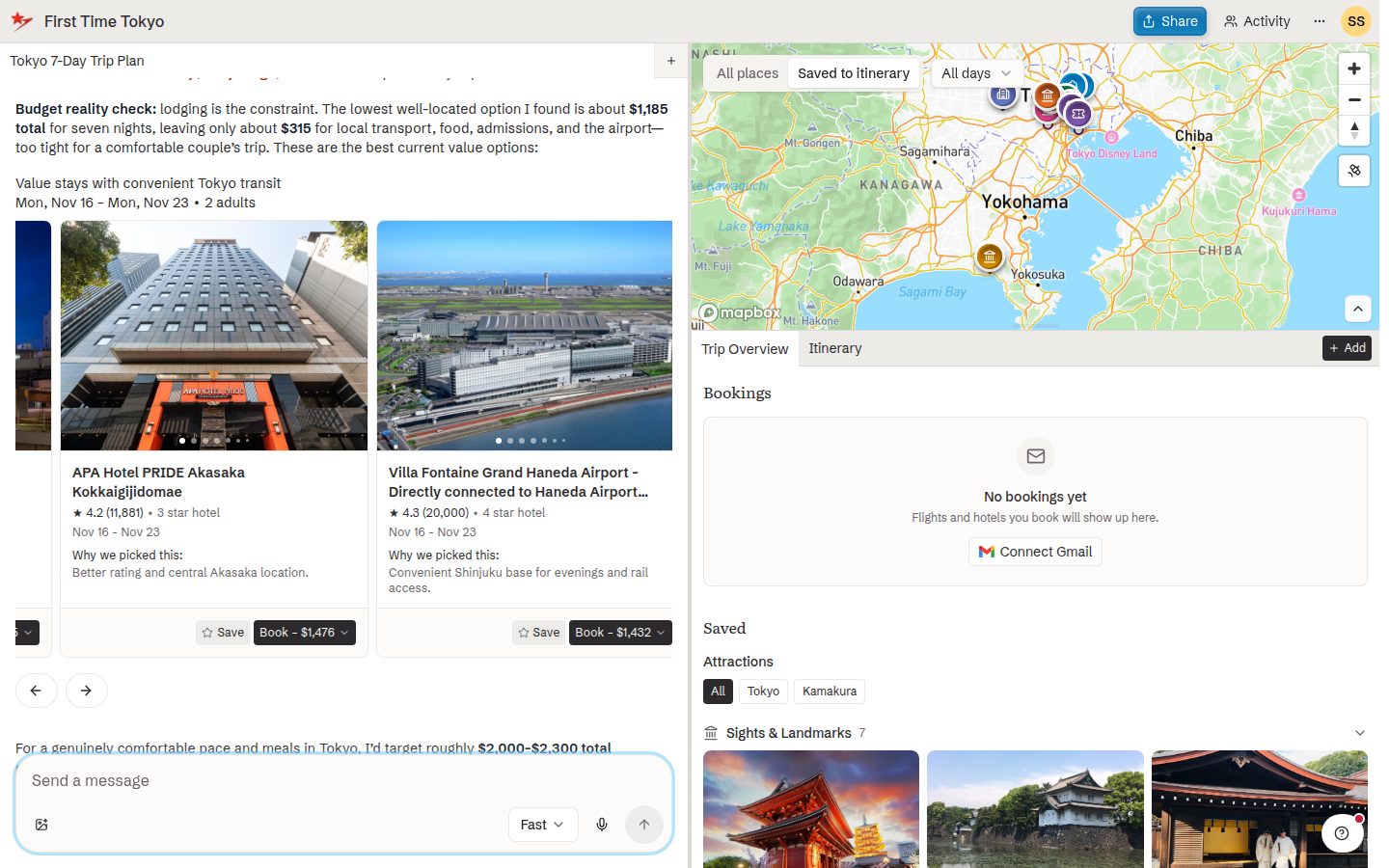
- The arithmetic: the cheapest hotel was USD 1,185 for "seven nights", leaving about USD 315 for everything else. The trip ends on November 22, so it needs six nights; every quote included an extra night.
- A hotel in the wrong place: Villa Fontaine Grand Haneda Airport is "directly connected to Haneda Airport Terminal 3", yet the card says "Why we picked this: Convenient Shinjuku base for evenings and rail access." Haneda is 40 minutes or more from Shinjuku by train.
- No breakdown: apart from hotels, the plan prices nothing, so the warning cannot be checked against food, transport or tickets.
What are Stardrift's limitations?
Stardrift's main limit is that it plans the days and stops there; the practical questions a week in Japan raises are left to you.
- Thin practical advice. Nothing on the airport transfer, cash, SIM cards, etiquette or November weather; the only clothing note is "pack a light layer".
- Checks pushed back to you. Notes such as "Confirm opening days and seasonal hours before going" and "check individual stall hours" name a problem instead of solving it.
- A breakfast on a closing day. Sunday starts with breakfast at Tsukiji Outer Market, whose official map says "Many shops are closed on Sundays, Wednesdays and National Holidays."
- No last-day plan. Sunday ends at teamLab Planets with "leave the evening open for a final meal or packing", and no word on the airport.
Is Stardrift good for a first trip to Japan?
Stardrift scores 10 on the Oh-No Travel Index and MonkeyEatingMango scores 4, out of 20, on the October 19, 2026 runs. Lower is better.
| # | Before you go | Stardrift | MonkeyEatingMango |
|---|---|---|---|
| 1 | Entry papers | ❌ | ✅ passport and visa check |
| 2 | Airport to the city | ❌ "the airport" appears only as a cost | ✅ Narita Express or limousine bus |
| 3 | Where to stay | ✅ Roppongi or Akasaka, priced hotels | ✅ Ginza, all six nights |
| 4 | The transit card and how trains work | ✅ "use an IC card", not named | ✅ Suica, tap in and out |
| 5 | Whether a JR Pass is worth it | ❌ | ❌ |
| 6 | Cash or card | ❌ | ✅ cash-only spots, 7-Eleven ATMs |
| 7 | SIM, eSIM or pocket Wi-Fi | ❌ | ✅ three options with prices |
| 8 | Etiquette and tipping | ❌ | ✅ no tipping, bowing at shrines |
| 9 | What to book ahead | ✅ Ghibli Museum, teamLab | ✅ teamLab, Kabuki-za, with book-by dates |
| 10 | Closures and holidays on your dates | ❌ "confirm opening days" | ❌ Mondays avoided, not explained |
| 11 | Weather and what to pack | ❌ "a light layer" only | ✅ forecast and a packing list |
| 12 | Scams and tourist traps | ✅ crowded-lane pickpocket warning | ✅ Roppongi bar touts |
| 13 | A day trip out of Tokyo | ✅ Kamakura, on Saturday | ✅ Kamakura, as a swap |
| 14 | The must-do sights | ✅ Senso-ji, Meiji Jingu, Shibuya | ✅ the same three |
| 15 | The leaving day | ❌ | ✅ checkout time, Narita for the flight |
| # | On the day | Stardrift | MonkeyEatingMango |
|---|---|---|---|
| 16 | Arrival day planned like a full day | ✅ 2 stops | ✅ 2 stops after landing |
| 17 | Too much in one day | ✅ 2 stops a day | ✅ at most 4 stops a day |
| 18 | A stop closed when you arrive | ❌ Tsukiji Outer Market on a Sunday | ❌ Tsukiji at 4:30 PM, stalls shut |
| 19 | A day that doubles back | ✅ | ❌ day 7 back to Ginza before the airport |
| 20 | The same place twice | ✅ | ✅ |
| Oh-No Travel Index (lower is better) | 10 | 4 |
Stardrift does better on the day than before you go: its two-stop days never double back or overload. Both planners sent the couple to Tsukiji Outer Market at a bad time.
Stardrift vs MonkeyEatingMango on the same brief
MonkeyEatingMango answers more of the practical questions and prices every stop; Stardrift names real hotels with prices for the dates, and lets other people edit the trip.
| Stardrift | MonkeyEatingMango | |
|---|---|---|
| See the plan yourself | Private to the account | ✅ Open the plan, no account |
| Input | One chat message, after sign-in | 8 tap cards, no account |
| Time to the plan | About 90 seconds | About 95 seconds |
| Stops | 14, with start times | 18, each with a time and a cost |
| Cost | Hotel totals only; "too tight" warning | USD 4,539 for 2, USD 2,419 on the ground; ❌ no warning past USD 1,500 |
| Hotels | 3 named, priced for the dates | An area and a price range |
| Opening hours | Notes to confirm them | ✅ On stops found in venue data |
| Oh-No Travel Index (lower is better) | 10 | 4 |
| Editing with others | Invite collaborators, publish | Share a link |
| Bookings | Gmail import | Typed in by hand |
- Where Stardrift is better: named hotels with live prices, editing with others, Gmail booking import, and days that never overload.
- Where MonkeyEatingMango is better: 13 of 15 must-dos answered against 6, a cost on every stop, and no account.
- Where both slip: Tsukiji Outer Market at a bad time. In MonkeyEatingMango's plan it was not found in venue data, carried no hours, and landed after the stalls close.
- Where Stardrift is more honest: MonkeyEatingMango asks no budget, so it never compared its USD 2,419 on-the-ground estimate with the USD 1,500 and gave no warning; Stardrift said plainly that USD 1,500 was too tight.
Open the full MonkeyEatingMango plan for this brief: all 7 days, the map and the cost estimate, with no sign-in. For other Japan routes, the Japan travel guide and the 7-day Japan itinerary start from the same data.
Try free
Plan a trip in about 2 minutes
Tap through 8 quick cards for a complete itinerary with budget, maps, and packing lists. No account required.
Plan a trip →What are the alternatives to Stardrift?
Five other planners received the same Tokyo brief on October 19, 2026. They run A to Z below, with MonkeyEatingMango, the product behind this blog, last and scored the same way, and each tool's Oh-No Travel Index (lower is better).
| Planner | From the brief | Free | Paid, as of October 2026 | Oh-No Travel Index |
|---|---|---|---|---|
| iMean | Prose days in a chat | 1 message a day | From $6.99 a month, billed yearly | 5 |
| Plantrip | ✅ 7 dated days, train fares | 3 plans a month | Plus $3 a month or $30 a year | 11 |
| Stippl | ❌ 3 bases, no stops | 20 AI messages | Pro EUR 3.99 a month or EUR 24.99 a year | 11, plus 5 not scored |
| Wanderlog | In a chat; the trip stays empty | 10 AI messages | Pro from $39.99 a year | 8 |
| MonkeyEatingMango | ✅ 7 timed days, every stop costed | ✅ The full plan, no account | $0.99 per trip, for downloads | 4 |
1. iMean: more answers, fewer messages
iMean answered 11 of the 15 must-dos where Stardrift answered 6, and listed ten priced hotels to Stardrift's three. It allows 1 free message a day and puts no dated itinerary beside the chat. Read the iMean review.
2. Plantrip: the closest in shape
Plantrip also turns one message into a full plan, and adds the train line and fare for every leg. Its busiest days hold five sights plus meals, against Stardrift's two stops a day. Read the Plantrip review.
3. Stippl: for building the days yourself
Stippl suits a group that will place each stop itself: it draws the route and splits shared expenses. Its free AI scheduled no stops for the same brief. Read the Stippl review.
4. Wanderlog: a careful plan, kept in a chat
Wanderlog's AI found none of its 27 stops closed and fitted USD 1,500 with a table that adds up. It writes the plan only in its chat, while Stardrift fills a dated itinerary beside its chat. Read the Wanderlog review.
5. MonkeyEatingMango: more must-dos, a cost on every stop
MonkeyEatingMango answered 13 of the 15 must-dos and priced every stop, with no account. Unlike Stardrift, it gave no warning that the trip ran past USD 1,500, because it asks no budget. Open the Tokyo plan.
How was this review done?
Stardrift received the brief word for word on October 19, 2026; MonkeyEatingMango, which has no free-text box or budget field, received the same trip through its 8 cards. Each plan was scored on the Oh-No Travel Index with every named venue checked against its official opening days. Stardrift ran on a signed-in account in a desktop browser and MonkeyEatingMango signed out; the screenshots come from those runs and from a recapture of the same trip on October 20.
Who should pick Stardrift?
Stardrift suits a traveler who knows how to travel and wants a well-paced trip shape with hotels priced for the dates, especially one planning with others. Someone on a first visit who needs the airport, money, phone and closing-day questions answered will have to find those elsewhere.
To see a plan that answers them for your own dates, start a trip on MonkeyEatingMango.
Disclosure: MonkeyEatingMango, the product behind this blog, also plans trips and appears in the comparison above. Stardrift facts were read off the live product, its website and the US App Store on October 19 to 21, 2026.
Last updated October 2026.

Written by Shobhit Shrivastava · Founder
Related reading
Plantrip AI Review 2026: Is It Free, and Is It Accurate?
Plantrip turned one typed brief into a full 7-day Tokyo plan in 92 seconds, with the clearest train directions of six planners tested. It also packed the days and scheduled a garden on the day it closes.
iMean AI Review 2026: Is It Free, and Is It Accurate?
iMean's first answer to a 7-day Tokyo brief answered 11 of 15 must-dos, the most of the five outside planners tested, with neighborhoods, ten priced hotels, a map and a budget split. The free plan then allowed no follow-up, and several facts were out of date.
Stippl Review 2026: Is It Free, and Does Its AI Plan?
Stippl's AI turned a 7-day Tokyo brief into three neighborhood bases and eight empty days. Its route, calendar and shared-expense tools are strong. Here is who it suits.