MonkeyEatingMango is one of the tools ranked below, and it placed second. The test that produced that order, the brief, the outputs and every venue check are on this page, so the ranking can be argued with rather than taken on trust.
Try free
Plan a trip in about a minute
Eight questions, a complete itinerary with budget, maps, and packing lists. No account required.
Plan a trip →The verdict
On a 5-day Tokyo brief for a couple with one vegetarian and USD 1,500 to spend, the only tool that kept the whole brief was a general chatbot. Gemini split the budget to the dollar and gave the vegetarian a named option at every meal it planned; it also skipped every lunch and named three restaurants in five days. MonkeyEatingMango produced the most verified plan, with a map pin on 21 of 25 stops, opening hours on 11 of them and an exact budget split, but it has no way to say one traveler is vegetarian and suggested two restaurants named for meat on the last day. Mindtrip named a restaurant for all ten meals and got the geography wrong three times. monkeytravel.app produced placeholder meals and did not apply the change its own chat said it made.
- Kept the brief: Gemini, 9 seconds, budget exactly 1,500, vegetarian at every dinner. No lunches, no map, no hours, three named restaurants.
- Most verified plan: MonkeyEatingMango, 83 seconds, pins and hours on the sights, ten named venues, budget split to the dollar. It has no dietary field, so it broke the vegetarian constraint.
- Most named venues, worst geography: Mindtrip, ten of ten meals named, one dinner in Kawasaki, one lunch spot that seats single diners only, one pork-broth ramen for the vegetarian.
- Weakest of the four: monkeytravel.app, one named restaurant in five days, the total shown in sterling, a Hakone day that leaves the city.
- Could not be run: Layla and Trip Planner AI (region block from India), Stippl (account wall), Wonderplan (no response). iplan.ai has no web planner.
The four that answered, side by side
| Tool | Time to plan | Restaurants named | Kept the vegetarian | Total shown | Map pins / hours | Account |
|---|---|---|---|---|---|---|
| Gemini | 9 s | 3 in 5 dinners; no lunches planned | Yes, at every dinner | $1,500 exactly | None | Developer key (run through the API) |
| MonkeyEatingMango | 83 s | 10 venues across 6 of 9 meal slots | No (no dietary field) | $1,500 exactly | 21 pins, 11 with hours | None |
| Mindtrip | Within 45 s | 10 of 10 meals | 9 of 10 | $416, meals and tickets only | Links to its own venue pages | None; modal can be closed |
| monkeytravel.app | Seconds after the wizard | 1 of 10 meals | Claimed, not applied | £1,277, about $1,700 | Map, no hours | None; saving is gated |
How the comparison was evaluated
Shobhit sent one brief to each tool on September 23, 2026, a Wednesday, typed the same way every time:
5 days in Tokyo, Japan. A couple, first visit. Mid-range budget: USD 1,500 total for the two of us, not counting flights. Food is the priority; one of us is vegetarian. Balanced pace.
How each tool received it:
- MonkeyEatingMango has a form and no free-text field, so the brief became form values: Tokyo, 5 days, couple, balanced pace, mid-range at 1,500 dollars, interests food and culture. Nothing in the form holds "one of us is vegetarian", and that is scored against it below. The request was the one the site's own form sends, timed from submit to the last event.
- monkeytravel.app and Wonderplan have a wizard or form plus a free-text box; the form carried Tokyo, 5 days, couple and food, and the brief went into the box verbatim.
- Mindtrip is a chat, so the brief went in with one extra line asking for a day-by-day plan with named restaurants, times and a cost in dollars. That line favors Mindtrip on completeness, and it is noted where it matters.
- Gemini received the brief and nothing else, through its API on the 3.1 Flash-Lite model, which takes a developer key and is billed per call. The consumer Gemini app was not used, so a reader at gemini.google.com may get a different answer.
Four things were scored, in this order:
- Venue reality. Nineteen of the restaurants the tools named were looked up in a public listing (Tabelog, HappyCow, Vegewel, the restaurant's own site) for three facts: does it exist, is it where the plan says, and which days does it close. Chains, market streets and eleven further single venues were not checked; the tables say which.
- Brief adherence. Did the plan respect the vegetarian, the couple, the food priority and the budget?
- Completeness. Day-by-day structure, times, a cost, a map, an export.
- Time and friction. Seconds to a plan, and what the tool asked for on the way.
Prices and closing days are as of that date and drift; the source links in each venue table are the ones to re-check. Two things this test cannot see: how each plan holds up on the ground, and how the tools behave for a traveler in the US or Europe, where Layla is available.
1. Gemini: kept the brief, skipped the lunches
Best if: the constraints in the brief matter more than the map around it.
Gemini answered in 9 seconds with five days of morning, afternoon and dinner, and a budget that adds up to the brief exactly: 750 dollars for the hotel, 450 for food, 150 for transport, 150 for tickets. The vegetarian got a named option at every dinner: Asakusa Ootoya on Day 1 (a chain, chosen for its allergy labeling), Kyushu Jangara Ramen in Shibuya on Day 2 (a chain with a vegan menu), T's Tantan on Day 3, a grilled-vegetable stall in Omoide Yokocho on Day 4, and an unnamed kaiseki on Day 5 with the advice to call 48 hours ahead. It added the three Japanese phrases for "I cannot eat meat or fish" and a note that dashi is in everything.
What it did not do is plan a single lunch, and it named three restaurants in five days. T's Tantan exists, inside the JR Ueno ticket gates, open 10:00 to 22:00 Monday to Saturday per its listing; the two chains were not checked branch by branch. There are no times, no map, no opening hours and no export, and nothing looks anything up: the venues were right this time, and the tool has no way to know when they are not.
| Day | Lunch | Dinner | Check |
|---|---|---|---|
| 1 | None planned | Asakusa Ootoya (chain) | Not checked |
| 2 | None planned | Kyushu Jangara Ramen, Shibuya (chain, vegan menu) | Not checked |
| 3 | Tsukiji Outer Market stalls | T's Tantan, JR Ueno | Exists; 10:00 to 22:00 Mon to Sat |
| 4 | None planned | Omoide Yokocho stall | Alley exists; no venue named |
| 5 | None planned | Kaiseki, unnamed | Nothing to check |
2. MonkeyEatingMango: the most verified plan, and it missed the vegetarian
Best if: a traveler wants every stop pinned, priced and checked, and can edit the meals.
We built MonkeyEatingMango, so its limits here are stated in the same detail as everyone else's. The run took 83 seconds from submit to the complete plan, the slowest of the four, because it looks up each place before it answers. What came back was five days of five stops, 21 of the 25 attached to a map pin with coordinates, opening hours on 11 of the sights, and a budget split to the dollar: 720 for the hotel, 450 for food, 130 for local transport, 200 for tickets, 1,500 in total. Every attraction it chose exists under its official name: The National Art Center, Shibuya Sky, Senso-ji, Ueno Park, Shinjuku Gyoen, Tokyo Tower, teamLab Planets, Nezu Shrine, Yanaka Ginza.
The meals are where it lost. The form has no dietary field, so the brief's vegetarian never reached the model, and the Day 5 lunch slot suggested Niku no Suzuki and Niku no Sato, two restaurants with meat in the name. Three of the nine meal slots came back with no venue at all, as a neighborhood and a note. The six that were named carry ten venues, and the three that were checked are real and well chosen for a food-first couple: Tempura Kondo in Ginza (closed Sundays, two lunch seatings per its site), Namiki Yabusoba in Asakusa (closed Thursdays and the second Wednesday per its listings), Kaikaya by the Sea in Shibuya (one listing shows a Wednesday closure). All three carry a closing day the plan does not show, because the brief had no dates.
| Day | Stops | Meal venues suggested | Check |
|---|---|---|---|
| 1 | Narita arrival, The National Art Center, Shibuya Sky | Lunch: Tempura Kondo, Ginza. Dinner: Kaikaya by the Sea, Sushi no Midori | Kondo closes Sundays; Kaikaya lists Wednesday; Midori not checked |
| 2 | Senso-ji, Ueno Park, Ameyoko | Lunch: Kanda Matsuya, Namiki Yabusoba. Dinner: none named | Namiki closes Thursdays; Matsuya not checked |
| 3 | Shinjuku Gyoen, Imperial Palace, Tokyo Tower | Lunch: Taimeiken. Dinner: none named | Not checked |
| 4 | teamLab Planets, Unicorn Gundam, teamLab Borderless | Lunch: none named. Dinner: Tempura Kondo, Tempura Motoyoshi, Tsunahachi | Kondo as above; the other two not checked |
| 5 | Nezu Shrine, Yanaka Ginza, Narita departure | Lunch: Niku no Suzuki, Niku no Sato. No dinner slot | Not checked; both named for meat |
With no field to put the constraint in, it is scored as a miss rather than a workaround. Generation is free with no account and the first two days are free to read; the rest of the days plus export to PDF, Excel or Google Sheets is a one-time $0.99 unlock.
3. Mindtrip: right about the diet, wrong about the map
Best if: the vegetarian in the couple gets to choose, and the couple is willing to check every address.
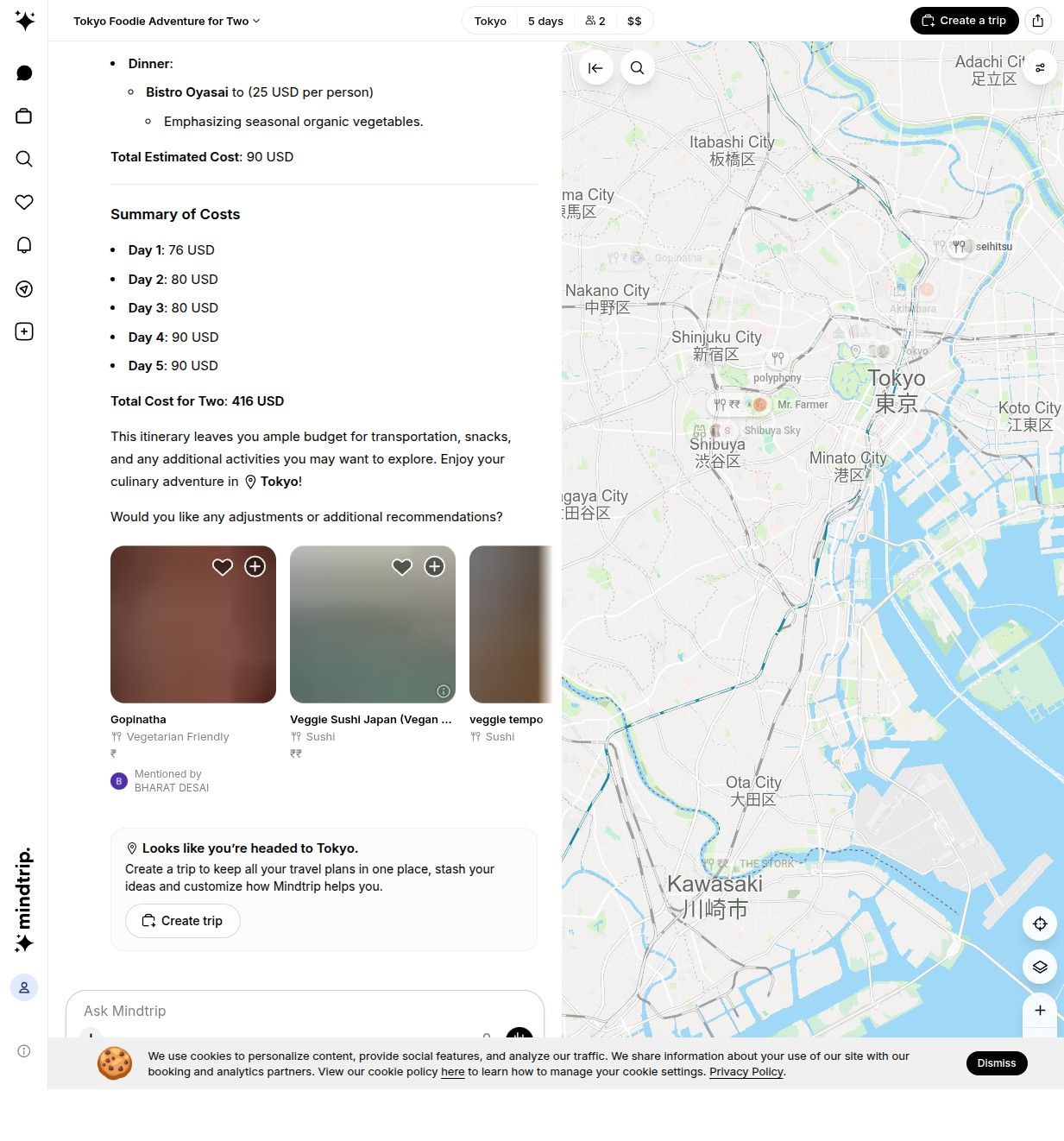
Mindtrip's chat produced a plan within 45 seconds without an account, after a sign-up modal that closes. Its prompt carried the extra format line, and it used it: all ten meals named, each with a per-person price and a link to Mindtrip's own page for the venue, and a summed trip cost of 416 dollars for two. That number covers meals and tickets; there is no hotel and no transport in it, so the "ample budget left" line under it is doing more work than it should.
The geography is where the plan fails, in ways a traveler would discover on the day. Gopinatha, the Day 1 lunch filed under a Shibuya day, is in Nakano, a different ward, and per Vegewel and HappyCow it is a one-woman restaurant that seats single diners only; a couple cannot eat there together. THE STORK, the Day 4 dinner, is in Kawasaki, in Kanagawa prefecture, after an afternoon in Yoyogi Park. Sōsakumen Kōbō Nakiryū, the Day 3 dinner, is the tantanmen counter in Otsuka that held a Michelin star, and its broths are chicken and pork per every listing found, with no vegetarian bowl. The closing days stack up too: Veggie Tempo serves lunch Thursday to Sunday only, Seihitsu closes Thursday and Friday, Polyphony closes Thursday and Sunday, Gopinatha closes Monday and Tuesday. A five-day plan with no dates cannot avoid any of them.
| Day | Lunch | Dinner | Check |
|---|---|---|---|
| 1 | Gopinatha | Veggie Sushi Japan | Gopinatha is in Nakano, single diners only, closed Mon and Tue; Veggie Sushi exists |
| 2 | Veggie Tempo, Yoyogi | Seihitsu, Asakusa | Lunch Thu to Sun only; Seihitsu closed Thu and Fri |
| 3 | Mr. Farmer | Nakiryū, Otsuka | Mr. Farmer not checked; Nakiryū has pork and chicken broths, no vegetarian bowl found |
| 4 | Polyphony, near Yotsuya | THE STORK | Polyphony closed Thu and Sun; THE STORK is in Kawasaki |
| 5 | Asakusa Hirayama | Bistro Oyasai to, Kagurazaka | Both exist; Hirayama holds a Bib Gourmand |
The good picks are very good. Asakusa Hirayama is a Bib Gourmand soba counter, Veggie Sushi Japan is a real vegan sushi bar, Polyphony pairs vegetarian courses with sake. A traveler who takes Mindtrip's list and checks each address would eat well. The tool did not do that check.
4. monkeytravel.app: a plan in seconds, and most of it is a placeholder
Best if: a traveler wants a sightseeing skeleton fast and will fill in every meal.
monkeytravel.app's wizard asks for a destination, who is going, dates and a travel style, then returns a plan within seconds; the run here landed on the same 19-activity Tokyo plan twice, which suggests a prepared plan rather than a fresh one. The sights are sound: Shinjuku Gyoen, Omoide Yokocho, Senso-ji, a Sumida river cruise, Toyosu market, Meiji Jingu, Shibuya Crossing. Day 5 is a Hakone loop (open-air museum, Lake Ashi, Owakudani), a full day out of the city for a five-day first visit with food as the priority.
The meals are the problem. Nine of ten are placeholders: "Dinner in Ginza, various restaurants," "Dinner and drinks in Shibuya." The one named restaurant, Asakusa Imahan International, is a sukiyaki and shabu-shabu house (open 11:30 to 21:30 daily per its listing), a fine lunch for the meat-eater and nothing for the vegetarian. The estimated budget appeared as £1,277, in sterling, for a brief written in dollars; at the 1.3344 rate the MTFX table showed for September 22, that is about 1,700 dollars, 14 percent over.
The chat step is the part to know about. Told the brief in full (couple, 1,500 dollars, vegetarian), the assistant replied that it had "adjusted Day 2" and replaced lunch at Asakusa Imahan with Asakusa Mugitoro, a real tororo restaurant open since 1929. The plan on the page still said Imahan. Saving the plan to keep working on it prompts for an account.
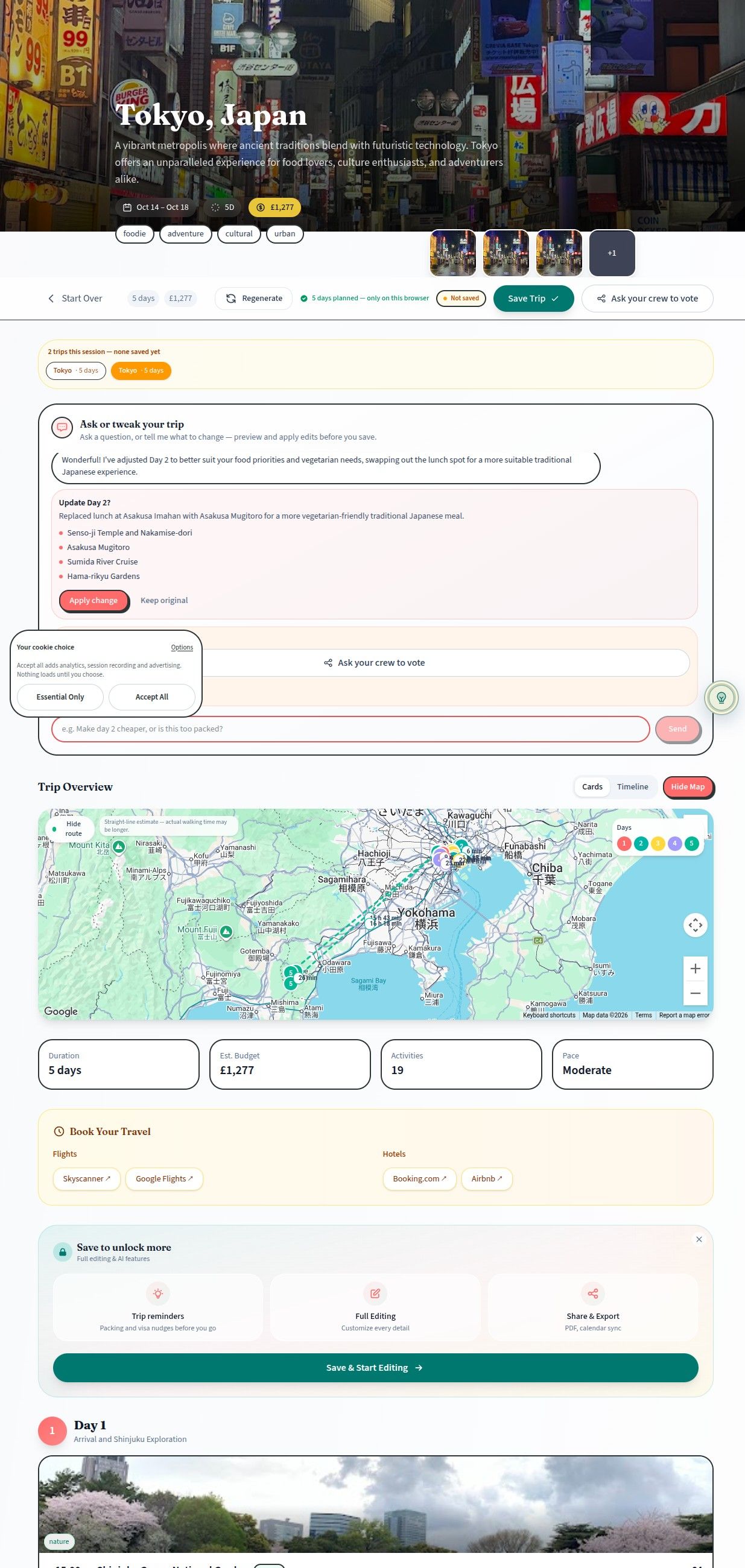
| Day | Named meals | Check |
|---|---|---|
| 1 | Omoide Yokocho (izakaya alley) | Alley exists; no venue named |
| 2 | Asakusa Imahan International | Exists; sukiyaki, no vegetarian course |
| 3 | Toyosu market breakfast, "dinner in Ginza" | Market exists; dinner unnamed |
| 4 | "Dinner and drinks in Shibuya" | Unnamed |
| 5 | "Return to Tokyo and dinner" | Unnamed |
The four that could not be run
These are not ranked, because nothing came back to rank. Each wall is worth knowing before a traveler picks a tool.
Layla returns a page reading "Layla isn't available in your region" with a 403 status from India. The tool may be the right answer for a traveler in the US or Europe; this test cannot say.
Trip Planner AI loads its homepage, and its "Create a new trip" link sends the browser to Layla's block page, with a tag in the address naming Trip Planner AI as the source. Layla acquired it in 2024, and the planner now runs on Layla's infrastructure and Layla's region rules.
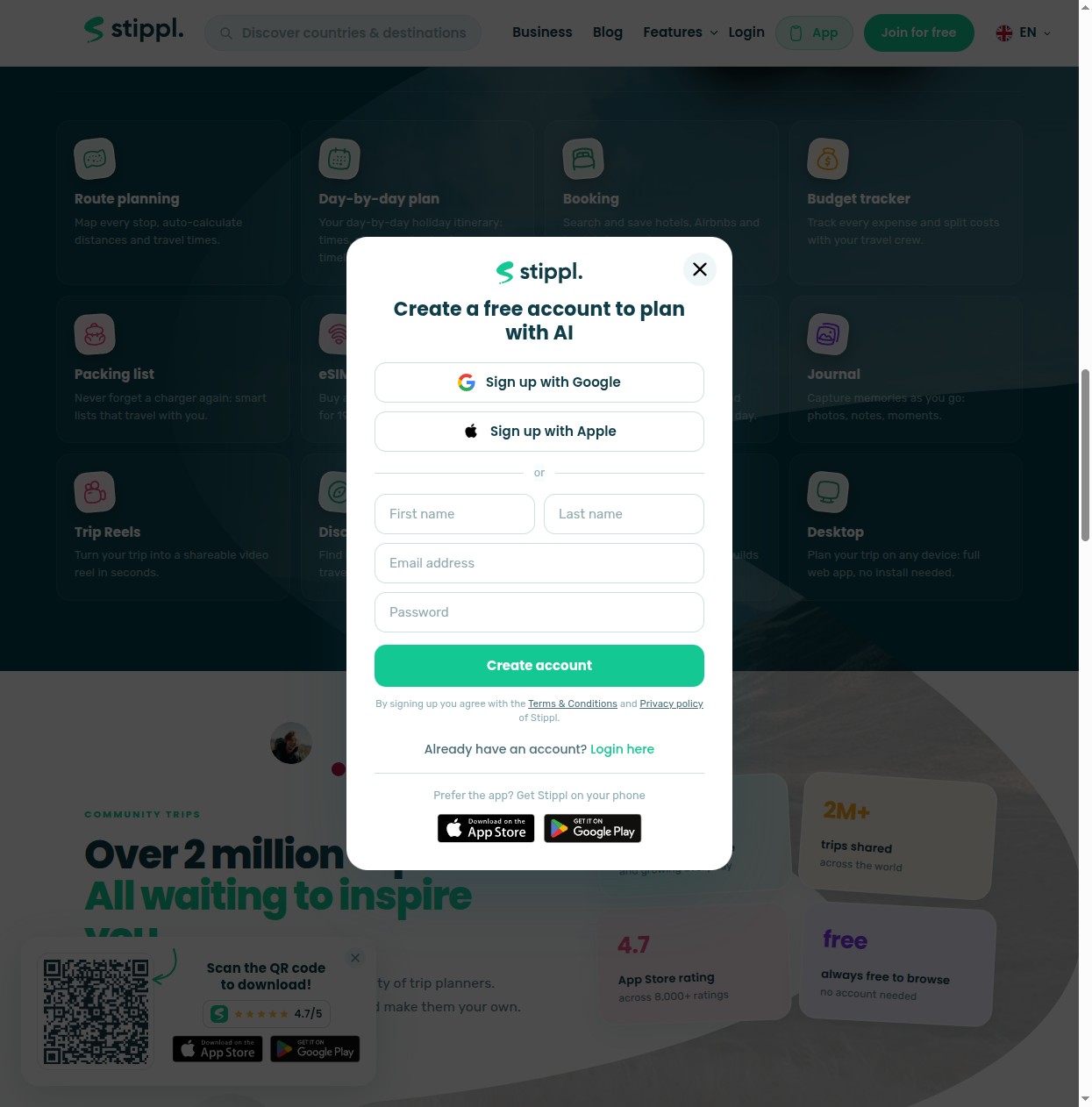
Stippl accepted the brief in its "Plan with AI" box, then opened a modal, and its "Start planning" button leads to a register page. The planner sits behind an account.
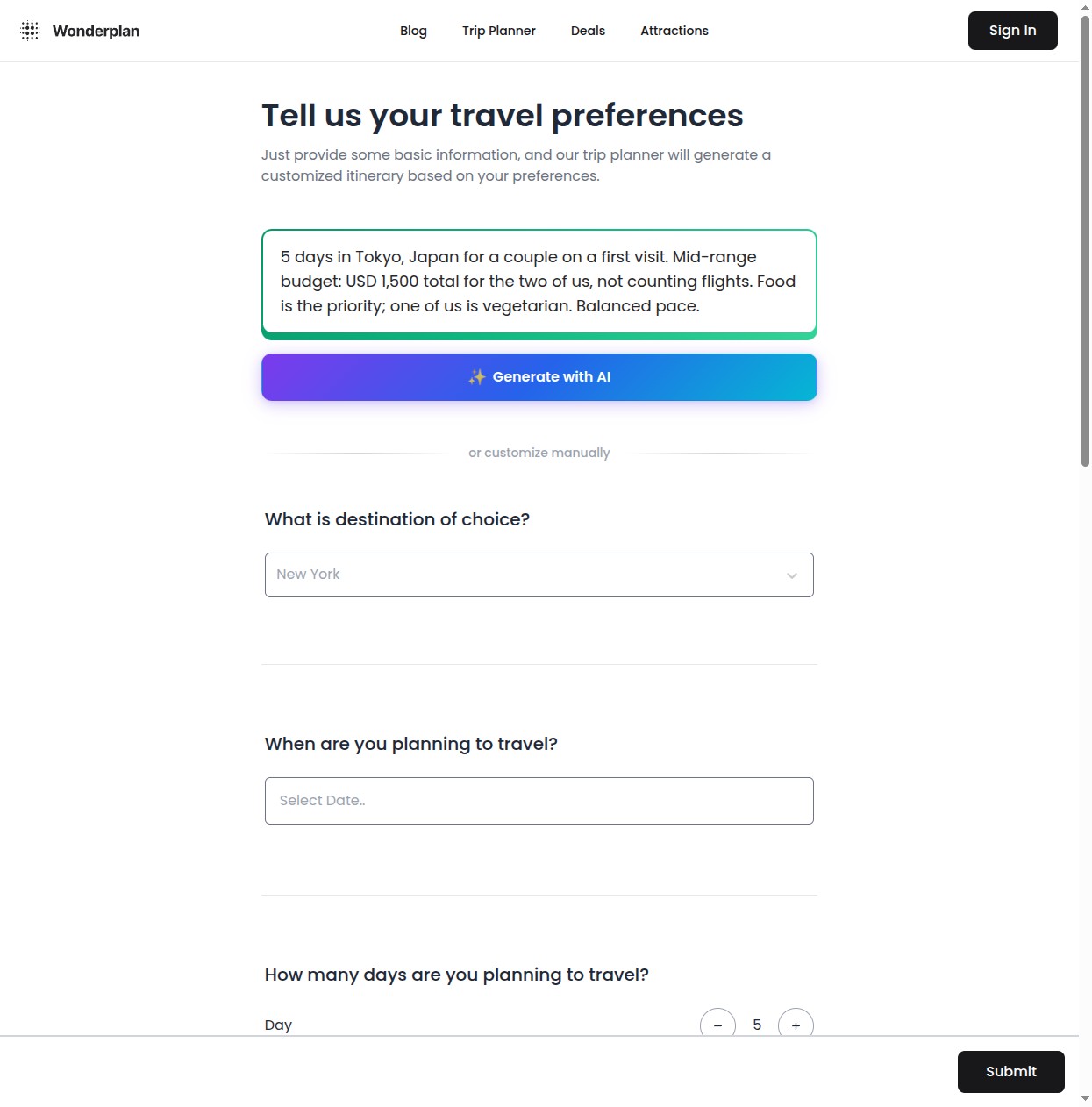
Wonderplan has a free-text box and a structured form (destination, dates, three budget bands, traveler type, interests, and two dietary boxes: halal and vegan, no vegetarian). The brief went into the text box and the "Generate with AI" button was clicked twice, 40 seconds apart. Nothing happened, and no sign-in prompt appeared, so the cause is unknown.
iplan.ai is not on the list of eight because its homepage has no planner: an email box, app store links, and a carousel of cities. The tool is the phone app.

Which AI for travel planning kept the brief?
Only Gemini kept every constraint the brief carried, and it did so by ignoring half the meals. The purpose-built tools convert a sentence into fields, and whatever the fields cannot hold is lost: the vegetarian at MonkeyEatingMango, the currency at monkeytravel.app, the couple at Mindtrip's single-seat restaurant. A traveler with a constraint a form cannot hold is better off with the chatbot and a checking session than with a form that silently drops it.
The Trip Cost Index puts Tokyo above this budget, and two plans priced it anyway. The index's Japan median is 400 dollars a day across the itineraries in it, so 2,000 for five days. Gemini and MonkeyEatingMango both fit the 1,500 brief to the dollar; monkeytravel.app ran 14 percent over; Mindtrip's 416 left the hotel out. For comparison, the 3-day Tokyo itinerary on this site prices three days at 1,100 to 1,400 dollars.
Which AI travel planners are actually free?
"Free" splits three ways in this category, and the difference decides whether a traveler ever sees a finished plan. Prices are as of August 2026 from each tool's public pages; check the live page before paying.
| Tool | Free tier | Paid tier | Ran in this test |
|---|---|---|---|
| MonkeyEatingMango | Full plan generated, first 2 days readable, no account | $0.99 per trip for the rest + exports | Yes |
| monkeytravel.app | Full plan, no account; saving gated | Not verified | Yes |
| Mindtrip | Core planning, modal can be closed | Pays through bookings | Yes |
| Gemini | Capable free consumer tier | $20/mo Plus | Via API only |
| Layla | Overview only | ~$49/yr for day-by-day + PDF | Region-blocked |
| Wonderplan | Full plan + PDF, when it responds | Paid tiers signaled | No response |
| Stippl | Behind an account | Not verified | Account wall |
| Wanderlog | Generous manual tier | $39.99/yr AI assistant | Not a generator; not run |
Which is the best AI for travel planning on a budget?
Budget handling was the axis where the two exact answers came from opposite kinds of tool. MonkeyEatingMango takes the budget as a form input and returns a split with a cost on every activity, converted to the traveler's currency. Gemini took the sentence and returned a split that also adds to 1,500. Mindtrip priced meals and tickets per person and left the hotel out. monkeytravel.app estimated in the wrong currency. Wanderlog, not run here, tracks a budget exactly because a person types the real prices in, which is slower and correct.
| Tool | Budget as input | Cost on each activity | Multi-currency | Total matched the brief |
|---|---|---|---|---|
| MonkeyEatingMango | Yes | Yes | Yes | Yes, to the dollar |
| Gemini | Via the sentence | Per category | If asked | Yes, to the dollar |
| Mindtrip | Via the sentence | Per person, meals and tickets | No | No hotel in the total |
| monkeytravel.app | Via the wizard | Per activity count only | Showed sterling | 14 percent over |
Use an estimate to choose the trip, then real prices to book it; an AI estimate that lands within 20 to 30 percent is enough to know whether a destination fits before spending an evening on it.
Which is the best AI for travel with a family?
The brief was a couple, so this test says nothing about kids directly. What it does show is which tools can hold a constraint at all, and a family trip is a bundle of them: nap windows, a 4pm meltdown, twenty minutes to get four people out of a hotel room. MonkeyEatingMango asks who is traveling and children's ages and paces the day around them, and it opens in any browser, so a plan on one parent's phone is also on the other's. The chat tools take the constraint as a sentence, which worked for the vegetarian here and would work for "two kids under six," with the same caveat that nothing checks the venues afterward. Tripsy, an organizer rather than a planner, is Apple-only for editing as of June 2026.
Where AI travel tools fall short, on this evidence
Three patterns held across all four plans.
Nobody checks closing days, because nobody asked for dates. Seven of the 19 venues checked close on at least one day of the week, and an eighth closes one Tuesday a month. Not one plan mentioned it. A tool that asks for travel dates and looks up hours per stop would have caught every case in this test; MonkeyEatingMango does the lookup and shows hours on the sights, but the brief gave no dates, so the closing-day check had nothing to work with either.
Forms drop what they cannot hold; chats drop what they were not asked for. The wizard-and-form tools lost the vegetarian and the currency. The chatbot, given the brief and nothing else, lost the lunches. Neither failure shows up in the output as a failure; each reads as a complete plan.
Named venues were real; placed venues were not always. Every one of the 19 venues checked exists. Three of Mindtrip's ten were in the wrong place for the day or the couple, and MonkeyEatingMango's two meat-named suggestions were in the right place for the wrong traveler. Existence is the easy half.
Which one should you pick?
- A couple with a diet, an allergy or any constraint a form cannot hold: Gemini, then plan the lunches and check each address and closing day by hand.
- A traveler who wants pins, hours, a budget split and an export, and will edit the meals: MonkeyEatingMango.
- A vegetarian who will verify addresses: Mindtrip's restaurant list is the fullest of the four; its map placement is the worst.
- A sightseeing skeleton in seconds: monkeytravel.app, with every meal still to plan.
- In the US or Europe: Layla and Trip Planner AI are available there and were not tested here.
For the wider planning stack beyond the AI tools, the Japan guide covers the trains, the passes and the seasons, and the best travel itinerary apps post covers organizers for a trip already booked.
Sources
- Venue listings checked on September 23, 2026: Tabelog, HappyCow, Vegewel, TableCheck, and each restaurant's own site where one exists; links sit in the tables above. The 19 checked: Asakusa Mugitoro, Veggie Sushi Japan, T's Tantan, Kaikaya by the Sea, Asakusa Unatoto, Gopinatha, Veggie Tempo, Seihitsu, Polyphony, THE STORK, Bistro Oyasai to, Nakiryū, Asakusa Imahan International, Ain Soph. Journey, Kushiyaki Bistro Fukumimi, Brown Rice by Neal's Yard, Tempura Kondo, Namiki Yabusoba, Asakusa Hirayama. Five of those came from an earlier Gemini run that carried the same format line Mindtrip's prompt had; that run was replaced by the bare-brief run scored above.
- Exchange rate: MTFX GBP to USD history, 1.3344 on September 22, 2026.
- Trip Cost Index: MonkeyEatingMango research, Japan median 400 dollars a day.
- August 2026 pricing for tools not run here: each tool's public pricing page, as recorded in the previous version of this post.
- Tool pages: Gemini, Mindtrip, monkeytravel.app, Layla, Trip Planner AI, Stippl, Wonderplan, iplan.ai.
Related reading
- Best travel itinerary apps (2026): generated, hand-built, or assembled from bookings
- How to use ChatGPT for travel planning: a working prompt, and where the output still breaks
- 43% of AI-planned days carry a fault: the measured study behind the closing-day pattern
- Mindtrip review (2026): what users say about the sign-up wall and the bookings
Last updated September 2026.

Written by Shobhit Shrivastava · Founder
Try free
Plan a trip in about a minute
Eight questions, a complete itinerary with budget, maps, and packing lists. No account required.
Plan a trip →Sample itineraries
Vienna, Austria
Austria · 4 days itinerary
Grand Canyon, United States
United States · 3 days itinerary
London, United Kingdom
United Kingdom · 3 days itinerary
Lisbon, Portugal; Lagos, Portugal
Portugal · 7 days itinerary
Related reading
Best Travel Itinerary Apps (2026): Generated, Built, or Assembled
'Itinerary app' means three different things depending on who's searching: a tool that writes the plan for you, a canvas to build one on, or something that turns your bookings into a timeline. Here's which is which.
Best Travel Apps (2026): One Stack for Before, During, and After
Most 'best travel apps' lists are one long undifferentiated list. Here's the same tools grouped by when you actually reach for them: before the trip, while you're booking, and once you're on the ground.
Best Road Trip Planner Apps (2026): Route, Detours, and Pit Stops
A road trip has different planning needs than a city break: verified drive times, stops worth the detour, and a break scheduled before a long leg gets brutal. Four apps that handle that differently.