The landmarks and experiences travelers rate highest — with photos, ratings, and where to find them.
Hagia Sophia Grand Mosque
Istanbul · Marmara Region · mosque · ★ 4.8 · 135,162 reviews ·
Open in Google Maps ↗Hagia Sophia, officially the Hagia Sophia Grand Mosque, is a mosque and a major cultural and historical site in Constantinople, Turkey. It was formerly a church (360–1453) and a museum (1935–2020). The last of three church buildings to be successively erected on the site by the Eastern Roman Empire, it was completed in AD 537, becoming the world's largest interior space and among the first to employ a fully pendentive dome. It is considered the epitome of Byzantine architecture and is said to have "changed the history of architecture". From its dedication in 360 until 1453, Hagia Sophia served as the cathedral of Constantinople in the Byzantine liturgical tradition, except for the period 1204–1261 when the Latin Crusaders installed their own hierarchy. After the fall of Constantinople in 1453, it served as a mosque, having its minarets added soon after. The site became a museum in 1935, and was redesignated as a mosque in 2020.
The current structure was built by the Byzantine emperor Justinian I as the Christian basilica of Constantinople between 532–537 and was designed by the Greek geometers Isidore of Miletus and Anthemius of Tralles. It was formally called the Temple of God's Holy Wisdom, (Greek: Ναὸς τῆς Ἁγίας τοῦ Θεοῦ Σοφίας, romanized: Naòs tês Hagías toû Theoû Sophías) the third church of the same name to occupy the site, as the prior one had been destroyed in the Nika riots. As the episcopal see of the ecumenical patriarch of Constantinople, it remained the world's largest church for more than five hundred years, until the abbey church at Cluny was completed in the 12th century.
Hagia Sophia became the quintessential model for Eastern Orthodox church architecture, and its architectural style was emulated by Ottoman mosques a thousand years later. The Hagia Sophia served as an architectural inspiration for many other religious buildings including the Hagia Sophia in Thessaloniki, Panagia Ekatontapiliani, the Şehzade Mosque, the Süleymaniye Mosque, the Rüstem Pasha Mosque and the Kılıç Ali Pasha Complex.
As the religious and spiritual centre of the Eastern Orthodox Church for nearly one thousand years, the church was dedicated to Holy Wisdom. The church has been described as "holding a unique position in the Christian world", and as "an architectural and cultural icon of Byzantine and Eastern Orthodox civilization". It was where the excommunication of Patriarch Michael I Cerularius was officially delivered by Humbert of Silva Candida, the envoy of Pope Leo IX in 1054, an act considered the start of the East–West Schism. In 1204, it was converted during the Fourth Crusade into a Catholic cathedral under the Latin Empire, before being restored to the Eastern Orthodox Church upon the restoration of the Byzantine Empire in 1261. Enrico Dandolo, the doge of Venice who led the Fourth Crusade and the 1204 Sack of Constantinople, was buried in the church.
After the fall of Constantinople to the Ottoman Empire in 1453, it was converted to a mosque by Mehmed the Conqueror and became the principal mosque of Istanbul until the 1616 construction of the Sultan Ahmed Mosque. The patriarchate moved to the Church of the Holy Apostles, which became the city's cathedral. The complex remained a mosque until 1931, when it was closed to the public for four years. It was re-opened in 1935 as a museum under the secular Republic of Turkey, and the building was Turkey's most visited tourist attraction as of 2019. In 2020, the Council of State annulled the 1934 decision to establish the museum, and the Hagia Sophia was reclassified as a mosque. The decision was highly controversial, sparking divided opinions and drawing condemnation from the Turkish opposition, UNESCO, the World Council of Churches and the International Association of Byzantine Studies, as well as numerous international leaders, while several Muslim leaders in Turkey and other countries welcomed its conversion.

Arild Vågen (CC BY-SA 3.0)
Sultan Ahmed Mosque
Istanbul · Marmara Region · mosque · ★ 4.7 · 119,924 reviews ·
Open in Google Maps ↗The Sultan Ahmed Mosque, popularly known as the Blue Mosque, is an Ottoman-era historical imperial mosque located in Istanbul, Turkey. It was constructed between 1609 and 1617 during the rule of Ahmed I. It attracts a large number of tourists and is one of the most iconic and popular monuments of Ottoman architecture.

Moonik (CC BY-SA 3.0)
Egyptian Bazaar
Istanbul · Marmara Region · ★ 4.5 · 190,463 reviews ·
Open in Google Maps ↗The Spice Bazaar (Turkish: Mısır Çarşısı, meaning "Egyptian Bazaar") in Istanbul, Turkey, is one of the largest bazaars in the city. Located in the Eminönü quarter of the Fatih district, it is the most famous covered shopping complex after the Grand Bazaar.

Miomir Magdevski (CC BY-SA 4.0)
Suleymaniye Mosque
Istanbul · Marmara Region · mosque · ★ 4.9 · 65,968 reviews ·
Open in Google Maps ↗The Süleymaniye Mosque (Turkish: Süleymaniye Camii, pronounced [sylejˈmaːnije]) is an Ottoman imperial mosque located on the Third Hill of Istanbul, Turkey. The mosque was commissioned by Suleiman the Magnificent (r. 1520–1566) and designed by the imperial architect Mimar Sinan. An inscription specifies the foundation date as 1550 and the inauguration date as 1557, although work on the complex probably continued for a few years after this.
The Süleymaniye Mosque is one of the best-known sights of Istanbul and from its location on the Third Hill it commands an extensive view of the city around the Golden Horn. It is considered a masterpiece of Ottoman architecture and one of Mimar Sinan's greatest works. It is the largest Ottoman-era mosque in the city.
Like other Ottoman imperial foundations, the mosque is part of a larger külliye (religious and charitable complex) which included madrasas, a public kitchen, and a hospital, among others. Behind the qibla wall of the mosque is an enclosed cemetery containing the separate octagonal mausoleums of Suleiman the Magnificent and his wife Hurrem Sultan (Roxelana).
The Süleymaniye Mosque and its Associated Conservation Area is one of the four components of the UNESCO World Heritage Site "Historic Areas of Istanbul", protected under cultural criteria (i), (ii), (iii), and (iv). Located within the Historic Peninsula, the site falls under multiple conservation designations: it was nationally registered in 1981 as an urban and historic conservation area and again in 1995 as an Archaeological, Urban Archaeological, Historical and Urban Site. The area contains 920 registered properties, including monumental and civil architecture.

Martin Falbisoner (CC BY-SA 4.0)
Topkapi Palace Museum
Istanbul · Marmara Region · museum · ★ 4.6 · 118,817 reviews ·
Open in Google Maps ↗
Bjørn Christian Tørrissen (CC BY-SA 3.0)
Grand Bazaar
Istanbul · Marmara Region · ★ 4.4 · 185,471 reviews ·
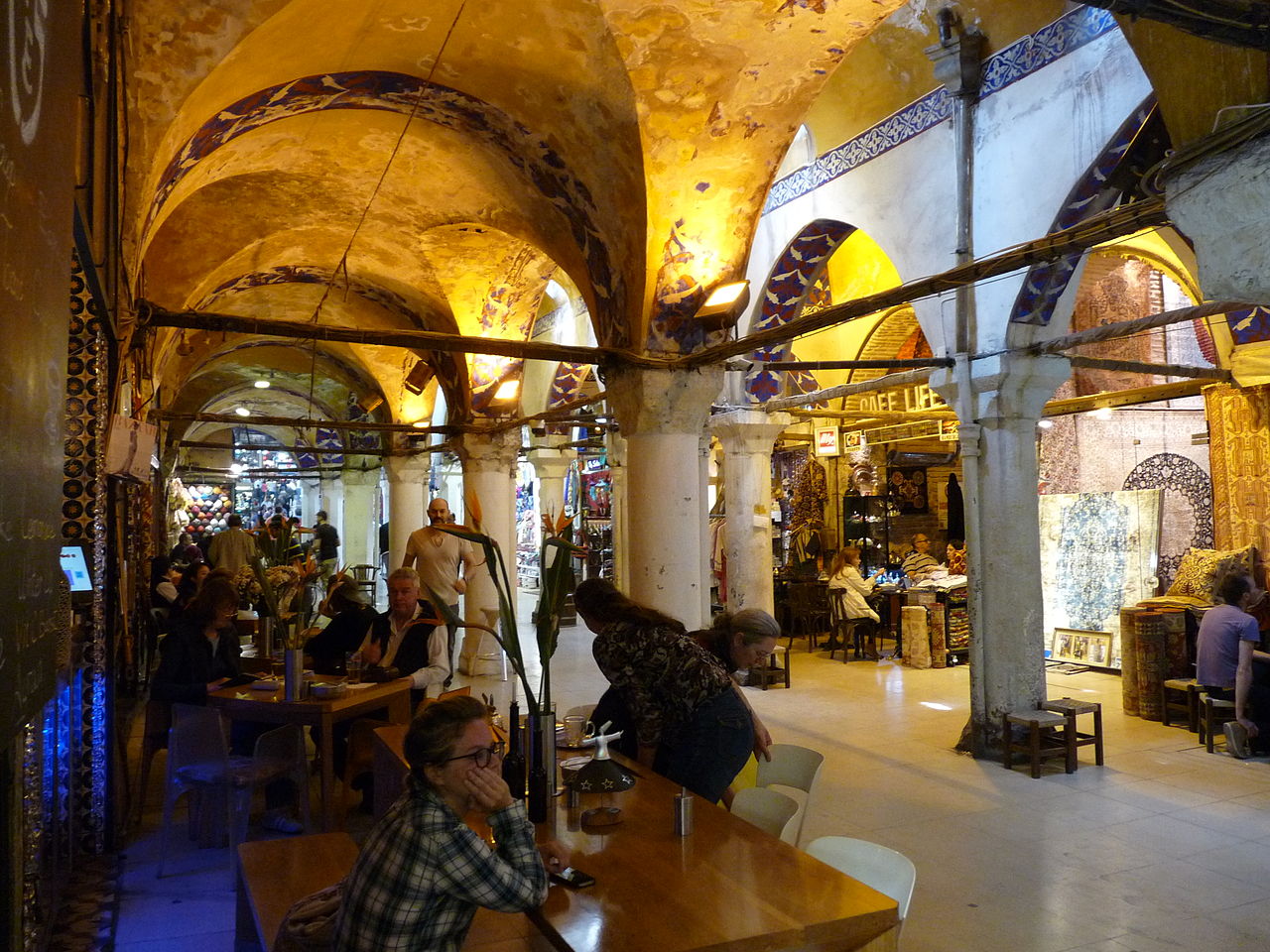
Open in Google Maps ↗The Grand Bazaar in Istanbul is one of the largest and oldest covered markets in the world, with 61 covered streets and over 4,000 shops on a total area of 30,700 m2, attracting between 250,000 and 400,000 visitors daily. In 2014, it was listed No.1 among the world's most-visited tourist attractions with 91,250,000 annual visitors. The Grand Bazaar in Istanbul is often regarded as one of the first shopping malls of the world.
Masygreen (CC BY-SA 4.0)
Eyüp Sultan Mosque
Istanbul · Marmara Region · mosque · ★ 4.8 · 66,228 reviews ·
Open in Google Maps ↗The Eyüp Sultan Mosque (Turkish: Eyüp Sultan Camii) is a mosque in Eyüp district of Istanbul, Turkey. The mosque complex includes a mausoleum marking the spot where Ebu Eyüp el-Ansari (Abu Ayyub al-Ansari), the standard-bearer and companion of the prophet Muhammad, is said to have been buried. On a much older site, the present building dates from the beginning of the 19th century.
Because of its particular sanctity, the mosque played a role in the coronation ceremony for new Ottoman Sultans, who came here — proceeding along the grand Cülus Yolu ('Accession Way') — to be girded with the Sword of Osman at the start of their reigns. Today it remains a popular pilgrimage destination.

Dosseman (CC BY-SA 4.0
Basilica Cistern
Istanbul · Marmara Region · historical landmark · ★ 4.6 · 95,183 reviews ·
Open in Google Maps ↗The Basilica Cistern, or Cisterna Basilica, is the largest of several hundred ancient cisterns that lie beneath the city of Istanbul, Turkey. The cistern, located 150 metres (490 ft) southwest of the Hagia Sophia on the historical peninsula of Sarayburnu, was built in the 6th century during the reign of Byzantine emperor Justinian I. Today it is kept with little water, for public access inside the space.

Diego Delso (CC BY-SA 4.0)
Mevlana Museum
Konya · Central Anatolia Region · museum · ★ 4.7 · 72,952 reviews ·
Open in Google Maps ↗The Mevlâna Museum, in Konya, Turkey, started life as the dervish lodge (Tekke) of the Mevlevi order, better known as the whirling dervishes. It houses the mausoleum of Jalal ad-Din Muhammad Rumi, a Persian Sufi mystic.

User:دانقولا (CC0
Gülhane Park
Istanbul · Marmara Region · park · ★ 4.7 · 68,716 reviews ·
Open in Google Maps ↗
Bjørn Erik Pedersen (CC BY-SA 4.0)
Büyük Mecidiye Mosque
Istanbul · Marmara Region · mosque · ★ 4.8 · 44,069 reviews ·
Open in Google Maps ↗Ortaköy Mosque (Turkish: Ortaköy Camii), formally the Büyük Mecidiye Camii (Turkish: Büyük Mecidiye Camii, lit. 'Great Mosque of Sultan Abdulmejid') in Beşiktaş, Istanbul, Turkey, is a mosque situated at the waterside of the Ortaköy pier square, one of the most popular locations on the Bosphorus. It was commissioned by the Ottoman sultan Abdülmecid I, and its construction was completed around 1854 or 1856.
This structure is symbolic of the district of Ortaköy and is often photographed, as it offers a distinctive view of the Bosphorus Strait of Istanbul and the Bosphorus Bridge.

A.Savin (FAL)
Fatih Mosque
Istanbul · Marmara Region · mosque · ★ 4.8 · 39,288 reviews
The Fatih Mosque is an Ottoman mosque off Fevzi Paşa Caddesi in the Fatih district of Istanbul, Turkey. The original mosque was constructed between 1463 and 1470 on the site of the Church of the Holy Apostles. Seriously damaged in the 1766 earthquake, it was rebuilt in 1771 to a different design. It is named after the Ottoman sultan Mehmed the Conqueror, known in Turkish as Fatih Sultan Mehmed, who conquered Constantinople in 1453.

Vogueeatss (CC BY-SA 4.0)
Ephesus Ancient City
Selçuk · Aegean Region · historical landmark · ★ 4.8 · 39,203 reviews ·
Open in Google Maps ↗Ephesus was an ancient Greek city on the coast of Ionia, in present-day Selçuk in İzmir Province, Turkey. It was built in the 10th century BC on the site of Apasa, a city-state that was also the capital of Arzawa, by Attic and Ionian Greek colonists. During the Classical Greek era, it was one of twelve cities that were members of the Ionian League. The city came under the control of the Roman Republic in 129 BC.

Benh LIEU SONG (CC BY-SA 3.0)
Sultanahmet Square
Istanbul · Marmara Region · plaza · ★ 4.7 · 36,303 reviews ·
Open in Google Maps ↗
Ninara (CC BY 2.0
Yildiz Park
Istanbul · Marmara Region · park · ★ 4.7 · 36,260 reviews
Rahmi M Koc Museum
Istanbul · Marmara Region · museum · ★ 4.8 · 27,073 reviews
Duden Waterfalls
Belek · Mediterranean Region · tourist attraction · ★ 4.6 · 38,295 reviews ·
Open in Google Maps ↗The Düden Waterfalls are two waterfalls of the Düden River in the province of Antalya, Turkey.

Saffron Blaze (CC BY-SA 3.0)
Istanbul Aquarium
Istanbul · Marmara Region · aquarium · ★ 4.4 · 38,745 reviews
Istanbul Aquarium (Istanbul Akvaryum) is a public aquarium in Istanbul, Turkey. It opened its doors in April 2011 and is an official member of World Association of Zoos and Aquariums (WAZA). The site is 5km from Atatürk International Airport, near the motorway and railway transportation systems in Florya, which is at the southwest coast of Istanbul.
Istanbul Aquarium holds a leading position among worldwide aquariums thanks to its volume, variety of fish species, and the activities on travel routes. Visitors follow a geographical route that includes 16 themes and 1 rainforest going from the Black Sea towards the Pacific. The aquarium was designed by public aquarium design consultants OCEAN Projects.
The aquarists at Istanbul Aquarium work to feed, clean and check the medical and physical conditions of the creatures according to the quarantine protocol set by the aquarium management. To allow all living creatures in the Aquarium continue to live in the conditions as nearest as possible to those of their habitat.
Land of Legends Theme Park
Belek · Mediterranean Region · amusement center · ★ 4.6 · 15,043 reviews
The Land of Legends is an amusement park and water park in Antalya, Turkey. It contains a shopping mall and a hotel within the park. It is the largest theme park in Turkey. There are three sections of the park which are "Adventure Land," "Masha and the Bear Land of Laughter," and "Nickelodeon Land."
Patara Beach
Patara · Mediterranean Region · beach · ★ 4.4 · 11,024 reviews ·
Open in Google Maps ↗Patara Beach is a beach located near the ancient Lycian city of Patara in Turkey, on the coast of the Turkish Riviera.

Abdullah kıyga (CC BY 3.0)