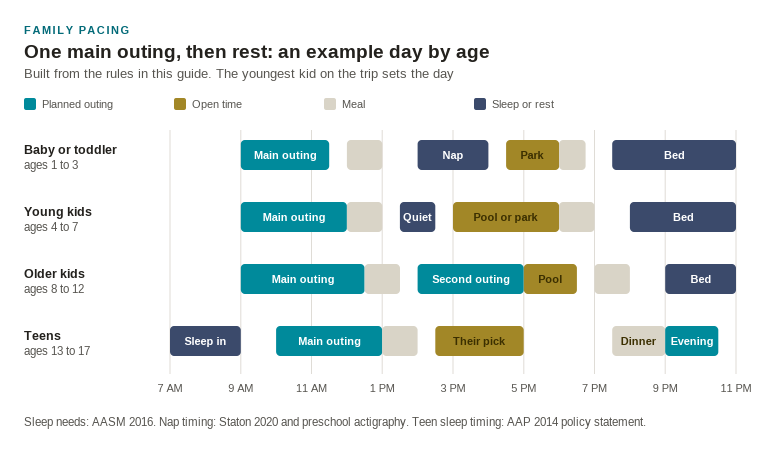
How to travel with kids: let the youngest kid's sleep set the day. Plan one main outing in the morning, a long break after lunch, and open time later. A toddler's break is a nap and a 10-year-old's is the pool. For a teenager, the whole day starts later.
How many activities a day with kids?
With kids under 6, plan one main outing a day, in the morning. From 6 to 12, plan one or two. Kids' meal times and need for sleep shaped the whole family's day in a diary study of 143 tourist groups. Families with kids also spent more of it at pools and beaches.
Put the outing you care about first. Eat lunch near it, then give the early afternoon to a nap or a quiet hour. In the late afternoon, let the kid set the pace at a playground or a pool.
How to travel with a baby or toddler
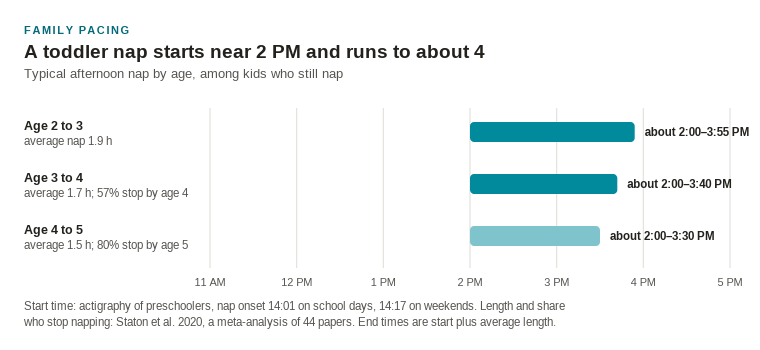
Keep a baby's or toddler's nap at its usual time from home. For most toddlers the nap starts soon after lunch. Preschoolers fall asleep near 2 PM. Younger toddlers may nap earlier: one parent of an 18-month-old reports 12:30 to 1 PM. Babies under about 15 months still take a morning nap too.
Hours per day. Staton et al. 2020, a meta-analysis of 44 papers.
The data · 5 rows
| Age | Average nap, hours |
|---|---|
| Under 1 | 3.1 |
| 1 to 2 | 2.3 |
| 2 to 3 | 1.9 |
| 3 to 4 | 1.7 |
| 4 to 5 | 1.5 |
The data · 3 rows
| Row | Start | End |
|---|---|---|
| Age 2 to 3 nap, average 1.9 h | about 2:00 PM | about 3:55 PM |
| Age 3 to 4 nap, average 1.7 h | about 2:00 PM | about 3:40 PM |
| Age 4 to 5 nap, average 1.5 h | about 2:00 PM | about 3:30 PM |
A nap that starts near 2 PM runs to about 4. Keep the afternoon free until your kid wakes up.
Skipping a nap now and then is fine. One parent's fix is to protect a full nap in a bed every two or three days. Test a stroller nap on a long day out near home first.
New walkers move in bouts of about 10 steps. Bring the stroller, or the carrier where the route has cobbles or stairs.
Cut the list to less than you think. In a three-week trip report from Japan, even one sight a day had to be cut back for a 22-month-old. At this age, leave some days with nothing planned.
Open-ended play holds a toddler far longer than a museum. One little boy played with a crocodile statue for an hour in a study of parents' travel blogs, so mark the playgrounds near your hotel on the map.
How to travel with young kids, ages 4 to 7
Kids stay on task better in 10-minute activities than in 30-minute ones, so break sightseeing into short pieces. Do a gallery, a snack and a hands-on room, and leave while it's still fun. Keep a museum to an hour or so, 75 minutes at most.
Pair each adult sight with something for the kid. One parent calls it the 50/50 rule: the Colosseum, then the zoo.
Cumulative. Fewer than 2.5% stop before age 2. Staton et al. 2020 meta-analysis.
The data · 3 rows
| Age | Stopped napping |
|---|---|
| Before 2 | 2.5% |
| By 4 | 57% |
| By 5 | 80% |
Give a 4-year-old a quiet hour after lunch instead of a fixed nap. Late naps push bedtime later, so keep any nap early.
Kids aged 3 to 5 need 10 to 13 hours of sleep a day. Keep dinner early, bedtime near 8, and mornings unhurried.
How to travel with kids aged 8 to 12
Kids aged 8 to 12 can manage a full day out. One family found that leaving around 10 AM and heading back by 5 or 6 PM worked for three weeks. At a museum, kids 8 to 13 spend about a minute at each exhibit, so pick the few that matter. Plan on about 90 minutes in all.
Protect bedtime and space out late nights. Losing 54 minutes of sleep across five nights changed how 7 to 11-year-olds behaved at school.
Before a theme park, check ride height limits. A common limit on bigger rides is 48 inches. The median kid reaches it at about age 7, and a shorter kid closer to 9.
Let your kids choose one activity a day. For 67% of parents, kids making choices is what makes a trip feel built for them.
How to travel with teenagers
The American Academy of Pediatrics says the average teenager "has difficulty falling asleep before 11:00 pm and is best suited to wake at 8:00 am or later."
Hours a night, from a meta-analysis of 79 actigraphy studies. Galland et al. 2018.
The data · 5 rows
| Age | Overnight sleep, hours |
|---|---|
| 3 to 5 | 9.68 |
| 6 to 8 | 8.98 |
| 9 to 11 | 8.85 |
| 12 to 14 | 8.05 |
| 15 to 18 | 7.4 |
Sleep falls through the teens, so keep mornings free until 10 unless a booked tour needs them. Save the big sights for the afternoon and evening.
Evenings out suit a teen's clock, but space out the late nights. A bedtime more than two hours late goes with sleepiness and low mood.
Young teens enjoy family leisure less than their parents do. Let them skip an outing once you agree on a meeting point. A phone data plan and a room of their own or a connecting one give them space.
Teens' activities need no time limit. With enough to drink, teens handle exercise in the heat about as well as adults. Don't put two hard activities back to back at midday.
Pacing a whole trip with kids
Plan a rest day about once a week, with nothing booked but the pool or a park. One family of school-age kids built about four rest days into three weeks. Change hotels as rarely as you can; each move costs a morning of packing.
A travel day counts as that day's outing. On a road trip, stop about every two hours. If early check-in isn't possible, book the room from the night before so a toddler has a bed for the nap on arrival.
With a 7 PM toddler bedtime in one hotel room, you sit in the dark all evening. Look for a suite with a door, a balcony or an apartment. For an evening of your own, book a kids' club or a sitter, or take turns going out.
How long do kids last at a museum, zoo or theme park?
The data · 7 venues
| Venue | Measured length | Source |
|---|---|---|
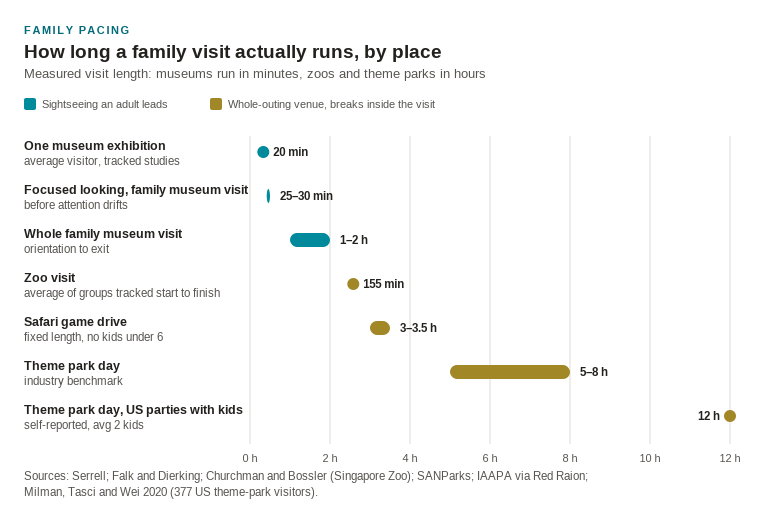
| One museum exhibition | 20 min | Serrell |
| Focused looking, family museum visit | 25 to 30 min | Falk and Dierking |
| Whole family museum visit | 1 to 2 h | Falk and Dierking |
| Zoo visit | 155 min | Churchman and Bossler, Singapore Zoo |
| Safari game drive | 3 to 3.5 h | SANParks, Kruger |
| Theme park day, industry benchmark | 5 to 8 h | Red Raion, citing IAAPA |
| Theme park day, US parties with kids | 12 h | Milman, Tasci and Wei 2020 |
Plan a museum visit at one to two hours, shorter for young kids, with a hands-on or outdoor stop after the first 25 to 30 minutes of focused looking. A zoo has its breaks built in. Plan it as a half day with lunch inside it.
A theme park is a half day with a toddler. Do about three hours of rides from opening, go back to the hotel for a nap or a swim, and return in the evening. Older kids can stay all day.
A guided tour won't wait for a nap, so check its length and age limit first. SANParks guided game drives in Kruger take no kids under 6.
Jet lag with kids
Start shifting your kid's sleep 2 to 3 days before you leave. After you land, expect the body clock to move about 1 hour a day after flying east and 1.5 hours a day after flying west. After five or more zones, keep the first three days to one short outing each, and plan a light day after you get home.
Get outside in the daylight and keep naps short. Ask your pediatrician before you give your kid melatonin.
What do kids want from a family trip?
Share of 778 US parents naming each. Family Travel Association 2025 survey.
The data · 8 rows
| Request | Parents |
|---|---|
| Relaxation or pool time | 75% |
| Beach activities | 73% |
| Theme or amusement parks | 67% |
| Outdoor adventures | 54% |
| Shopping | 40% |
| Unique dining | 40% |
| Cultural or historical sites | 35% |
| Hands-on learning | 20% |
Build the pool hour into the plan, and add a theme park when your kids ask for one. Stay within arm's reach of young kids in the water, since pools abroad may lack safe drains or a lifeguard.
For where to go, the best places to travel with kids sorts 17 trips by your kids' ages, each in its best month. Family vacations on a budget adds the cheapest month and daily cost for 15 family favorites, the best family beach vacations times 17 beaches to their best family month, a European vacation with kids does the same for 16 places in Europe, and spring break destinations for families covers the March week. If museums are on the list, what museums charge in each country helps you pick which ones are worth a short visit.
Rules of thumb to live by
| Rule | Ages | Why |
|---|---|---|
| One main outing a day, in the morning, plus a kid-picked activity and an unplanned block. Under 3, days with no planned sight are fine | Under 6: one main outing. 6 to 12: one or two | Meals and sleep set the shape of a family's day (143 tourist groups) |
| Each adult sight is paired with something for the kid | 2 to 7 | One parent's 50/50 rule |
| Museums, monuments and guided tours in short stretches: about 45 minutes under 4, 60 to 75 minutes at 4 to 7, 90 minutes at 8 to 12, broken up by a hands-on or outdoor stop | 0 to 12 | Focused looking lasts 25 to 30 minutes; shorter activities keep kids on task |
| Pools, beaches, parks and playgrounds have no time limit, with an adult within arm's reach of young kids in the water | All | Free play holds attention from age 2 (67 kids); AAP water safety |
| A zoo, theme park or water park is a half day with lunch and a break inside it for kids under 6, and can fill the day from 6 | All | A zoo visit averages 155 minutes; a theme park day runs 5 to 8 hours |
| A theme park goes on the plan only when the family asks for one | All | Theme or water parks are in 45% of family trips, behind beaches and family visits |
| Fixed-length tours keep their real length and the operator's age limit, and diving follows the certifying body's age rules | All | Kruger's guided drives take no kids under 6; PADI's junior depth limits |
| The nap goes at the kid's usual early-afternoon time: about 2 hours at ages 1 to 3, 1.5 hours at 3 to 4, a quiet hour at 4, none from 5 | 1 to 5 | Nap onset near 2 PM for preschoolers; length and the age kids stop from the Staton meta-analysis |
| A morning nap too, around 9:30, for babies under about 15 months | Under 15 months | Two naps are the norm until 15 to 24 months |
| A stroller or carrier is assumed under 3, and cobbled or stepped routes get a warning | Under 3 | Toddlers walk in bouts of about 10 steps and pay more energy per meter |
| Late nights are spaced out, never stacked | 5 to 17 | Losing 54 minutes over five nights changed school behavior at 7 to 11; a 2-hour bedtime shift went with sleepiness in teens |
| The day starts around 10 AM, unless a booked tour needs the morning | 8 to 17 | Teens are "best suited to wake at 8:00 am or later" (AAP 2014); families of school-age kids leave around 10 |
| No time limit on a teen's activities, with recovery between strenuous ones and none back to back at midday | 13 to 17 | Hydrated youth handle heat like adults; recovery is the risk (AAP 2011) |
| An activity the kid picks every day, and evening outings allowed from 13 | 8 to 17 | Kid choice is the top kid-centered feature (67%) |
| A rest day about once a week, and as few hotel changes as possible | All | Families of school-age kids build rest days in |
| A travel day counts as the day's outing, and road trips stop about every two hours | All | AAP travel safety tips |
| A light first day; after five or more time zones, one short outing a day for the first three days, with sleep shifted 2 to 3 days before leaving | All | The body clock shifts about 1 hour a day east, 1.5 west; the AAP's jet lag tip |
| On hot days, outdoor blocks move out of midday and the plan adds shade and drink breaks | All | Hydration and recovery between bouts are the risks the AAP names |
| In late-dinner countries, lunch is the main meal and young kids get an early dinner | Under 6 | Kids need 10 to 14 hours of sleep a day at ages 1 to 5 |
Our trip planner follows these rules for every family trip.
Example: 4 days in Paris with a 2-year-old
| Day | Morning | After lunch | Afternoon and evening |
|---|---|---|---|
| 1, arrival | Land at Paris CDG at 10 AM, lunch | Nothing planned | Luxembourg Gardens and the Poussin playground, dinner |
| 2 | Eiffel Tower for 45 minutes, then the Champ de Mars playground | Nap | Rue Cler market street, dinner at 7 PM |
| 3 | Louvre for 45 minutes, the Palais Royal garden, a workshop at the Musée en Herbe | Nap | Passage Verdeau, dinner |
| 4, departure | Jardin des Plantes and the Ménagerie zoo, about 2 hours | Nap | Marché des Enfants Rouges and the Square du Temple playground, checkout at 6 PM, flight at 8 PM |
The big sight goes first while a toddler is fresh, stays short, and a playground follows so the morning ends on something for the kid. An 8 PM flight leaves day 4 mostly free; with an earlier flight, keep just the Jardin des Plantes and its zoo.
The full trip comes to about $2,000 for two adults and a 2-year-old: see the 4-day Paris itinerary.
Try free
Plan a trip in about 2 minutes
Tap through 8 quick cards for a complete itinerary with budget, maps, and packing lists. No account required.
Plan a trip →Sources
Notes on the evidence:
-
These rules come from sleep research, museum and zoo visitor studies, parents' trip reports and a 2025 survey of 1,596 parents and grandparents.
-
No survey with a published method counts how many sights families see in a day; the one-outing rhythm follows from the sleep and meal data, not a measured average.
-
The example day at the top applies this guide's rules; it is an illustration.
-
The museum lengths by age (about 45 minutes under 4, 60 to 75 minutes at 4 to 7, 90 minutes at 8 to 12) are planner settings built from the 25 to 30 minutes of focused looking and the 1 to 2 hour family visit; no study measures them by age.
-
No study has measured how fast kids adapt to a new time zone; the CDC's rates are general guidance.
-
Walking: a toddler at free play covers about 700 meters an hour and falls 17 times (Adolph 2012), and walking costs a 3 or 4-year-old 5.9 joules per kilogram per meter against 3.6 after age 10 (DeJaeger 2001).
-
The age at which kids reach 48 inches comes from CDC growth chart data.
-
The Family Travel Association sample came from a magazine's mailing list, and 94% of parent respondents were women.
-
Reddit threads are parents' own reports, not studies.
-
Adolph, K. E. et al. (2012). How do you learn to walk? Thousands of steps and dozens of falls per day. Psychological Science.
-
American Academy of Pediatrics, Adolescent Sleep Working Group (2014). School start times for adolescents. Pediatrics.
-
American Academy of Pediatrics, Council on Sports Medicine and Fitness and Council on School Health (2011). Climatic heat stress and exercising children and adolescents. Pediatrics.
-
American Academy of Pediatrics, HealthyChildren.org. Travel safety tips. Read November 2026.
-
American Academy of Sleep Medicine (2022). Rethinking the use of melatonin as a sleep aid for kids.
-
Churchman, D. and Bossler, C. (1990). Visitor behavior at Singapore Zoo. ERIC ED317426. 15 groups tracked for their whole visit, 1,556 groups observed at 18 exhibits.
-
Dancstep, T. and Gutwill, J. (2019). How do children engage with STEM museum exhibits? InformalScience. 906 kids aged 8 to 13 at 301 exhibits.
-
DeJaeger, D., Willems, P. A. and Heglund, N. C. (2001). The energy cost of walking in children. Pflügers Archiv.
-
Denver Zoo. Frequently asked questions. Read November 2026.
-
Double Your WDW. How to tour with toddlers. Read November 2026.
-
Engage Families. What does family learning look like?, summarizing Falk and Dierking's family museum visit model.
-
Family Travel Association and NYU School of Professional Studies (2025). Family travel survey report. 1,596 respondents: 778 parents and 818 grandparents.
-
Galland, B. C. et al. (2018). Establishing normal values for pediatric nighttime sleep measured by actigraphy. Sleep. 79 studies in the meta-analysis.
-
Godwin, K. E., Fisher, A. V. et al. (2016). Off-task behavior in elementary school children. Learning and Instruction. 22 classrooms.
-
Gruber, R. et al. (2012). Impact of sleep extension and restriction on children's emotional lability and impulsivity. Pediatrics. 34 kids aged 7 to 11.
-
Hoch, J. E., O'Grady, S. M. and Adolph, K. E. (2018). It's the journey, not the destination: locomotor exploration in infants. Developmental Science.
-
Iglowstein, I., Jenni, O. G., Molinari, L. and Largo, R. H. (2003). Sleep duration from infancy to adolescence. Pediatrics. 493 kids.
-
Larson, R. W., Gillman, S. A. and Richards, M. H. (1997). Divergent experiences of family leisure: fathers, mothers, and young adolescents. Journal of Leisure Research. 55 families.
-
Li, M., Xu, W. and Chen, Y. (2020). Young children's vacation experience: through the eyes of parents. Tourism Management Perspectives.
-
Milman, A., Tasci, A. D. A. and Wei, W. (2020). Crowded and popular: the two sides of the coin affecting theme-park experience. Journal of Destination Marketing and Management. 377 respondents.
-
Nakagawa, M. et al. (2016). Daytime nap controls toddlers' nighttime sleep. Scientific Reports.
-
PADI. Junior Open Water Diver vs. Open Water Diver. Read November 2026.
-
Paruthi, S. et al. (2016). Recommended amount of sleep for pediatric populations. American Academy of Sleep Medicine consensus statement.
-
Red Raion. Theme park guests' behavior, citing IAAPA. Industry benchmark, second-hand.
-
Ruff, H. A. and Lawson, K. R. (1990). Development of sustained, focused attention in young children during free play. Developmental Psychology. 67 kids.
-
SANParks. Kruger National Park game drives.
-
Serrell, B. (2010). Paying more attention to Paying Attention. InformalScience.
-
Staton, S. et al. (2020). Many naps, one nap, none: a systematic review and meta-analysis of napping patterns in children 0 to 12 years. Sleep Medicine Reviews. 44 papers.
-
The interplay between nap and nighttime sleep in preschool-aged children: an actigraphic study. PubMed Central.
-
Thornton, P. R., Shaw, G. and Williams, A. M. (1997). Tourist group holiday decision-making and behaviour: the influence of children. Tourism Management. 143 tourist groups.
-
US Centers for Disease Control and Prevention. Clinical growth charts data, used for the age at which the median kid reaches 48 inches.
-
US Centers for Disease Control and Prevention. Jet lag disorder. CDC Yellow Book.
-
Weissbluth, M. (1995). Naps in children: 6 months to 7 years. Sleep. 172 kids.
-
Wolfson, A. R. and Carskadon, M. A. (1998). Sleep schedules and daytime functioning in adolescents. Child Development. 3,120 students.
-
Parent discussions on Reddit, read November 2026: naps for a 15 to 18-month-old, a nap every two or three days, a toddler in Japan for three weeks, the 50/50 rule, three weeks with school-age kids, traveling with teenagers and a 7 PM bedtime in a hotel room.
Common questions
What is the best way to travel with kids?
Plan the day around the youngest kid's sleep: one main outing in the morning, a long break after lunch, and open time at a pool, beach or park later. Kids' meal times and sleep shape a family's whole vacation day, as a diary study of 143 tourist groups found. Let older kids pick one activity a day.
How many activities should you plan per day with kids?
One main outing a day for kids under 6, and one or two for kids 6 to 12, plus an activity the kids pick and an unplanned block. Teens can manage a full day and an evening outing, as long as hard activities are spaced out.
What is the hardest age to travel with kids?
Ages 1 to 3 put the most limits on a day. A 2 to 3-year-old naps for about 1.9 hours from around 2 PM, walks in bouts of a few steps and focuses on adult sightseeing for minutes. By age 5, 80% of kids have stopped napping and the afternoon opens up.
What time do toddlers nap on vacation?
Toddlers who nap once a day usually sleep soon after lunch, so keep the nap at your kid's usual time from home. Preschoolers in a sleep-tracker study fell asleep for their nap near 2 PM, and younger toddlers may nap earlier: one parent of an 18-month-old reports 12:30 to 1 PM. The average nap lasts 2.3 hours at age 1 to 2 and 1.9 hours at 2 to 3.
At what age do kids stop napping?
57% of kids have stopped napping by age 4 and 80% by age 5, according to a 2020 meta-analysis of 44 papers. Fewer than 2.5% stop before age 2. A 4-year-old on a trip may nap one day and skip it the next.
How long can kids last in a museum?
A family's focused looking in a museum lasts about 25 to 30 minutes before attention drifts, and a whole family visit runs 1 to 2 hours. In three US science centers, kids aged 8 to 13 spent an average of 62.5 seconds at an exhibit. Plan short stretches with a hands-on or outdoor stop between them.
Is a theme park a full day with kids?
With a toddler, a theme park works best as about three hours of rides from opening, a nap or swim back at the hotel, and an evening return. With older kids it can fill the day: the industry benchmark is 5 to 8 hours. Check ride height limits before you go, since the median kid reaches 48 inches at about age 7.
What time should teenagers wake up on vacation?
Later than younger kids. The American Academy of Pediatrics says the average teenager has difficulty falling asleep before 11 PM and is best suited to wake at 8 AM or later. Start the day around 10 AM unless a booked tour needs an early start.
How long does jet lag last in kids?
Plan on about a day per time zone. The CDC's general rule is that the body clock shifts about 1 hour a day after flying east and 1.5 hours a day after flying west, so six zones east takes close to a week. Start shifting your kid's sleep 2 to 3 days before you leave, and keep the first days light.
What is the 3-3-3 rule for traveling with kids?
The 3-3-3 rule is a road-trip rule of thumb: drive no more than 300 miles a day, arrive by 3 PM, and stay at least 3 nights in each place. Its origin is undocumented. The rule suits families because an early arrival protects naps and bedtime, and fewer moves mean fewer packing mornings.
Do kids want theme parks on vacation?
Kids ask for pool and relaxation time more often than theme parks. In the Family Travel Association's 2025 survey of 778 parents, 75% said their kids request pool time, 73% beach activities and 67% theme parks. Theme or water parks were in 45% of planned family trips.
How to cite
“A toddler's afternoon nap starts near 2 PM and lasts 1.9 hours on average at age 2 to 3 (Staton et al. 2020), and the average teenager has difficulty falling asleep before 11 PM and is best suited to wake at 8 AM or later (AAP 2014).” with a link to monkeyeatingmango.com/research/how-to-travel-with-kids/. Data and charts are licensed CC BY 4.0: free to republish with attribution.

Written by Shobhit Shrivastava · Founder
Related reading
What Time Do People Eat Dinner? 65 Countries Compared
Dinner peaks at 17:10 in Finland, 18:00 in the United States and 21:30 in Argentina. Breakfast, lunch and dinner times for 65 countries, each with its source, mostly official time-use and nutrition surveys.
Can You Leave Luggage at a Hotel? First and Last Day Plan
How to plan the first and last day of a trip: when you reach the hotel after landing, what fits before a 3 PM check-in, and how much of the last day is yours before the flight home.
Trip Planning Report Q3 2026: What 444 Trips Show
What 444 trips planned between July 9 and September 30, 2026 show: Japan led, couples made up 42%, the median trip ran 7 days, and most travelers with a date in mind were leaving within three months.