The landmarks and experiences travelers rate highest — with photos, ratings, and where to find them.
Sagrada Familia
Barcelona · Catalonia · church · ★ 4.8 · 326,411 reviews ·
Open in Google Maps ↗Basílica i Temple Expiatori de la Sagrada Família, or simply Sagrada Família, is a Catholic church that was under construction in the Eixample district of Barcelona, Catalonia, Spain. Designed by the Catalan architect Antoni Gaudí, it is the tallest church
in the world. On 7 November 2010, Pope Benedict XVI consecrated the church and proclaimed it a basilica. In 2005, parts of the Sagrada Família (Nativity façade and Crypt) were declared a UNESCO World Heritage Site, under "Works of Antoni Gaudí".
On 19 March 1882, construction of Sagrada Família began under the architect Francisco de Paula del Villar. In 1883, when Villar resigned, Gaudí took over as chief architect, transforming the project with his architectural and engineering style, combining Gothic and curvilinear Art Nouveau forms. Gaudí devoted the remainder of his life to the project, and he is buried in the church's crypt. At the time of his death in 1926, less than a quarter of the project was complete.
Relying solely on private donations, Sagrada Família's construction progressed slowly and was interrupted by the Spanish Civil War. In July 1936, anarchists from the Iberian Anarchist Federation (Federación Anarquista Ibérica, or FAI) set fire to the crypt and broke their way into the workshop, partially destroying Gaudí's original plans. In 1939, Francesc de Paula Quintana took over site management, which was able to go on with the material that was saved from Gaudí's workshop and that was reconstructed from published plans and photographs. Construction resumed with intermittent progress in the 1950s. Advancements in technologies such as computer-aided design and computerised numerical control (CNC) have since enabled faster progress, and construction passed the midpoint in 2010. In 2014, it was anticipated that the building would be completed by 2026, the centenary of Gaudí's death, but this schedule was threatened by work slowdowns caused by the COVID-19 pandemic.
The central Tower of Jesus Christ reached structural completion on 20 February 2026, when the final piece was installed, and it was inaugurated and blessed by Pope Leo XIV on 10 June 2026 during his visit to Spain, coinciding with the centenary of Gaudí's death. The tower, with a height of 172.5 m (566 ft), makes the Sagrada Família the world's tallest church.
Describing Sagrada Família, the art critic Rainer Zerbst said "it is probably impossible to find a church building anything like it in the entire history of art", and Paul Goldberger describes it as "the most extraordinary personal interpretation of Gothic architecture since the Middle Ages".
Though sometimes described as a cathedral, the basilica is not the cathedral church of the Archdiocese of Barcelona; that title belongs to the Cathedral of the Holy Cross and Saint Eulalia.

Canaan (CC BY-SA 4.0)
Parque del Buen Retiro
Madrid · Community of Madrid · park · ★ 4.8 · 213,707 reviews ·
Open in Google Maps ↗The Retiro Park, also known as Buen Retiro Park or simply El Retiro, is one of the largest city parks in Madrid, Spain. The park belonged to the Spanish monarchy until 1868, when it became a public park following the Glorious Revolution. The park is located at the edge of the city centre, near both the Alcalá Gate and the Museo del Prado, and covers 1.4 km2. It has gardens, monuments, galleries, an artificial lake, and event-hosting venues. In 2021, Buen Retiro Park became part of a combined UNESCO World Heritage Site that also includes Paseo del Prado.

pictures Jettcom (CC BY 3.0)
Plaza de España
Seville · Andalusia · plaza · ★ 4.8 · 187,554 reviews ·
Open in Google Maps ↗The Plaza de España ("Spain Square", in English) is a plaza in Maria Luisa Park in Seville, Spain. It was built in 1928 for the Ibero-American Exposition of 1929. It is a landmark example of Regionalism Architecture, mixing elements of the Baroque Revival, Renaissance Revival and Moorish Revival (Neo-Mudéjar) styles of Spanish architecture.

Carlos Delgado (CC BY-SA 4.0)
Casa Batlló
Barcelona · Catalonia · historical landmark · ★ 4.7 · 212,917 reviews ·
Open in Google Maps ↗Casa Batlló (Catalan pronunciation: [ˈkazə βəˈʎːo] ) is a building in the center of Barcelona, Spain. It was designed by Antoni Gaudí, and is considered one of his masterpieces. A remodel of a previously built house, it was redesigned in 1904 by Gaudí (although the actual construction had not begun at this point) and has been refurbished several times since. Gaudí's assistants Domènec Sugrañes i Gras, Josep Canaleta and Joan Rubió also contributed to the renovation project.
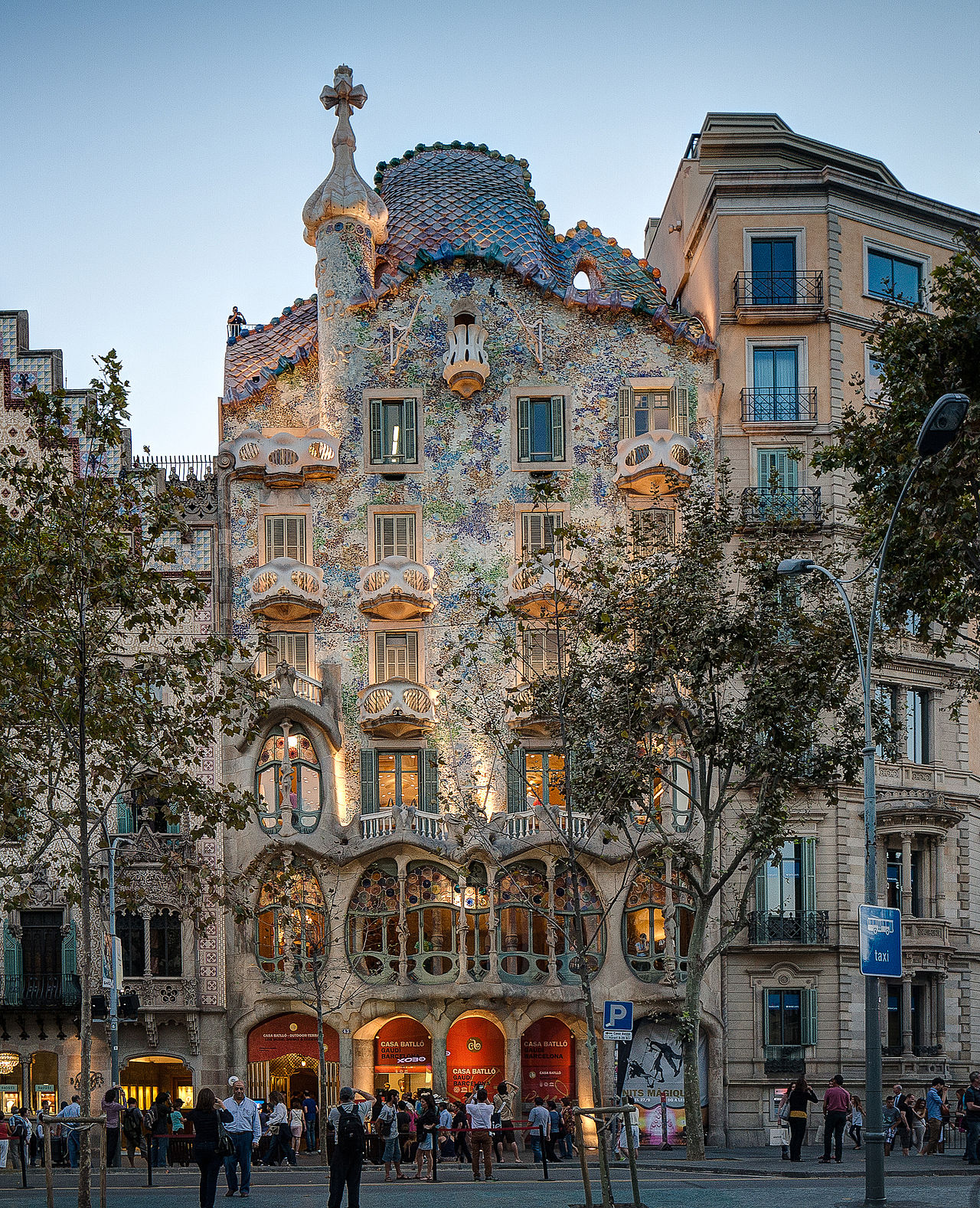
Casa Batlló is located on the Passeig de Gràcia in the Eixample district and forms part of a row of houses known as the Illa de la Discòrdia (or Mansana de la Discòrdia, the "Block of Discord"), so named because it features four striking, and strikingly different, buildings by noted Modernista architects of Barcelona.
Like everything Gaudí designed, Casa Batlló is only identifiable as Modernisme in the broadest sense. The ground floor, in particular, has unusual tracery, irregular oval windows and sculpted stonework with sinuous, squiggly forms. There are few straight lines, and much of the façade is decorated with a colorful mosaic made of broken ceramic tiles (trencadís).
In 2005, Casa Batlló became a UNESCO World Heritage Site.

ChristianSchd (CC BY-SA 3.0)
Alhambra
Granada · Andalusia · ★ 4.8 · 158,987 reviews ·
Open in Google Maps ↗The Alhambra is a palatine city and fortress complex located in Granada, Spain. It is one of the most famous monuments of Islamic architecture and the only well-preserved palace from the medieval Islamic world. Additionally, the palace contains notable examples of Spanish Renaissance architecture.

Jebulon (CC0)
Segovia Aqueduct
Toledo · Castile-La Mancha · historical landmark · ★ 4.9 · 118,271 reviews ·
Open in Google Maps ↗Plaza Mayor
Madrid · Community of Madrid · plaza · ★ 4.6 · 202,600 reviews ·
Open in Google Maps ↗The Plaza Mayor is the principal public square in the heart of Madrid, the capital of Spain. It was once the centre of Old Madrid. It was first built (1580–1619) during the reign of Philip III. Only a few blocks away is another famous plaza, the Puerta del Sol.

Sbharris (CC BY-SA 4.0
Museo del Prado
Madrid · Community of Madrid · art museum · ★ 4.7 · 154,928 reviews ·
Open in Google Maps ↗The Museo del Prado, officially known as Museo Nacional del Prado, is the main Spanish national art museum, located in central Madrid. It houses collections of European art, dating from the 12th century to the early 20th century, based on the former Spanish royal collection, and the single best collection of Spanish art. Founded as a museum of paintings and sculpture in 1819, it also contains important collections of other types of works. The numerous works by Francisco Goya, the single most extensively represented artist, as well as by Hieronymus Bosch, El Greco, Peter Paul Rubens, Titian, and Diego Velázquez, are some of the highlights of the collection. Velázquez and his keen eye and sensibility were also responsible for bringing much of the museum's fine collection of Italian masters to Spain, now one of the largest outside of Italy.

Emilio J. Rodríguez Posada (CC BY-SA 2.0)
Ciudad de las Artes y las Ciencias
Valencia · Valencian Community · museum · ★ 4.7 · 154,856 reviews ·
Open in Google Maps ↗
Diego Delso (CC BY-SA 3.0)
Royal Palace of Madrid
Madrid · Community of Madrid · castle · ★ 4.7 · 131,172 reviews ·
Open in Google Maps ↗The Royal Palace of Madrid is the official residence of the Spanish royal family and is used primarily for state ceremonies. With over 135,000 m2 (1,450,000 sq ft) of floor space and 3,418 rooms, the Royal Palace of Madrid is the largest palace in Western Europe, the largest royal palace in Europe, and among the largest palaces in the world.

Tim Adams (CC BY-SA 4.0)
Plaça de Catalunya
Barcelona · Catalonia · plaza · ★ 4.5 · 216,294 reviews ·
Open in Google Maps ↗Plaça de Catalunya (pronounced [ˈplasə ðə kətəˈluɲə], meaning in English "Catalonia Square"; sometimes referred to as Plaza de Cataluña, its Spanish name) is a large square in central Barcelona that is generally considered to be both its city centre and the place where the old city (see Barri Gòtic and Raval, in Ciutat Vella) and the 19th century-built Eixample meet.
The plaza is especially known for its fountains and statues, the central compass rose (or "wind rose") on the pavement, its proximity to some of Barcelona's most popular attractions, and the flocks of pigeons that gather in the centre. Some of the city's most important streets and avenues meet at Plaça Catalunya: Passeig de Gràcia, Rambla de Catalunya, La Rambla, and Portal de l'Àngel, in addition to Ronda de Sant Pere, Carrer de Vergara, and Carrer de Pelai. The plaza occupies an area of about 50,000 square metres. The square played a significant part in the Spanish Civil War, in particular as a site of key events of the May Days.

Didier Descouens (CC BY-SA 4.0)
La Boqueria Market
Barcelona · Catalonia · market · ★ 4.5 · 214,207 reviews ·
Open in Google Maps ↗The Mercat de Sant Josep de la Boqueria (Catalan: [məɾˈkad də ˈsaɲ ʒuˈzɛb də lə βukəˈɾi.ə]; Spanish: Mercado de San José de la Boquería), usually simply referred to as La Boqueria, is a large public market in the Ciutat Vella district of Barcelona, Catalonia, Spain, and one of the city's foremost tourist landmarks, with an entrance from La Rambla, not far from the Liceu, Barcelona's opera house. The market has a very diverse selection of goods.

Didier Descouens (CC BY-SA 4.0
Park Güell
Barcelona · Catalonia · park · ★ 4.4 · 238,115 reviews ·
Open in Google Maps ↗Park Güell (Catalan: Parc Güell [ˈpaɾɡ ˈɡweʎ]; Spanish: Parque Güell) is a complex of parks and gardens in Barcelona with architectural elements, located in the La Salut neighborhood of the Gràcia district in Barcelona, Catalonia, Spain. It is situated on the southern slope of the Turó del Carmel hill, part of the Collserola mountain range, overlooking the city. The separate Parc del Carmel lies on the northern side of the same hill.
In the context of Barcelona's late 19th and early 20th-century urban expansion, Catalan industrialist and art patron Eusebi Güell commissioned architect Antoni Gaudí, a leading figure of the aesthetic movement in Catalan modernism, to design a park.
Construction took place between 1900 and 1914, and the park officially opened to the public in 1926. In 1984, UNESCO designated the park a World Heritage Site, recognizing it as part of the "Works of Antoni Gaudí" collection and stating "the architecture of the park combined elements from the Arts and Crafts movement, Symbolism, Expressionism, and Rationalism, and presaged and influenced many forms and techniques of 20th-century Modernism."

essetefano (CC BY 3.0)
Mercado Central de Valencia
Valencia · Valencian Community · market · ★ 4.7 · 94,822 reviews ·
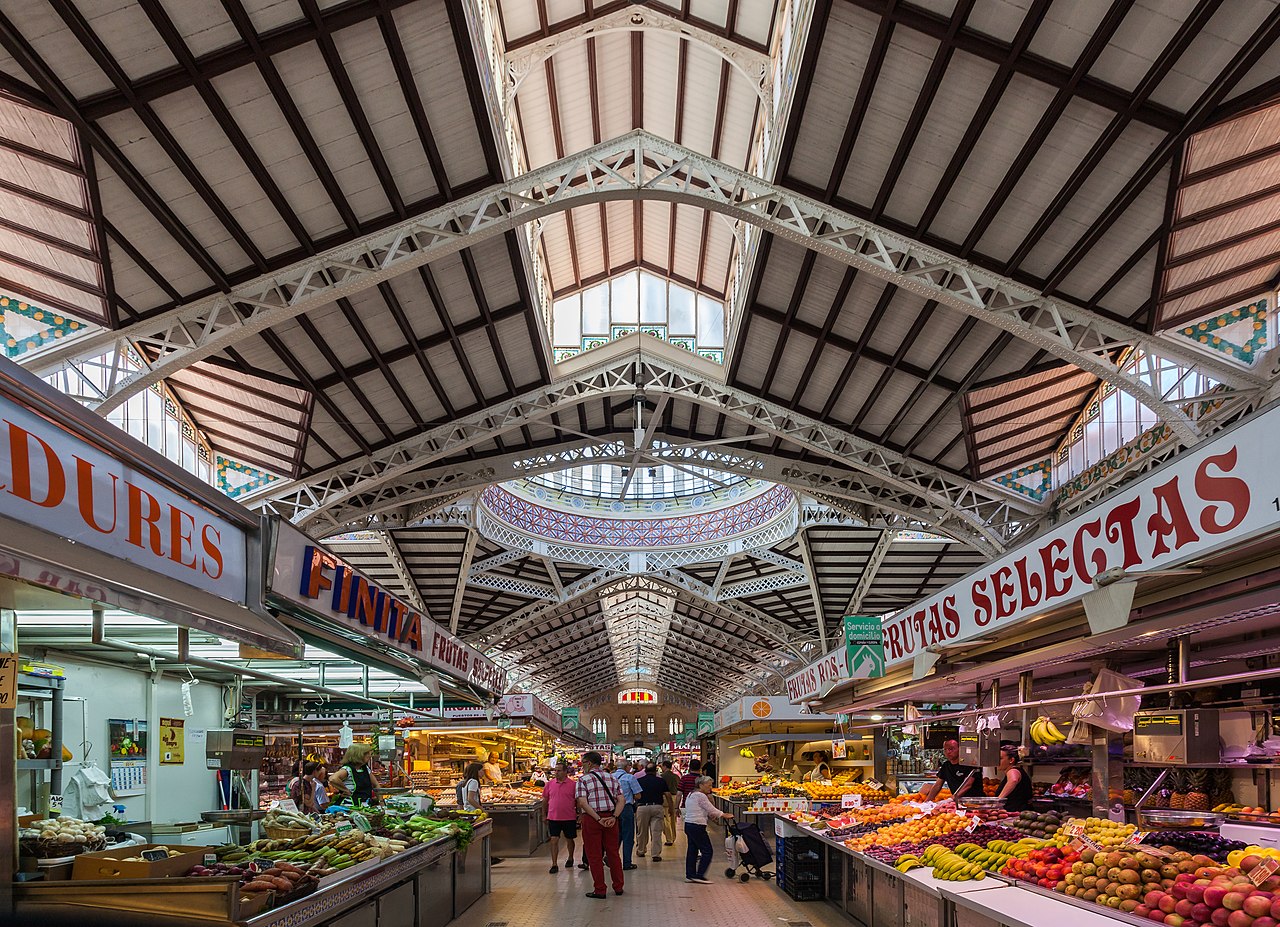
Open in Google Maps ↗Mercado Central or Mercat Central is a public market located across from the Llotja de la Seda and the Church of Santos Juanes in central Valencia, Spain. It is one of the main works of the Valencian Art Nouveau.
Felivet (Public domain
La Pedrera - Casa Milà
Barcelona · Catalonia · ★ 4.6 · 112,481 reviews ·
Open in Google Maps ↗Casa Milà (Catalan: [ˈkazə miˈla], Spanish: [ˈkasa miˈla]), popularly known as La Pedrera (Catalan: [lə pəˈðɾeɾə], Spanish: [la peˈðɾeɾa]; "the stone quarry") in reference to its unconventional rough-hewn appearance, is a Modernista building in Barcelona, Catalonia, Spain. It was the last private residence designed by architect Antoni Gaudí and was built between 1906 and 1912.
The building was commissioned in 1906 by Pere Milà and his wife Roser Segimon. At the time, it was controversial because of its undulating stone facade, twisting wrought iron balconies, and design by Josep Maria Jujol. Several structural innovations include a self-supporting stone façade, and a free-plan floor, underground garage and the spectacular terrace on the roof.
In 1984, it was declared a World Heritage Site by UNESCO. Since 2013 it has been the headquarters of the Fundació Catalunya La Pedrera, which manages visits to the building, exhibitions and other cultural and educational activities at Casa Milà.

Thomas Ledl (CC BY-SA 4.0)
Cathedral of Santiago de Compostela
Santiago de Compostela · Galicia · church · ★ 4.7 · 85,976 reviews ·
Open in Google Maps ↗The Santiago de Compostela Archcathedral Basilica is part of the Metropolitan Archdiocese of Santiago de Compostela and is an integral component of the Santiago de Compostela World Heritage Site in Galicia, Spain. The cathedral is the reputed burial place of Saint James the Great, one of the apostles of Jesus Christ. It is also among the remaining churches in the world built over the tomb of an apostle, the other ones being St Peter's Basilica in Vatican City, St Thomas Cathedral Basilica in Chennai, India, and Basilica of St. John in İzmir, Turkey.

Fernando (CC BY-SA 4.0
L'Oceanogràfic
Valencia · Valencian Community · aquarium · ★ 4.6 · 109,176 reviews ·
Open in Google Maps ↗L'Oceanogràfic is an oceanarium situated in the Garden of the Turia to the southeast of the city center of Valencia, Spain, where different marine habitats are represented. It was designed by the architect Félix Candela and the structural engineers Alberto Domingo and Carlos Lázaro. It is integrated inside the cultural complex known as the City of Arts and Sciences. It was opened on 14 February 2003.

Diliff (CC BY-SA 3.0
Mirador de San Nicolás
Granada · Andalusia · scenic spot · ★ 4.7 · 80,514 reviews ·
Open in Google Maps ↗
Jmdigne (CC BY-SA 3.0
Arc de Triomf
Barcelona · Catalonia · premise · ★ 4.6 · 98,279 reviews ·
Open in Google Maps ↗The Arc de Triomf, translated: Arch of Victory, is a memorial arch in Barcelona, Catalonia, Spain. It was built by architect Josep Vilaseca i Casanovas as the main access gate for the 1888 Barcelona World Fair. The arch crosses over the wide central promenade of the Passeig de Lluís Companys, leading to the Ciutadella Park that now occupies the site of the world fair. It is located at the northern end of the promenade, facing the Passeig de Sant Joan.

Bajajvikram (CC BY-SA 3.0
La Concha Beach
San Sebastián · Basque Country · beach · ★ 4.7 · 23,671 reviews ·
Open in Google Maps ↗The Beach of La Concha is a crescent shaped urban seaboard of the city of San Sebastián located at the Bay of La Concha in the Basque Country, in northern Spain. Its name “Concha” is given upon its remarkably regular shape. The scenic setting in the Bay of La Concha and the 19th century elegance of fashionable seaside resorts have made the site very popular, as it is frequently cited as one of the most beautiful and the most famous urban beaches in Europe.

No machine-readable author provided. Josugoni assumed (based on copyright claims). (Public domain)