If you're comparing Wanderlog and MonkeyEatingMango, you've probably noticed they approach trip planning from opposite directions. Wanderlog gives you a workspace to manually research, organize, and optimize your own itinerary. MonkeyEatingMango asks you 8 questions and generates a complete day-by-day plan in about 60 seconds.
Neither approach is universally better. The right choice depends on whether you enjoy the planning process or just want to get to the plan.
This comparison covers what each tool does well, where each falls short, and when you might want to use both. Full disclosure: MonkeyEatingMango is our product. We've aimed to represent both tools fairly based on publicly available features.
The Fundamental Difference
Wanderlog and MonkeyEatingMango are built on fundamentally different philosophies about how trip planning should work.
Wanderlog is a planning workspace. You search for restaurants, attractions, and hotels. You add them to a list. You drag them into a day-by-day schedule. You optimize routes on a map. The tool gives you professional-grade organization features, but the research and decision-making is entirely yours.
MonkeyEatingMango is a plan generator. You answer 8 questions about your destination, dates, budget, interests, and travel style. The AI generates a complete itinerary with activities, restaurants, estimated costs, commute times, and hotel suggestions. You get a finished starting point that you can export and customize.
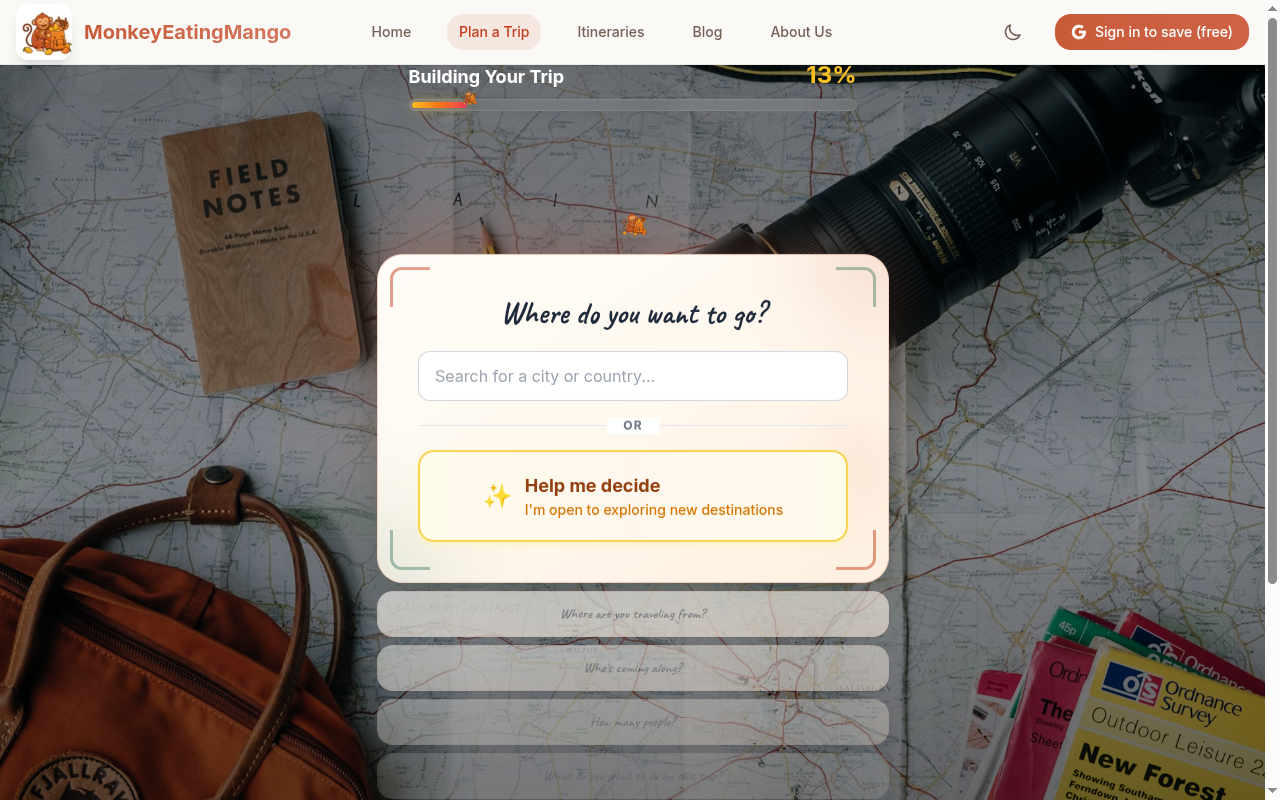
Think of it this way: Wanderlog is a blank canvas with professional brushes. You decide every brushstroke. MonkeyEatingMango is a professional sketch delivered to your door -- you can hang it as-is or paint over it to make it your own.
Both produce a trip plan. The difference is who does the initial work.
Feature-by-Feature Comparison
| Feature | Wanderlog | MonkeyEatingMango |
|---|---|---|
| Approach | Manual planner | AI generator |
| Time to first plan | ~1-3 hours | ~60 seconds |
| AI generation | No | Yes (Google Gemini) |
| Map integration | Interactive drag-and-drop | Embedded per-day routes |
| Budget tracking | Manual entry | Auto-generated in local currency |
| PDF export | Pro only ($40/yr) | Free |
| Google Sheets export | No | Free |
| Collaborative editing | Yes (Pro) | View-only sharing + Sheets export |
| Offline access | Pro only | Via PDF download |
| Route optimization | Real-time drag-and-drop | Per-day generated routes |
| Mobile app | iOS + Android | Mobile web |
| Packing list | No | Auto-generated by destination/season |
| Food guide | No | Auto-generated local cuisine guide |
| Price | Free + Pro ($40/yr) | Free |
The table shows a clear pattern: Wanderlog invests in manual control and collaboration features, while MonkeyEatingMango invests in automated generation and free access to exports.
Wanderlog's free tier is functional for basic planning, but the features most travelers want -- PDF export, offline access, and collaborative editing -- sit behind the $40/year Pro subscription. MonkeyEatingMango has no paid tier; everything including PDF, Excel, and Google Sheets export is free with no account required.
That said, Wanderlog's manual features are genuinely deeper. If you want to drag an activity from Tuesday to Thursday and watch your route map update in real time, Wanderlog does that. MonkeyEatingMango generates a plan; rearranging it means exporting and editing in Sheets or another tool.
Where Wanderlog Wins
To be clear about what Wanderlog does better:
Granular Manual Control
Wanderlog's drag-and-drop interface lets you move activities between days, reorder your schedule, and see your route update on the map in real time. If you've spent three hours researching the perfect restaurant for Thursday evening, you can slot it in exactly where you want it. MonkeyEatingMango generates the full schedule for you, which is faster but gives you less control over individual placements within the tool itself.
Real-Time Collaborative Editing
For group trips, Wanderlog's Pro plan lets multiple people edit the same itinerary simultaneously. Everyone can add suggestions, vote on activities, and see changes in real time. MonkeyEatingMango generates a single plan and lets you share it via link or export to Google Sheets for group editing -- functional, but not the same as purpose-built collaborative features.
Community-Shared Itineraries
Wanderlog has a large library of user-shared itineraries you can browse for inspiration. If you want to see what other travelers did in Barcelona for 5 days, you can find real examples and clone them as a starting point. MonkeyEatingMango has hundreds of curated itineraries, but they're AI-generated rather than user-contributed.
Venue Availability Warnings
Wanderlog can flag when a venue you've added is closed on your planned visit day. This is a practical detail that prevents wasted time during your trip. MonkeyEatingMango's AI-generated plans don't currently verify real-time opening hours for individual venues.
Native Mobile Apps
Wanderlog offers dedicated iOS and Android apps with offline support (on Pro). MonkeyEatingMango works on mobile browsers and offers offline access via PDF download, but there's no native app with features like push notifications or background sync.
Where MonkeyEatingMango Wins
Speed: 60 Seconds vs Hours
The most obvious difference. Answer 8 questions -- where, when, how long, budget, interests, travel style, pace preference, and who you're traveling with -- and MonkeyEatingMango generates a complete itinerary with activities, restaurants, costs, commute times, and hotel suggestions. With Wanderlog, you're starting from a blank slate and researching every element yourself.
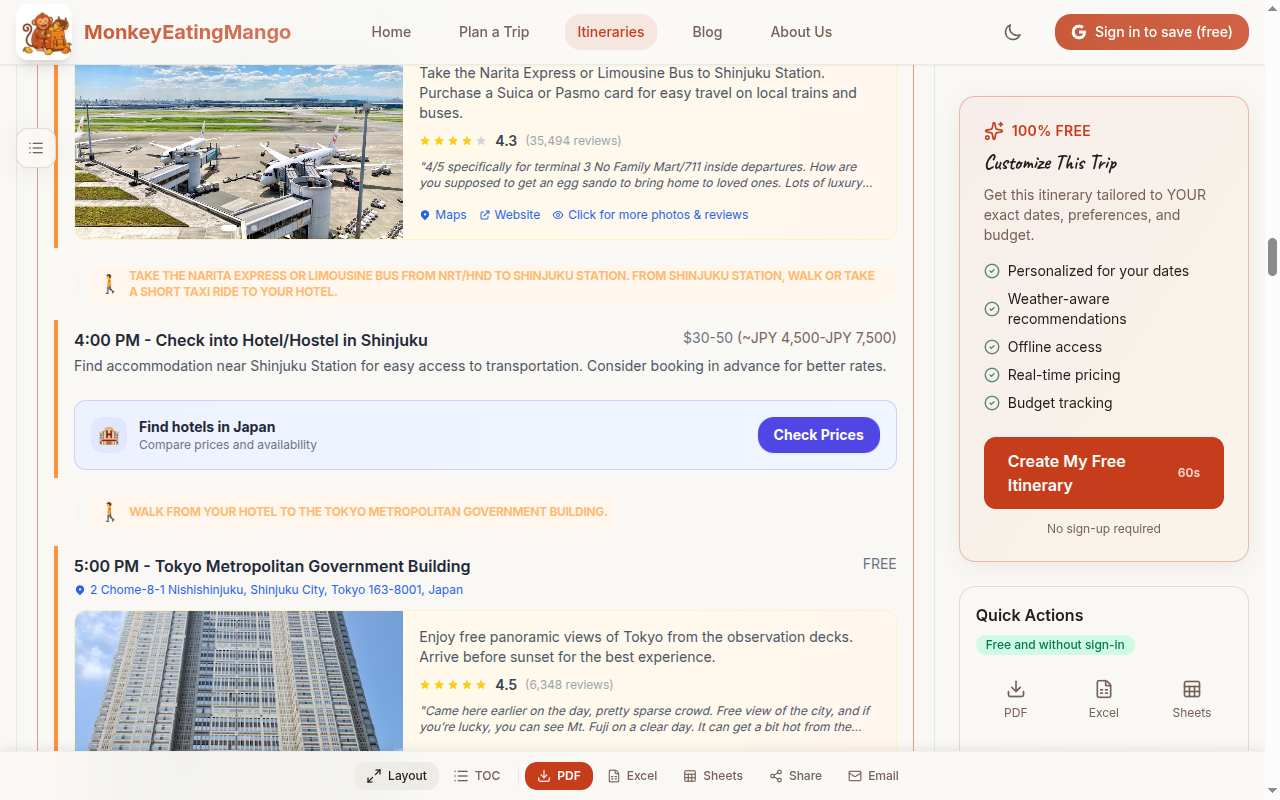
For travelers who don't enjoy the research phase, this is the defining advantage.
Free Exports Without a Paywall
MonkeyEatingMango offers PDF, Excel, and Google Sheets export at no cost, with no account required. Wanderlog locks PDF export behind its $40/year Pro subscription. If you just want a printable itinerary to carry on your trip, this is a meaningful difference.
Budget Estimates in Your Local Currency
MonkeyEatingMango generates cost estimates for every activity, meal, and transport option in your local currency. You get a realistic daily and total budget without manually looking up prices. Wanderlog has budget tracking, but you enter every cost yourself.
Realistic Pacing
MonkeyEatingMango asks about your travel style and pace preference before generating. If you say you prefer a relaxed pace, you won't get an itinerary that crams 12 attractions into a single day. The AI adjusts activity density based on your answers.
Built-In Travel Content
Each generated itinerary includes a local food guide, destination-specific packing list, budget tips, must-have experiences, and travel advice. These aren't generic lists -- they're generated based on your specific destination, season, and travel dates. Wanderlog focuses on the itinerary structure and leaves this research to you.
Curated Itineraries
MonkeyEatingMango has a growing library of curated itineraries covering popular destinations worldwide. These are ready-to-use plans you can browse without generating anything, useful for quick inspiration or immediate travel plans.
When to Choose Wanderlog
Wanderlog is the better choice when:
- You enjoy the planning process. If researching restaurants, reading reviews, and building your own schedule is part of the fun, Wanderlog gives you the tools to do it well.
- You're planning a group trip with active collaborators. If four friends all want to contribute ideas and edit the plan in real time, Wanderlog's collaborative editing is purpose-built for this.
- You want to manually control every detail. If you already know exactly which restaurants and attractions you want to visit and need a tool to organize them spatially and temporally, Wanderlog's map-based drag-and-drop is excellent.
- You need native mobile apps. If you want a dedicated app with offline access and native performance on your phone, Wanderlog has mature iOS and Android apps.
When to Choose MonkeyEatingMango
MonkeyEatingMango is the better choice when:
- You want a solid starting point without hours of research. If you'd rather start with a complete plan and make adjustments than build one from scratch, the 60-second generation saves significant time.
- You're planning solo or with a partner. When you don't need real-time collaborative editing and just need a good plan to follow or share, AI generation plus free export covers the workflow.
- You want free exports. If paying $40/year for PDF export doesn't make sense for your travel frequency, MonkeyEatingMango gives you PDF, Excel, and Google Sheets export at no cost.
- You value budget visibility. If knowing the estimated cost of your trip before you go matters to you, auto-generated budget estimates in your local currency remove a layer of manual research.
- You'd rather spend time traveling than planning. If trip planning feels like a chore rather than a hobby, getting a complete plan in 60 seconds shifts your time toward the trip itself.
Can You Use Both?
Yes, and this is a genuinely good workflow for travelers who want both speed and control.
Generate, then customize: Use MonkeyEatingMango to create a starting itinerary in 60 seconds. Export it to Google Sheets. Import the key activities into Wanderlog for route optimization and collaborative editing with your travel group. You get the speed of AI generation with the manual control of Wanderlog's planning tools.
Browse, then build: Look through MonkeyEatingMango's curated itineraries for destination inspiration and a sense of realistic pacing. Then build your own version in Wanderlog with the specific restaurants and attractions you've researched.
The tools aren't mutually exclusive. One generates the plan; the other lets you fine-tune it.
Related Reading
- 11 Best Wanderlog Alternatives — manual and AI planners compared
- Wanderlog Pricing: Free vs Pro — is the $40/year upgrade worth it?
- Best Free AI Travel Planners (2026) — 7 tools compared side by side
- 10 Best TripIt Alternatives — booking organizers and AI planners
Frequently Asked Questions
Is MonkeyEatingMango better than Wanderlog?
It depends on your planning style. MonkeyEatingMango is better if you want a complete itinerary generated in 60 seconds with free export. Wanderlog is better if you enjoy manually researching and organizing every detail of your trip.
Is MonkeyEatingMango free?
Yes, completely free. No account required, no credit card, no limits on itinerary generation. PDF, Excel, and Google Sheets export are all free.
Does Wanderlog have AI features?
No. Wanderlog is a manual trip planner. You search for places, add them to your itinerary, and organize them yourself. There is no AI generation feature.
Can I use both Wanderlog and MonkeyEatingMango?
Yes. A common workflow is to generate a starting plan with MonkeyEatingMango, export it to Google Sheets, and then use Wanderlog for detailed route optimization and collaborative editing.
Which is better for group trips?
Wanderlog has collaborative editing on its Pro plan ($40/year). MonkeyEatingMango generates the itinerary and lets you export to Google Sheets for group collaboration -- different approach, same result.
Ready to Try the AI Approach?
If you want to see what a complete AI-generated itinerary looks like for your next trip, start planning here. Answer 8 questions and get a full day-by-day plan in about 60 seconds -- no account needed, no cost.
Want to see real examples first? Browse hundreds of curated itineraries or read our Wanderlog alternatives roundup for more options.
Disclosure: MonkeyEatingMango is our product. We've aimed to represent both tools fairly. Last updated March 2026.
Written by
Mango
Photos from Wikimedia Commons, used under Creative Commons licenses
Popular Itineraries
Hand-crafted day-by-day travel plans
Japan
7-day itinerary
Tokyo, Kyoto & Osaka
Paris
5-day itinerary
Perfect for couples
Bali
7-day itinerary
Temples, rice fields & beaches
Italy
10-day itinerary
The Italian grand tour
Want More Travel Tips?
Browse our collection of travel guides, tips, and inspiration for your next adventure.